AI Misuse Risks: How Developer Decisions Shape Cyber, Bio, and Chemical Terrorism Threats
AI developer decisions directly affect cyber, bio, and chemical terrorism risks, requiring safety guardrails and multi-stakeholder governance.
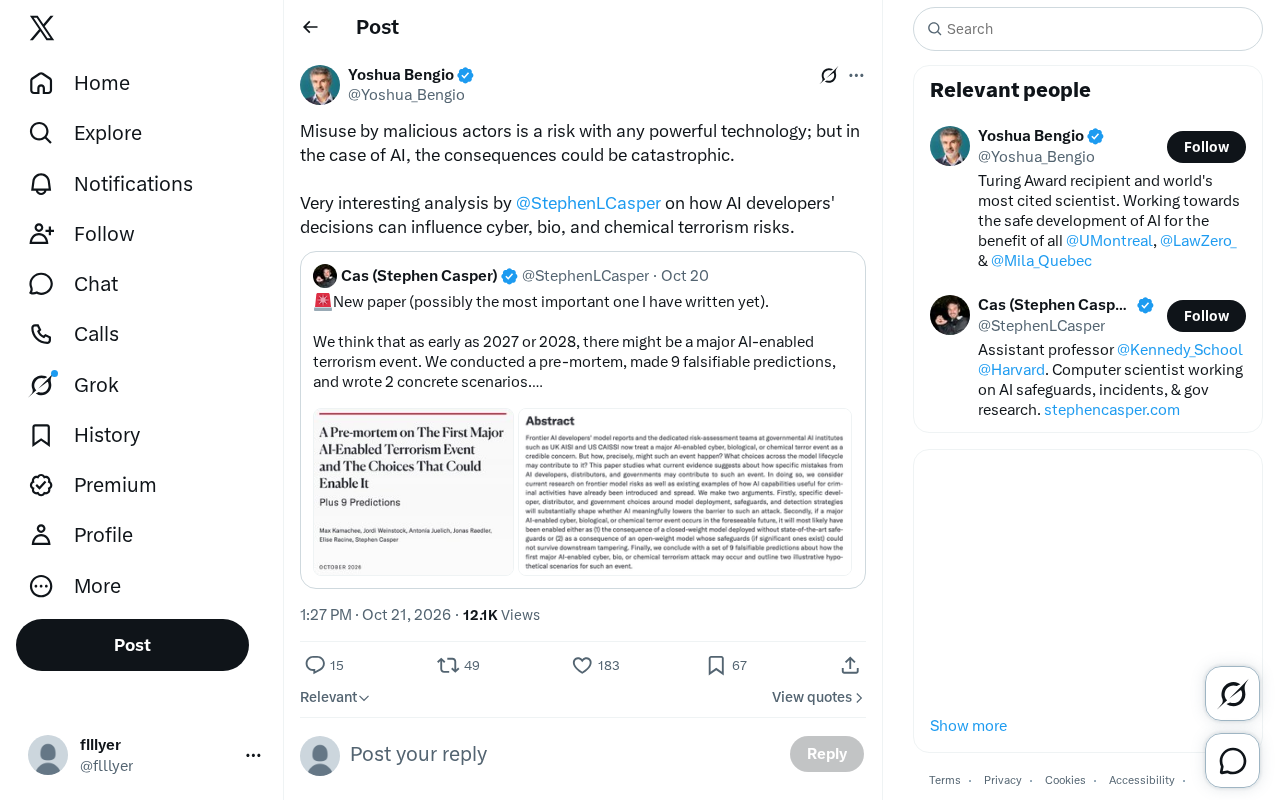
Based on a tweet and Stephen L. Casper's analysis, this article explores how AI developer decisions affect cyber, biological, and chemical terrorism risks. AI is dual-use, with low barriers and broad applications, and misuse could be catastrophic. In the cyber domain, whether developers restrict exploit code generation and set safety guardrails directly affects attack barriers; in the bio and chemical domains, whether models generate pathogen-enhancement information or dangerous chemical synthesis routes bears on mass-casualty risks. The article proposes response directions: developers should proactively assess misuse risks and take mitigation measures, the industry should establish shared safety standards, and policymakers, research institutions, and civil society must jointly participate to form a globally collaborative governance framework.
Introduction
Any powerful technology carries the risk of misuse by malicious actors, but what makes artificial intelligence (AI) unique is that the consequences of misuse could be catastrophic. This is the core point shared by a Twitter user, who cited @StephenLCasper's analysis of how AI developer decisions affect cyber, biological, and chemical terrorism risks. Although the original post was only a brief tweet without detailed elaboration, the issues it raises deserve deeper discussion. Based on the clues provided in the tweet, this article analyzes the connection between AI developer decisions and three major terrorism risk domains, and discusses possible directions for response.
The Potentially Catastrophic Consequences of AI Misuse
The tweet explicitly states: "Any powerful technology carries the risk of misuse by malicious actors; but in the case of AI, the consequences could be catastrophic." This judgment is not alarmist. AI technology has a dual-use nature—it can benefit society or be used for malicious purposes. Unlike nuclear or biological weapons, the barriers to developing and deploying AI are relatively low, and its application scenarios are broad, making misuse risks more diffuse and harder to regulate.
Stephen L. Casper's analysis focuses on how AI developer decisions affect cyber, biological, and chemical terrorism risks. Although the tweet does not provide specific details, it can be inferred that developers' choices regarding model design, access control, and security safeguards will directly or indirectly shape malicious actors' ability to exploit AI. For example, whether developers choose to open-source models, whether they implement abuse detection mechanisms, and whether they restrict the generation of dangerous knowledge will all affect how easy it is to misuse AI.
Dual-use is a foundational concept for understanding AI misuse risks. It refers to the fact that the same technology can be used for constructive purposes or diverted for destructive ones, often sharing underlying capabilities. For example, a large language model's ability to generate code can be used for software development or for writing exploit programs; the ability to predict protein structures can be used for drug discovery or for assessing pathogen characteristics. Compared with traditional dual-use research (such as biotechnology), AI's dual-use nature has three distinctive features: first, capability generalization—the same model can be transferred to multiple risk scenarios; second, low barriers—users do not need deep expertise to invoke it; third, it is difficult to distinguish intent in advance, and safety filters can easily harm legitimate uses. Therefore, AI developers need to make fine-grained trade-offs between openness of capabilities and risk suppression, rather than simply imposing one-size-fits-all restrictions.
How Developer Decisions Affect Cyber Terrorism Risks
In the cyber domain, AI can be used for automated attacks, generating malicious code, and discovering software vulnerabilities. Developer decisions play a key role here. If developers choose not to restrict the model's ability to generate exploit code, malicious actors may use AI to accelerate the development of attack tools. Conversely, if developers filter sensitive content in training data and set up safety guardrails at the output layer, they can raise the barrier to misuse.
Although the tweet does not detail specific cases, it mentions "cyber" risks, implying that AI developers need to balance model capabilities and security. For example, overly strict safety restrictions may weaken legitimate uses of the model (such as security research), while overly lax ones may encourage malicious behavior. This trade-off is at the core of developer decisions.
AI's Role in Biological and Chemical Terrorism Risks
The risks in the biological and chemical domains are more severe. AI could be used to assist in designing harmful substances, optimizing synthesis pathways, or evading regulation. Stephen L. Casper's analysis points out that developer decisions also affect these risks. For example, whether developers allow models to generate information related to pathogen enhancement and whether they restrict synthesis routes for specific chemicals will directly affect the likelihood of malicious actors obtaining dangerous knowledge.
The tweet emphasizes that "the consequences could be catastrophic," which may precisely describe biological and chemical risks. Unlike cyberattacks, biological or chemical terrorism incidents could cause mass casualties, making AI developers' responsibilities especially significant. Developers need to embed safety considerations early in model development rather than remediating afterward.
Biosecurity risks of large language models have received significant attention in recent years. During training, large language models absorb massive amounts of scientific literature and may "remember" and reproduce sensitive information such as pathogen characteristics and experimental operation details. Studies have shown that some general-purpose models, when prompted, can provide experimental suggestions that are easier to operationalize than publicly available literature—this is known as "information aggregation risk": individual pieces of information are not sensitive, but when aggregated they may lower the barrier to obtaining dangerous knowledge. In addition, models can be used to assist in screening compounds and inferring synthesis routes, thereby reducing the trial-and-error costs for malicious actors. Corresponding mitigation measures include: filtering sensitive content in training data, deploying classifiers at the output layer for interception, refusing or downgrading responses to high-risk queries, and establishing biosecurity red-teaming mechanisms. The effectiveness of these measures is closely related to developers' early safety design.
Response Directions: Developer Responsibility and Multi-Stakeholder Collaboration
Based on the tweet information, several response directions can be summarized. First, AI developers should proactively assess the risks of their models being misused, especially in the cyber, biological, and chemical domains, and take corresponding mitigation measures. Second, the industry needs to establish shared safety standards and best practices to prevent short-sighted behavior by individual developers from lowering the overall safety level. In addition, policymakers, research institutions, and civil society should also participate in the dialogue to form a multi-stakeholder governance framework.
By sharing Stephen L. Casper's analysis, the tweet author aims to raise awareness of this issue. Although the original information is limited, the issues it raises are forward-looking. Governance of AI misuse risks cannot be accomplished by a single developer or a single country; it requires global cooperation and continuous oversight.
Responsible disclosure and safety guardrails are two mechanisms that can be implemented at the developer level. Safety guardrails refer to deploying filtering, classification, or rewriting strategies at the model's input and output stages so that the model refuses or provides safe alternative information when encountering high-risk requests; responsible disclosure draws on practices in the cybersecurity field and requires researchers to notify relevant parties and allow a remediation window before publicly releasing model capabilities or vulnerability findings that could be misused. In addition, model evaluation and red teaming have become industry practice: before deployment, independent teams simulate malicious use scenarios and systematically investigate misuse pathways in cyber, biological, chemical, and other domains. A common prerequisite for these practices is that developers need interdisciplinary risk knowledge and must collaborate with experts in biosecurity, cybersecurity, and other fields, rather than relying solely on internal judgment by engineering teams.
Conclusion
The powerful capabilities of AI technology carry the risk of misuse, and developer decisions play a key role in shaping these risks. Cyber, biological, and chemical terrorism are three domains that require focused attention. Through responsible design, industry self-regulation, and multi-stakeholder collaboration, the likelihood of AI being maliciously exploited can be reduced. Although the tweet is short, it reminds us: while pursuing improvements in AI capabilities, safety must be an inseparable part.
Related articles

Anthropic Releases Fable 5.2 and Mythos 5.2: Benchmark Dominance and Biorobotics Breakthroughs
Anthropic launches Claude Fable 5.2 and Mythos 5.2, leading nearly all benchmarks and breaking ground in protein design, gene therapy, and robot control.

Anthropic Launches Dual Flagships Claude Fable 5.2 and Mythos 5.2, Topping Coding and Science Benchmarks
Anthropic releases Claude Fable 5.2 and Mythos 5.2 dual flagships, with full upgrades in coding, 3D interaction, and life sciences, topping third-party intelligence index, integrated by GitHub Copilot and Cursor, API pricing lower than competitors.
Claude Code Reportedly Leaks Secrets to GitHub, Sounding the Alarm for AI Coding Security
Claude Code reportedly exposed passwords and API keys to GitHub, per Ars Technica. We recap the incident alongside Claude Fable 5.2's 20% price cut and Meta Muse Ember, urging developers to check commit settings before granting permissions.