Anthropic Releases Fable 5.2 and Mythos 5.2: Benchmark Dominance and Biorobotics Breakthroughs

Anthropic releases Fable 5.2 and Mythos 5.2: benchmark dominance, biology and robotics advances, lower pricing but still costly.
Anthropic officially launched Claude Fable 5.2 and Claude Mythos 5.2—essentially the same model, with the former being the commercial version with safety guardrails. The new model leads most benchmarks, losing only to Gemini 4 Carbon in business workflows and Opus 5.5 in knowledge work. It shows breakthroughs in protein design, capsid structure prediction, and robot control (RoboDojo). Pricing is lower and speed about 30% faster, but it remains expensive; the community suggests using Fable for planning and Opus for execution. Early users have generated voxel engines and a Mirror Earth game, showing potential to accelerate game and video workflows.
Anthropic has officially launched its most powerful models to date—Claude Fable 5.2 and Claude Mythos 5.2. Many had expected to see Fable 5.5, but what arrived was a 0.1-level upgrade. According to a first-look breakdown from a Bilibili creator, this update delivers significant progress in benchmarks, scientific research, and robot control, with early user outputs being described as outright "insane."
Benchmarks: Near-Universal Lead, But Not Flawless
Fable 5.2 beats every model on the market on the vast majority of benchmarks. According to the comparison chart shown by the creator, it only loses to Gemini 4 Carbon in business workflow tests and to Anthropic's own Opus 5.5 in knowledge work tests, leading in all other categories.
On the Frontier Code 2.0 test for agentic coding, Fable 5.2 takes second place, behind only Opus 5.5; it also performs strongly on the Frontier Software Engineering 2 benchmark. More notably, beyond cybersecurity, the model is being applied to broader domains such as scientific research and biology.
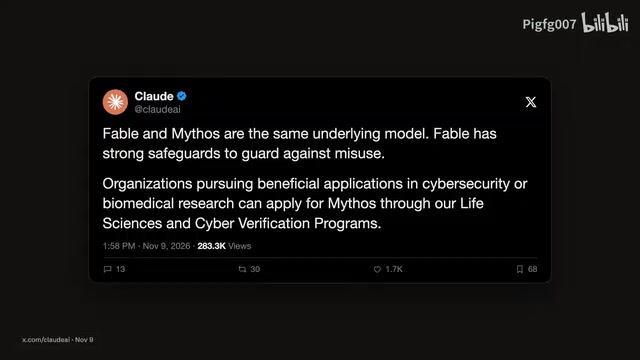
One easily confused point needs clarification: Mythos 5.2 and Fable 5.2 are essentially the same model, but Fable 5.2 is the commercial version with safety guardrails. The creator specifically explains this naming difference in the video to prevent viewers from being confused by the two names.
Biology and Robotics: The Model Enters the Physical World
On protein design, an atypical benchmark, Fable 5.2 scores higher than its predecessor Fable 5.1 and Opus 5.5. A more concrete case is gene therapy: Mythos 5.2 found a new method for predicting complete capsid structures, and in Anthropic's own tests it successfully modeled most of the capsids it attempted. Biologists can use this to design capsids faster and more cheaply.

Robotics is a new focus of this release. Fable 5.2 has been used to control physical robots, even completing tasks it was never explicitly trained on. On the RoboDojo benchmark for simulated dual-arm robots, it significantly outperforms other models as well as most AI systems built specifically for robot control. The creator predicts that this kind of capability will become a standard showcase item for every new model in the years ahead, just like game development, 3D animation, and 3D structure generation before it.
Capsid is the outermost protein shell of a virus, assembled from multiple protein subunits that encase and protect the viral genome. Its structure is highly symmetrical and complex, and is traditionally resolved through experimental methods such as cryo-electron microscopy, which are time-consuming and expensive. Accurately predicting the atomic-level structure of a complete capsid is crucial for understanding viral invasion mechanisms and designing gene therapy delivery vectors (such as AAV capsid engineering). If AI models can efficiently model capsid structures, they will greatly shorten the development cycle of gene therapy vectors and reduce trial-and-error costs.
RoboDojo is a benchmark platform for evaluating embodied agents performing manipulation tasks on simulated dual-arm robots. It typically includes a variety of fine manipulation tasks requiring dual-arm coordination (such as grasping, assembly, and tool use), emphasizing generalization under physical constraints and partial observability. Unlike pure software programming benchmarks, RoboDojo assesses a model's ability to translate language instructions into continuous control signals and handle real-time feedback—a key metric for whether a model can migrate from the digital world to the physical world.
Pricing and Efficiency: Faster, Cheaper, But Watch the "New Meta Workflow"
Fable 5.2 is cheaper than Fable 5.1, continuing Anthropic's recent downward pricing trend. The model is already available on the Claude platform and in Claude Code, is about 30% faster than Fable 5.1, and costs around $8.40 per million tokens, compared with $10.50 for Fable 5.1.
However, the creator cautions that Fable 5.2 is still an expensive model overall, and Anthropic explicitly warns users that it will consume usage limits faster. In the "effort vs. output" comparison chart, Fable 5.2 scores higher than Opus 5.5 at the same price point, but the gap is not a cliff. This also explains why many had expected Fable 5.5—some speculate that Anthropic may be deliberately holding back, releasing a stronger model around its IPO.
A community consensus is taking shape: use Fable 5.2 for planning and Opus 5.5 for execution. Tests show that on the same task, Opus takes about 15 minutes and costs about $8.20, while Fable takes about 60 minutes and costs $18—but Fable's added details are noticeably richer. For cost-sensitive scenarios, this division of labor may be more economical.
"Use Fable for planning, Opus for execution" is a hybrid workflow proposed by the community: the more capable but slower and pricier Fable 5.2 breaks down tasks, formulates steps, and fills in details, then hands the concrete execution steps to the faster, cheaper Opus 5.5. This division leverages the differences between the two in reasoning depth and runtime efficiency, aiming to balance output quality and total cost. It reflects a shift in model usage from single-model calls to multi-model orchestration, adapting to the cost-performance needs of different subtasks.
Early Works: From Game Simulations to "Mirror Earth"
Early access users have showcased a wealth of impressive works. A clip the creator described as "not looking like COD gameplay footage" was in fact a game simulation generated by Fable 5.1; Fable 5.2's output goes even further.

Some users have used Fable 5.2 for video editing and to build games and animations in UE and three.js based on existing codebases; someone generated a voxel engine from a single prompt, building a complete voxel world; others made a playable "Mirror Earth" game where you can travel to any location, destroy any object, and match real Earth weather in real time. A Harry Potter universe battle-royale-style game was also generated and is actually playable.

One user spent about 400 billion tokens testing Fable 5.2, producing works including a voxel engine and various simulated scenes. The creator admits that while these outputs still have flaws, they are already close to what game developers achieve after months of work, and their acceleration of 3D game development and video workflows cannot be ignored.
Subscription Perks and Customer Loyalty
Anthropic has also adjusted the number of Fable resets for subscribers: those subscribed for less than 6 months get 1 reset, 6 to 12 months get 2, and more than 12 months get 3. This design is clearly intended to reward long-term users and strengthen customer loyalty.
Overall, Fable 5.2 feels more like a solid iteration than a revolutionary leap, but its penetration into new domains such as biology and robotics, along with the creativity shown in early works, is enough to demonstrate Anthropic's current lead in model capabilities. For developers and researchers, now may be the time to reassess the value of a Claude subscription.
Related articles

Claude Fable 5.2 Hands-On: Top Intelligence but Absurdly Expensive
Anthropic releases Claude Fable 5.2 and Mythos 5.2, topping the Artificial Analysis intelligence leaderboard with big gains in scientific reasoning, strong game and hardware design, but max mode costs ~$26.54 per task. Hands-on game, circuit board design, and pricing advice.

1,000 AI Agents Formalize Fermat's Last Theorem in 30 Hours, Anthropic Releases New Claude Models
Anthropic releases Claude Fable 5.2 and Mythos 5.2: 1,000 agents formalize Fermat's Last Theorem in 30 hours, coding costs halved, plus hardware design and physics.

Claude Fable 5.2 Released: A Thousand AI Agents Build a Bootable OS in 8 Days
Anthropic releases Claude Fable 5.2 and Mythos 5.2—same model, two safety tiers. Demo shows 1,000 AI agents build a bootable OS in 8 days, formalize Fermat proof in 30 hours, score 64.6 beating Gemini 4 Carbon, price cut 20%.