Claude Fable 5.2 Hands-On: Top Intelligence but Absurdly Expensive

Anthropic releases Fable 5.2 and Mythos 5.2: big leaps on hardcore tasks, modest gains in everyday coding, and max mode isn't worth it.
Anthropic released Fable 5.2 and Mythos 5.2, essentially the same model—the former for regular users with stricter cybersecurity guardrails, the latter for security testers. Fable 5.2 sets new SOTA on hardcore benchmarks like agentic scientific research, rising from 58.7 on Opus 5.5 to 74.6, but everyday coding gains are modest and it trails Gemini Carbon by two points in business workflows. Testing shows diminishing returns at max reasoning, with extra high scoring higher at lower cost. Game generation gets mechanics right on the first try but visuals lag slightly; hardware design outputs complete parts lists, firmware, and 3D print files. API pricing is $8 per million input tokens and $40 per million output tokens, twice Opus 5.5. Anthropic recommends Opus 5.5 for daily tasks and Fable 5.2 as an advisor or orchestrator for hard problems.
Anthropic released two new models at once: Fable 5.2 and Mythos 5.2. They are essentially the same model; Mythos 5.2 targets cybersecurity testers with fewer guardrails, while Fable 5.2 is what regular users get, with stricter limits around cybersecurity. According to hands-on testing by a Bilibili creator, this is one of the rare recent models that is actually usable and shows a clear improvement—Google's Carbon has been announced but is not yet publicly available.
Benchmarks: Big Leaps on Hardcore Tasks, Modest Gains in Everyday Coding
Fable 5.2 sets new SOTA on most benchmarks. The most striking is agentic scientific research, jumping from 58.7 on Opus 5.5 to 74.6, with Astra at 68.1 and Carbon at 64.8 in between. By contrast, progress in agentic coding is much more moderate: Frontier code rises from 45.5% on Opus 5 to 49.1%, and Frontier SWE v2 improves by about 7 percentage points. In business workflows, Gemini Carbon actually leads by two percentage points.
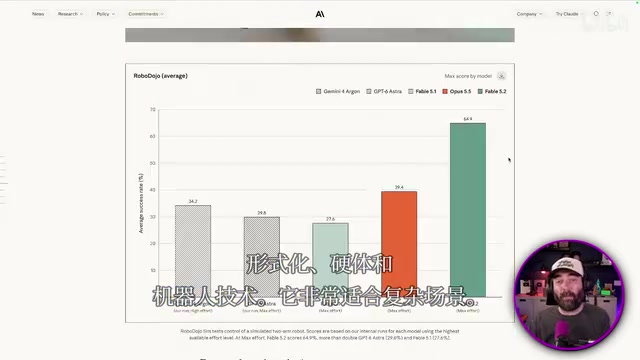
A counterintuitive finding: making the model "think longer" isn't always better. On Frontier code 2.0, Fable 5.2 scores higher at the extra high setting than at max—max mode thinks longer and costs more but performs worse. Another comparison is even more interesting: Fable 5.2 at high roughly matches Opus 5.5 at max, but at lower cost.
In Artificial Analysis's composite intelligence score, Fable 5.2 takes the top spot, even surpassing the not-yet-fully-released Gemini 4 Carbon. But it comes at a price: in max reasoning mode, the average cost per task is about $26.54, the most expensive of all models. However, its output token consumption is lower than Sonnet 5.5, meaning it actually uses fewer tokens per task.
Agentic benchmarks refer to evaluations where the model autonomously completes multi-step tasks in a simulated or real environment (rather than single-turn Q&A)—for example, autonomously calling tools, writing and running code, retrieving information, and iterating based on feedback. Compared with static Q&A benchmarks, they are closer to real workflows and harder to game, so score gaps tend to be amplified in interpretation. The agentic scientific research, agentic coding, and Frontier SWE v2 mentioned in this article all fall into this category.
SWE benchmarks (Software Engineering benchmarks) use issues from real open-source repositories as questions, requiring the model to locate and modify code and pass the repository's own tests. Frontier SWE v2 is a newer, harder version of this type of benchmark. It measures end-to-end fixing capability, not just code completion accuracy.
Hands-On Game Test: Mechanics Right on the First Try, Art Slightly Behind Opus
The creator tested with the classic "clone Mega Bonk" prompt. Anthropic recently adjusted its policy so the model no longer directly clones existing games, but it doesn't refuse either—it first states that it "won't replicate Mega Bonk itself," then builds an original game of the same genre.

The resulting game is called Shard Storm: third-person, survival roguelite, auto-fire, XP gems, upgrade choices—all mechanics work properly: dashing consumes stamina, upgrades grant double jump, sound effects trigger as expected. It was generated in 16 minutes and ran correctly on the first try. The creator's verdict: "mechanics perfect, but visuals not as good as Opus 5.5"—he suspects part of the reason is that he only used the medium reasoning setting.
Developers in the community with early access showed a higher ceiling: Matt Berman's team's Gears of War clone looked stunning; Alex built a Zelda remake, a Halo-style game, an Iron Man game, a Photoshop clone, a Premiere clone, and a voice changer in a two-hour demo, running 23 demos in a day. Peter Yang had it generate a 20-second autumn shrine travel ad purely with code—music, art, and animation all code-driven. Another developer, Matt Schumer, built an open-world game that maps the real Earth in real time, with destructible environments and real-time weather, though occasional clipping and character-freezing bugs appeared.
Reasoning settings (such as medium, high, extra high, max) are the "thinking budget" switches these models offer: the higher the setting, the more internal reasoning tokens the model generates before answering, and the higher the latency and cost. The industry usually assumes higher is better, but the Frontier code 2.0 results in this article show that assumption doesn't always hold—excessively long reasoning can introduce over-exploration or drift from the goal, performing worse than a medium setting. In practice, therefore, choose the setting based on task type and cost sensitivity rather than defaulting to max.
Hardware Design: From Parts List to 3D-Printed Enclosure
The creator gave it a real-world task: design a handheld desktop gadget where a pixel-art Gary Busey reacts when a button is pressed, requiring specs, component selection, firmware code, a 3D-printable enclosure, and wiring instructions.
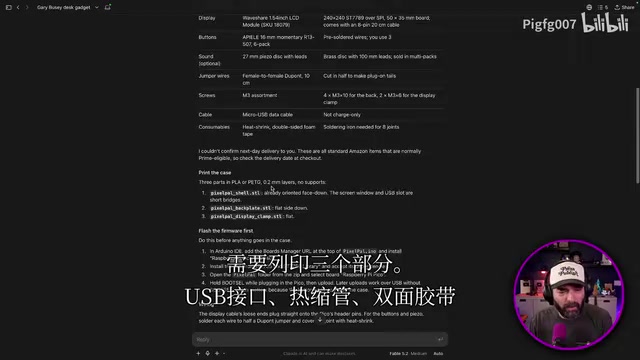
The model delivered a complete plan: a bill of materials including Raspberry Pi Pico H as the controller, display, buttons, jumper wires, screws, and heat-shrink tubing, four STL print files, Python firmware, and a step-by-step assembly manual. Guardrails also kicked in here—it refused to use a real person's likeness and replaced the character with an original robot. The creator followed up with a request for a "detailed assembly manual with images" at the high setting and got a layer-by-layer illustrated guide in about 15 minutes; he said he plans to actually build the device.
Anthropic's official examples are even more extreme: one engineer had Fable 5.2 design a prototype operating system starting from an empty folder; the model coordinated over 1,000 sub-agents working continuously for eight days, producing a system that boots on a laptop, complete with drivers, persistent file storage, windows, a login screen, and an installer. It also used two open-source protein folding models to find a new method that accurately predicts full capsid structures. On the hardware side, a one-paragraph prompt produced three electronic devices with circuit boards, 3D-printed enclosures, and software.
Sub-agent orchestration means the main model breaks a large goal into multiple subtasks, dispatches them to independent model instances to execute in parallel or in sequence, then aggregates the results, checks consistency, and continues. "Coordinating over 1,000 sub-agents working continuously for eight days" in this article is an example: it tests not just the capability of a single model but also task decomposition, context passing, error recovery, and long-horizon state management. This is also an extreme form of the "orchestrator" usage pattern.
Pricing and Usage Advice: Opus for Everyday, Fable for the Hard Fights
API pricing is $8 per million input tokens and $40 per million output tokens—twice that of Opus 5.5, but cheaper than the previous generation Fable 5.1 at 10/50 and slightly below Astra via OpenAI (10/50)—and it's smarter on most benchmarks. All paid Claude plans (Pro from $17/month, Max Ultra, etc.) can see Fable 5.2 in the model dropdown; free users can't use it. There are extra usage allowances and weekly usage discounts in the first week of release.
Anthropic's own advice is straightforward: start most coding and knowledge tasks with Opus 5.5 and switch to Fable when needed. Fable 5.2 fits two roles best—advisor, where it guides Haiku, Sonnet, and Opus as they work; or orchestrator, where it keeps the big picture and delegates simple tasks to smaller models.
As for the most important benchmark of all, the "Busey Bench"—generating an SVG version of Gary Busey—the creator spent 19 minutes 50 seconds, 122,248 tokens, and nearly $5, only to rank sixth among LLM judges, behind all GPT models and Gemini 4 Argon.
Advisor mode and orchestrator mode are two different approaches to model division of labor. In advisor mode, the strong model doesn't directly produce the final result; instead it provides plans, reviews, or corrections while smaller models execute, trading a small amount of high-value tokens for overall quality gains. In orchestrator mode, the strong model handles global planning and task dispatch, delegating simple subtasks to cheaper models and handling only the hard parts itself. Both share the goal of letting smaller models absorb most of the token consumption to offset the high unit price of the strong model.
One-Line Conclusion
This is a model built for hard problems: theoretical physics, protein folding, mathematical formalization, hardware, and robotics. If you're only doing everyday research and small-to-medium coding projects, Opus 5.5 is enough; if you're building games, hunting deep bugs, or designing physical devices, Fable 5.2 is one of the strongest tools currently available—just don't casually turn on max mode.

Related articles

1,000 AI Agents Formalize Fermat's Last Theorem in 30 Hours, Anthropic Releases New Claude Models
Anthropic releases Claude Fable 5.2 and Mythos 5.2: 1,000 agents formalize Fermat's Last Theorem in 30 hours, coding costs halved, plus hardware design and physics.

Claude Fable 5.2 Released: A Thousand AI Agents Build a Bootable OS in 8 Days
Anthropic releases Claude Fable 5.2 and Mythos 5.2—same model, two safety tiers. Demo shows 1,000 AI agents build a bootable OS in 8 days, formalize Fermat proof in 30 hours, score 64.6 beating Gemini 4 Carbon, price cut 20%.

Claude Fable 5.2 Release Analysis: The Strongest Model Deliberately Weakened?
Analysis of Claude Fable 5.2 and Mythos 5.2: Anthropic deliberately restricted accelerator kernel optimization and architecture improvements during training, drawing a line before recursive self-improvement. The video also reconstructs a 1,000-agent, eight-day OS-building experiment and discusses whether open-source models will overtake.