AI SDK Releases @ai-sdk/zai Patch Update: Dependency Chain Synchronized
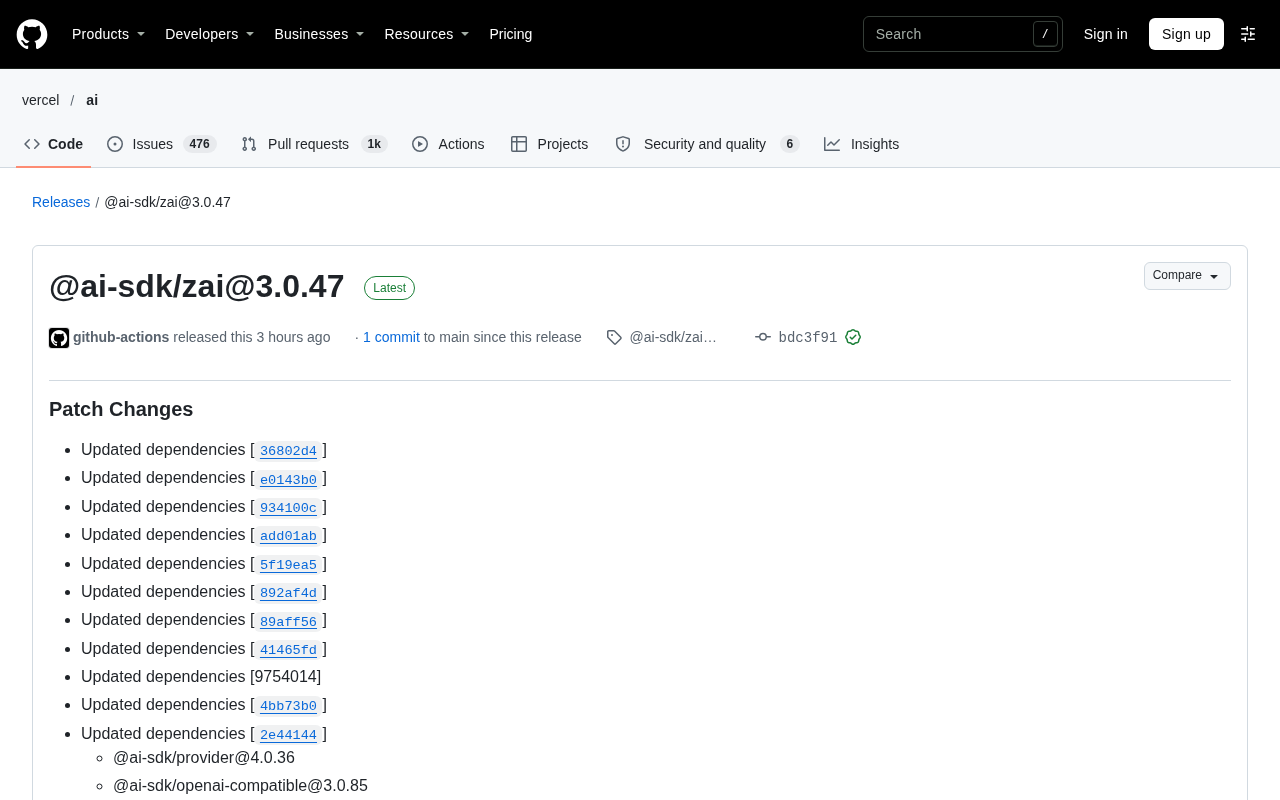
@ai-sdk/zai 3.0.47 released: a pure dependency-sync patch with no new features.
Vercel AI SDK's @ai-sdk/zai package releases version 3.0.47 as Patch Changes, with all changes being dependency synchronization: @ai-sdk/provider to 4.0.36, @ai-sdk/openai-compatible to 3.0.85, and @ai-sdk/provider-utils to 5.0.75. The article explains how such updates propagate through AI SDK's multi-layer package structure, notes that dependency drift can cause type conflicts and runtime differences, and recommends upgrading foundational packages together to keep the dependency tree clean, while verifying streaming and tool-call paths first in projects with strict locking.
The AI SDK project under Vercel has released version 3.0.47 of the @ai-sdk/zai package. This is a standard patch update whose core content does not involve new features or API changes, but rather revolves around synchronized upgrades of the dependency chain. For developers using Z.ai model integration capabilities, this type of update typically means maintenance of underlying compatibility and stability, and is worth noting in dependency management.
What the Patch Update Actually Contains
According to the release notes, the change type for @ai-sdk/zai@3.0.47 is marked as Patch Changes, and the listed entries all point to dependency updates. The number of specific commits involved is fairly large, but each one points to the same kind of operation: following the latest versions of upstream packages and adjusting this package's dependency declarations.
The explicitly mentioned dependency packages include @ai-sdk/provider, @ai-sdk/openai-compatible, and @ai-sdk/provider-utils, at versions 4.0.36, 3.0.85, and 5.0.75 respectively. These three packages are the foundational modules in the AI SDK ecosystem responsible for model provider abstraction, the OpenAI compatibility layer, and utility functions.
This update pattern is quite common in AI SDK's release cadence. Because the ecosystem consists of multiple interdependent packages, any fix in a foundational package propagates in a chain-like manner to upper-layer provider packages, ultimately resulting in what appears to be a thin patch release.
Why Dependency Synchronization Matters
For developers who use @ai-sdk/zai directly, the significance of dependency synchronization lies in avoiding hidden failures caused by version drift. AI SDK's provider layer relies on @ai-sdk/provider-utils to handle critical logic such as request construction and streaming response parsing. Once the upper-layer package and the foundational package versions do not match, type definition conflicts or runtime behavior differences may occur.
Keeping old versions in the lock file won't cause immediate errors, but as other packages upgrade successively, the dependency tree will gradually diverge, and troubleshooting costs will rise accordingly. Incorporating such patch updates into a regular upgrade process is a low-cost way to keep the dependency tree clean.
Version Drift refers to the phenomenon where the same package appears in multiple incompatible versions within a project's dependency tree, or where the version ranges of upper-layer packages and lower-level foundational packages do not match. In the npm ecosystem, each package declares the version range it depends on via dependencies, and the package manager tries to reuse already-installed versions; however, when the ranges declared by different packages do not intersect, multiple copies are produced. For type-sensitive modules like @ai-sdk/provider-utils that carry request construction and streaming parsing, two copies can lead to TypeScript type incompatibilities, failed instanceof checks, or divergent runtime behavior. The lock file can only pin the current resolution result and cannot prevent subsequent new dependencies from introducing conflicts, so regularly synchronizing provider-related packages is a proactive way to curb drift.
Z.ai's Position in the AI SDK Ecosystem
@ai-sdk/zai is the official integration package provided by AI SDK for Z.ai models. Through it, developers can call Z.ai's model capabilities under AI SDK's unified interface without having to handle request formats and response parsing separately. This complements the positioning of @ai-sdk/openai-compatible: the latter provides a general adaptation layer for a large number of third-party services that follow the OpenAI interface specification.
In this update, @ai-sdk/openai-compatible was also synchronized to 3.0.85, indicating that the Z.ai package may reuse part of this compatibility layer's implementation, and the versions of the two need to remain coordinated.
From an ecosystem perspective, AI SDK's strategy is to split different model providers into independent packages, each maintaining its own version number while sharing the underlying abstraction. This structure allows fixes for a single provider to be released quickly, but also makes dependency management more fragmented. For users, understanding this package structure helps determine when to proactively upgrade and when to wait.
AI SDK's provider abstraction layer is the core design of Vercel AI SDK: it defines a unified set of interfaces such as LanguageModelV1, decoupling "input messages and generation parameters" from "the specific vendor's HTTP request format." @ai-sdk/provider provides interfaces and type definitions, @ai-sdk/provider-utils provides shared utilities such as parameter validation, streaming response parsing, and error wrapping, while vendor packages (such as @ai-sdk/zai) are only responsible for translating the unified interface into that vendor's API calls. This layering means upper-layer application code does not need to change when switching model vendors, but it also means that any fix in the foundational packages must propagate through the dependency chain, and provider packages themselves often only need to bump dependency versions to gain behavioral improvements.
Upgrade Recommendations and Caveats
This release was completed automatically by GitHub Actions, and the commits carry GitHub verified signatures, making it a routine automated release process with no signs of manual intervention. Developers can safely treat it as a maintenance update.
When upgrading, it is recommended to update @ai-sdk/provider, @ai-sdk/openai-compatible, and @ai-sdk/provider-utils together to avoid manually specifying versions that cause multiple copies in the dependency tree. If the project also uses other AI SDK provider packages, check whether those packages have followed up with the same foundational dependency versions.
If the current project has strict dependency version locking, you can first verify paths that rely on provider-utils, such as streaming responses and tool calls, in a test environment, and merge after confirming there are no anomalies. For projects that only use Z.ai integration at the prototype stage, upgrading directly to 3.0.47 is a reasonable choice.
Conclusion
@ai-sdk/zai@3.0.47 is a patch release centered on dependency synchronization. It introduces no new capabilities but maintains version consistency between the Z.ai integration package and AI SDK's foundational modules. Such updates should not be overlooked—their value is not at the feature level, but in preventing dependency divergence from accumulating into future maintenance burdens.
Related articles
 Tech Frontiers
Sherlock: An Open-Source Tool for Tracking Usernames Across Social Networks
Sherlock is an open-source Python tool that tracks social accounts across networks by username. This article covers its core features, why developers love it, typical use cases, and privacy compliance considerations.
 Tech Frontiers
GitHub Daily·Nov 07: Agent-Ready and Context Compression
GitHub Trending Nov 07: meta's agent-ready design system astryx, billion-context's 5x context compression, sherlock nearing 100k stars, plus local-first localthings and bare-metal GPU orchestration nvke.
 Tech Frontiers
Buoyant Open-Sources Kinference: An Inference Control Plane for vLLM on K8s
Buoyant open-sources Kinference, an inference control plane for vLLM on Kubernetes, with declarative routing, KV-cache-aware load balancing, and per-tenant metrics—claiming 95% lower median TTFT in official benchmarks.