AI SDK Releases zai 3.0.55: Model Autocomplete Now Updates Automatically with the Catalog
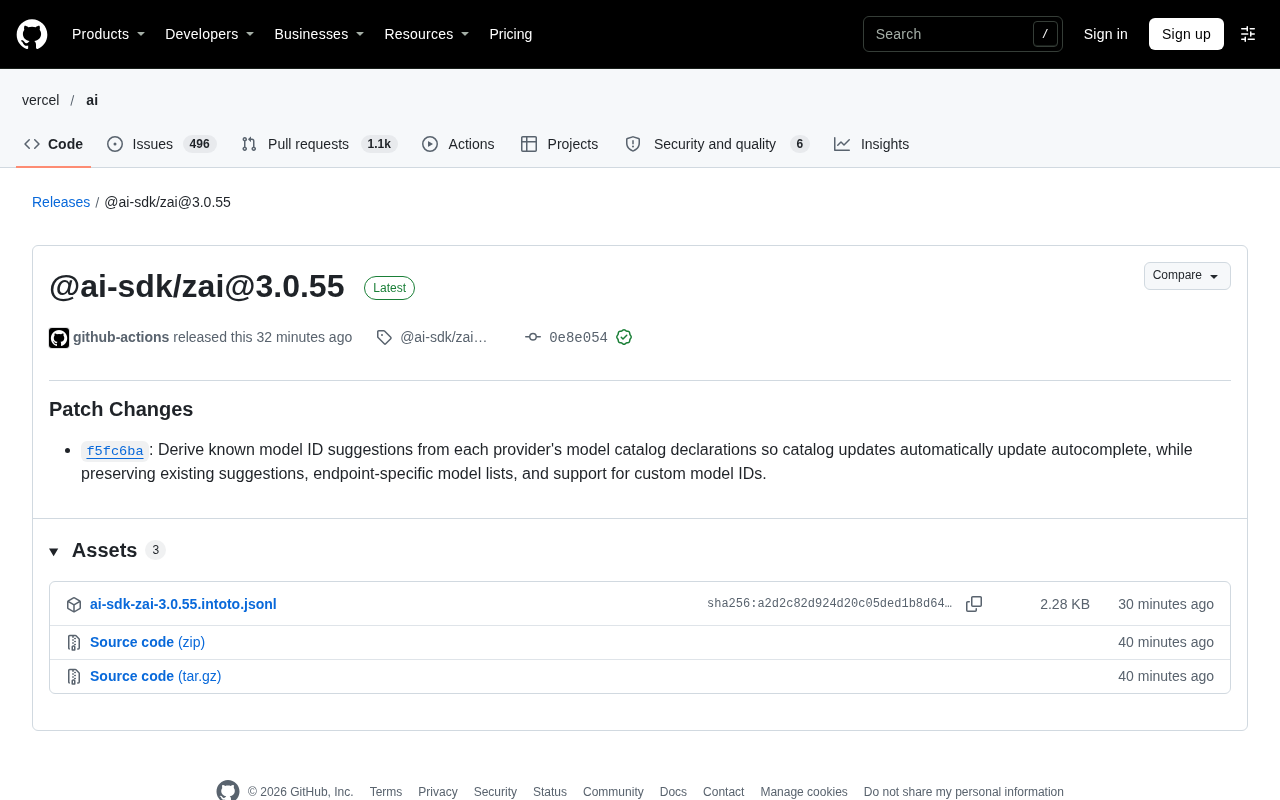
@ai-sdk/zai 3.0.55 patch derives model ID autocomplete from provider model catalog declarations while preserving custom ID support.
The @ai-sdk/zai package in Vercel's AI SDK ecosystem has released patch version 3.0.55, whose core change is that model ID autocomplete suggestions no longer rely on a hardcoded list but are dynamically derived from each provider's model catalog declarations. This means that after a provider updates its model pool, autocomplete candidates in the editor refresh automatically, reducing manual doc lookups and typos. The update also preserves the existing suggestion list, endpoint-specific model lists, and support for custom model IDs, balancing automation and flexibility. The patch is auto-published via GitHub Actions with GPG signature verification, and no breaking changes are mentioned officially, so the upgrade cost is low. The article also notes from an industry perspective that model metadata management is evolving from an internal SDK detail into an infrastructure capability, and the derived autocomplete approach is worth learning from for teams building their own model catalogs.
A minor version update that solves the long-standing problem of maintaining model IDs
The AI SDK ecosystem under Vercel has received an unremarkable but practical patch update. @ai-sdk/zai@3.0.55 has been released on GitHub with version number 3.0.55, a patch-level update. The commit history shows that this change focuses on how model ID suggestions are generated.
For AI applications with multiple models and multiple providers, maintaining the model list has always been a hidden cost: providers launch new models and retire old ones, yet developers still have to manually remember and type model IDs in their code editors. The idea behind this update is to hand that "memory" over to the code itself.
Core change: deriving autocomplete suggestions from model catalog declarations
According to the commit message (commit f5fc6ba), the core of this change is: autocomplete suggestions for known model IDs no longer rely on a hardcoded list, but are derived from each provider's model catalog declarations.
The technical meaning of this statement is worth unpacking:
- The model catalog itself is a structured declaration describing which models a given provider currently supports;
- Autocomplete suggestions are dynamically generated from this declaration, so when the catalog updates, the candidate models in the editor update along with it;
- The update also preserves the existing suggestion list, the model lists for specific endpoints, and support for custom model IDs.
In other words, this is not a rebuild from scratch, but rather an "automatic sync" capability layered on top of the existing autocomplete mechanism. Developers can use the latest models in the official catalog, and can also continue to enter private deployment names or third-party proxy models that are outside the catalog.
Why "preserving custom IDs" matters
Many teams access models through gateways or proxies, and the model IDs actually passed to the SDK often differ from the official catalog. If the autocomplete mechanism only recognized the official catalog, custom IDs would be flagged as invalid input, which would actually interfere with the development experience. This change explicitly preserves support for custom IDs, showing that the maintainers made a trade-off between automation and flexibility.
Model catalog declarations typically use structured data (such as JSON or TypeScript type definitions) to describe the set of models a provider supports, including metadata such as model ID, display name, context window, and supported modalities. In the AI SDK ecosystem, such declarations are often maintained by providers or released alongside the SDK as a single source of truth. Deriving autocomplete suggestions from the declaration means that editor plugins or language servers read this data and dynamically generate the candidate list, rather than hardcoding a string array in the code. This way, when the declaration file changes due to a provider update, the autocomplete results follow automatically, reducing the lag between SDK releases and documentation sync.
Custom model IDs refer to identifiers not listed in the official model catalog, commonly seen in private deployments, fine-tuned models, enterprise internal gateways, or third-party proxy services. These IDs may follow different naming conventions from the official ones, and may even include environment prefixes or routing paths. If the autocomplete mechanism enforced validation against the official catalog, developers entering custom IDs might receive "unknown model" warnings or be auto-corrected, breaking existing workflows. Preserving support for custom IDs usually means the autocomplete system treats the official catalog as a source of suggestions rather than a whitelist, so any string entered can still pass validation, striking a balance between automated hints and flexibility.
Practical impact on developers
This kind of patch may seem to touch only a few lines of derivation logic, but the real benefits show up in everyday development workflows:
- Less manual doc lookup: after a provider updates its model pool, there is no need to wait for an SDK release or manually edit configuration; autocomplete candidates refresh with the catalog;
- Fewer typos: once a model ID is mistyped, errors often only surface at runtime; autocomplete suggestions can catch these problems early;
- No missed endpoint differences: different endpoints of the same provider may support different models, and preserving endpoint-specific lists prevents autocomplete from offering suggestions that "look right but are actually unavailable."
It should be noted that this is a patch version update with low upgrade cost, and the official release notes do not mention any breaking changes. The project is automatically published via GitHub Actions, and commits are verified with GPG signatures, making the supply chain relatively transparent.
GPG signature verification is a cryptographic signing mechanism for Git commits and tags, used to confirm the committer's identity and detect whether content has been tampered with. In automated release workflows, the CI system uses a private key held by the maintainers to sign the release commit or tag, and dependents can verify the signature chain using the public key. Combined with GitHub Actions automated publishing, this means the version build process is triggered by a pipeline and the artifacts are bound to a specific commit, reducing the oversights that manual releases might introduce. For teams concerned about supply chain security, signature verification provides an auditable path, but it cannot replace independent review of dependency contents.
Industry perspective: the model catalog is becoming infrastructure
Zooming out a bit, this update reflects a trend: as the number of model providers grows, the management of model metadata is evolving from an internal SDK detail into an infrastructure capability.
In the past, each SDK maintained its own model table, with updates made through manual pull requests; now more and more toolchains are trying to have metadata driven by provider declarations, with the SDK only responsible for reading and deriving. The benefit of this approach is a shorter update chain and better cross-tool consistency, but the cost is higher requirements for the standardization of catalog declaration formats—once a declaration is written incorrectly, it affects the autocomplete behavior of all dependents.
For teams building multi-model applications with the AI SDK, this patch will not bring a leap in functionality, but it does reduce the friction caused by model list drift. If you are using @ai-sdk/zai, you can upgrade along the way; if you are building your own model catalog, the implementation approach of this derived autocomplete is also worth learning from.
Related articles

Why Microsoft CEO Nadella Still Backs Nvidia After Jensen Huang's Departure
Microsoft CEO Nadella publicly expresses confidence in Nvidia interim CEO Colette Kress. This article analyzes Nvidia's power transition after Jensen Huang's departure, Microsoft's compute dependency, and the trust logic of the AI supply chain.

Nadella: Critical Infrastructure Is 'Unpatchable' as AI Cybersecurity Arms Race Escalates
Microsoft CEO Nadella addresses AI cyberattack fears, saying much critical infrastructure is unpatchable, downplaying the Outlook outage, and analyzing AI's dual role in cybersecurity.

Musk Backs Jensen Huang: Firing Him Is Like Cutting Jordan
Musk says Jensen Huang is loyal to the U.S. and likens firing him to cutting Michael Jordan—highlighting politicization anxieties in the AI chip industry and defending talent value.