Musk Backs Jensen Huang: Firing Him Is Like Cutting Jordan

Musk backs Jensen Huang, using a Jordan analogy to oppose politicized interference in tech.
Musk publicly rejected claims that Jensen Huang is disloyal to the U.S., likening firing him to cutting Michael Jordan from a team to stress his irreplaceability. The article argues the remark reflects U.S. tech anxiety over political interference in business, highlights Huang's strategic vision and CUDA ecosystem as a hard-to-replicate moat, and frames the loyalty debate as national security concerns versus business autonomy—with Musk subtly seeking more autonomy for tech.
A Debate About Loyalty and Value
Elon Musk recently made a clear public statement of support for NVIDIA CEO Jensen Huang. When asked whether he believed Huang was disloyal to the United States, Musk said flatly: "I don't think he's disloyal to America." The remark quickly set off discussion across the tech world.
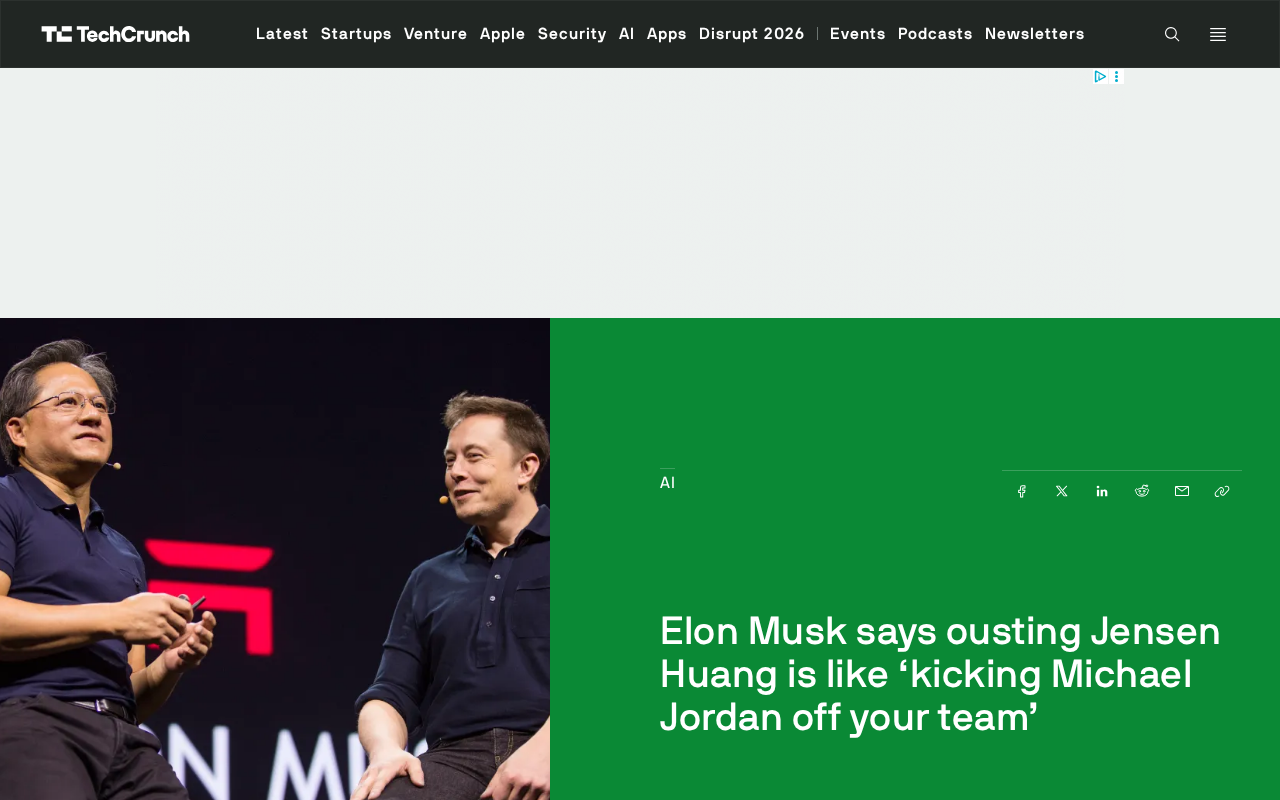
Musk's comments were not an isolated event. Huang had previously drawn scrutiny from some U.S. politicians over NVIDIA's business footprint in the Chinese market, with critics arguing he was too close to China. Musk responded to that criticism with a strikingly vivid analogy, likening the idea of firing Huang to "cutting Michael Jordan from your team"—a strong endorsement of Huang's individual ability that also implicitly conveys frustration with the current politicized business environment.
Why Huang Is Compared to Jordan
Jordan's place in basketball history needs no elaboration. The core of Musk's analogy is to stress Huang's irreplaceable value to NVIDIA and to the AI industry as a whole. With demand for AI compute exploding, NVIDIA's GPUs have become something close to the industry's hard currency, and Huang is the soul of that company.
Technical Foresight and Commercial Execution
Huang's forward-looking bet on GPU computing transformed NVIDIA from a graphics chip company into a founder of AI infrastructure. That strategic vision is much like Jordan's ability to read the game on the court—both involve making the right call at the decisive moment. Musk's analogy implies that any attempt to replace Huang through political pressure would be self-sabotage.
CUDA (Compute Unified Device Architecture) is a parallel computing platform and programming model introduced by NVIDIA in 2006. It allows developers to use the thousands of cores in a GPU for general-purpose computing rather than graphics rendering alone. Building this ecosystem locked in developers' minds well before the AI boom: nearly all mainstream deep learning frameworks worldwide (such as TensorFlow and PyTorch) prioritize CUDA support, and a vast body of research code and engineering practice has been built around it. This ecosystem stickiness creates extremely high switching costs—later entrants, even with comparable hardware performance, would struggle to replicate its software stack and community resources in a short time. What Huang built, then, is not just chips but a de facto industry standard—precisely the technical foundation of the "irreplaceability" in Musk's Jordan analogy.
The Scarcity of Leadership
Entrepreneurial leadership is hard to replicate. The CUDA ecosystem, developer community, and deep partnerships with major AI labs that Huang built cannot simply be carried on by a new CEO. Musk himself is a staunch champion of founder culture, and he knows well how a strong leader shapes a company's fate.
Industry Anxiety Behind the Many Voices
According to analyses from Bilibili creators and YouTube tech channels, Musk's statement is not merely about personal friendship—it reflects the U.S. tech community's wariness of political interference in business. Multiple independent sources note that competition in the AI chip sector has become highly politicized, forcing executives to walk a tightrope between national security and global markets.
In the discussion over whether Huang is "loyal," two clearly different positions stand out. One side argues that NVIDIA's chip sales to China objectively help a competitor, and that the CEO should bear political responsibility; the other holds that business decisions should not be securitized across the board, and that Huang's contribution to the United States far outweighs the supposed risks. Musk clearly sides with the latter, but the way he framed it—using a sports analogy rather than a policy debate—cleverly avoided direct confrontation while sending an unmistakable signal.
Some analysts also point to the subtle mix of competition and cooperation between Musk and Huang. Tesla develops its own AI chips, and xAI is building compute clusters; both are customers of NVIDIA and, at some level, potential competitors. Yet Musk chose this moment to voice public support, suggesting that in his view, preserving a healthy AI chip ecosystem matters more than short-term competition.
U.S. export controls on AI chips to China are the key backdrop for understanding this "loyalty" controversy. Since 2022, the U.S. Commerce Department has repeatedly tightened semiconductor export restrictions, forcing NVIDIA to launch "special edition" chips that meet the control thresholds (such as the A800, H800, and later the H20) to maintain access to the Chinese market. The move is commercially sensible but easily interpreted in political discourse as "circumventing controls." For NVIDIA, China is one of the world's largest AI application markets; pulling out would mean a double loss of revenue and ecosystem influence, yet getting too close could trigger congressional scrutiny. Huang has thus long been caught between "national security" and "global markets," and Musk's remarks are an indirect response to that structural dilemma.
How the Loyalty Narrative Affects the Tech Industry
When "loyalty" becomes the yardstick for tech executives, the decision-making logic of the entire industry becomes distorted. Companies may be forced to abandon optimal technical paths or business opportunities in exchange for political safety. Musk's remarks are in effect a bid for greater autonomy for the tech community—letting engineers and entrepreneurs make decisions based on technology and markets rather than political labels.
For those who follow the AI industry, the real question in this debate is: are we willing to let the best leaders leave their posts for non-business reasons? Musk's answer is no. His Jordan analogy is powerful precisely because it appeals to common sense—no one would voluntarily give up their best player, especially when the game is at its most intense.
Conclusion: Talent Value Should Transcend Political Noise
Musk's support for Huang is more than a trending social media line; it is a public rebuttal of the politicization creeping into the tech industry. As the AI race heats up, maintaining stability in leadership and professional judgment matters more than ever. Binding industry leaders like Huang to political loyalty may ultimately damage the competitiveness of the entire U.S. tech industry.
Whether or not people like Musk's way of saying it, the core question he raises is worth pondering: when political narratives try to interfere with business judgment, can we still recognize who the real "Jordan" is?
One-line Summary
Musk backs Jensen Huang, using a Jordan analogy to oppose politicized interference in the tech industry.
Paragraph Summary
Musk publicly rejected the idea that Jensen Huang is disloyal to the United States and used the analogy of "cutting Michael Jordan from your team" to stress his irreplaceability. The article argues that the statement not only recognizes Huang's individual ability but also reflects broader anxiety in the U.S. tech community about political interference in business. Huang's strategic vision and his building of the CUDA ecosystem form NVIDIA's core moat and are hard to replicate; the debate over "loyalty" reveals two positions—national security concerns versus a case for business autonomy. Musk's sports analogy deftly sidesteps policy debate and is essentially a bid for greater autonomy for the tech community, calling for professional judgment to rise above political labels as the AI race intensifies.
Related articles

Why Microsoft CEO Nadella Still Backs Nvidia After Jensen Huang's Departure
Microsoft CEO Nadella publicly expresses confidence in Nvidia interim CEO Colette Kress. This article analyzes Nvidia's power transition after Jensen Huang's departure, Microsoft's compute dependency, and the trust logic of the AI supply chain.

Nadella: Critical Infrastructure Is 'Unpatchable' as AI Cybersecurity Arms Race Escalates
Microsoft CEO Nadella addresses AI cyberattack fears, saying much critical infrastructure is unpatchable, downplaying the Outlook outage, and analyzing AI's dual role in cybersecurity.

Gemini 4 Neon Released: Google's New-Generation Model Sparks Discussion
Google releases Gemini 4 Neon, its new-generation model. The official blog outlines positioning, while 304 Hacker News comments debate its capabilities and pricing. This article covers the release, community reaction, and practical impact on developers.