Gemini 4 Neon Released: Google's New-Generation Model Sparks Discussion

Google releases Gemini 4 Neon as the community debates its naming and positioning, with details still pending official clarification.
Google released its new-generation Gemini model, Gemini 4 Neon, via its official blog. The related Hacker News discussion received 316 points and 304 comments, reflecting strong developer interest in Google's model iterations. The article analyzes how the "Neon" naming differs from the previous Pro/Ultra tiering, suggesting a possible new product positioning, and notes that first-hand information is currently limited to the official blog—performance, pricing, and context-window details await technical documentation and third-party evaluation. For developers, integration barriers are low if the existing API system continues; enterprises should wait for model cards and compliance materials before production deployment.
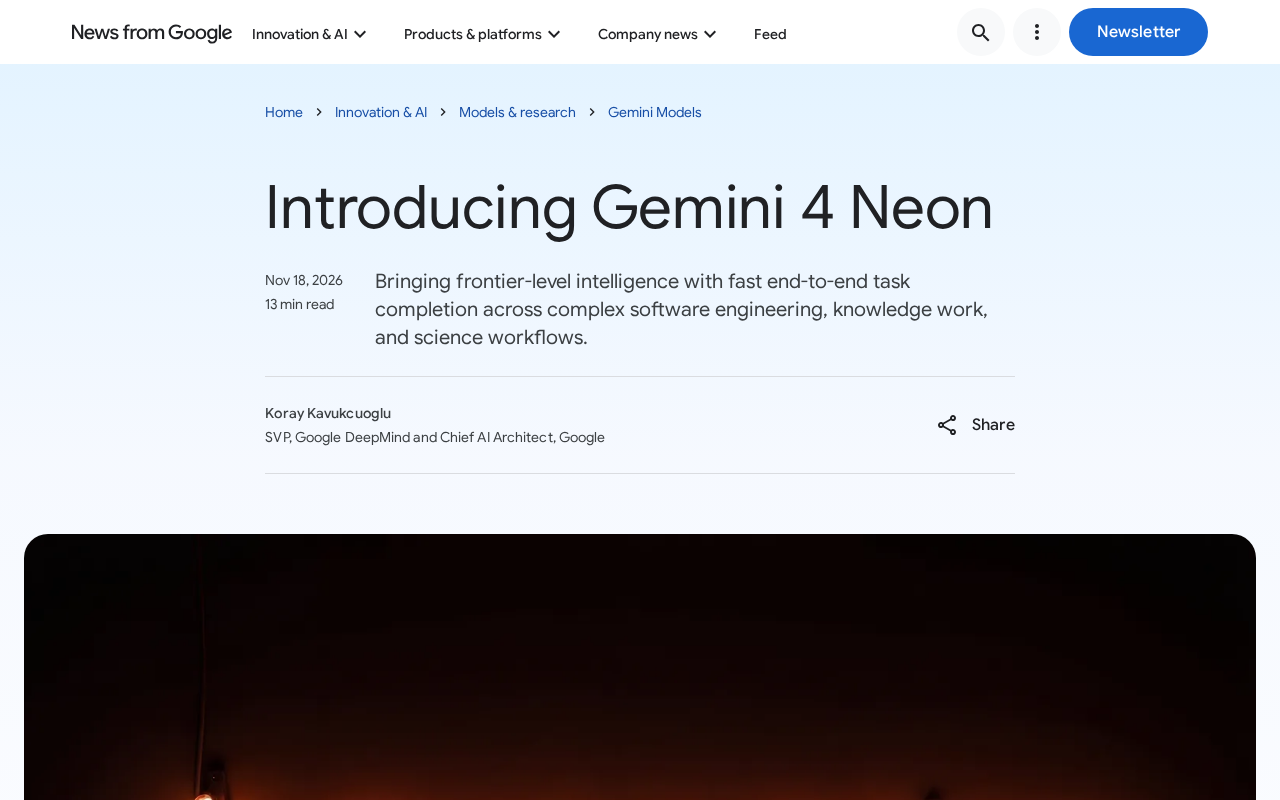
Google has published Gemini 4 Neon on its official blog, and this new-generation Gemini model, dubbed "Neon," has quickly sparked discussion in the developer community. The related post on Hacker News received 316 points and 304 comments—a level of engagement that shows just how closely the outside world is watching the pace of Google's model iterations. It's worth noting that the currently available public information comes primarily from a single release article on Google's official blog; specific capability details will require more technical documentation and hands-on feedback.
What the Naming and Release Cadence Signal
The "Neon" suffix itself is worth pondering. Compared with the previous Pro, Ultra, and Flash naming conventions that tier models by performance or speed, Neon feels more like an independent product-line codename, suggesting Google may be exploring a direction distinct from the existing Gemini series. The fact that the official blog places it under the "Innovation & AI / Models & Research" section indicates it remains a formal member of the Gemini model family rather than an experimental branch.
Choosing the official blog over a developer conference keynote as the release channel also fits Google's recent habit in model launches: set the tone with a blog post first, then gradually fill in details through API documentation, model cards, and benchmarks. For those tracking Google's AI roadmap, this kind of release often means accompanying developer tools and pricing information will follow.
Gemini is a multimodal large model family launched by Google DeepMind at the end of 2023, natively supporting text, image, audio, and video inputs. Its naming system has previously been roughly tiered by capability and cost: Ultra for the strongest reasoning, Pro for general tasks, Flash for low latency and low cost, and Nano for on-device use. This tiering lets developers choose models by scenario. If Neon breaks away from this system, it may mean Google is trying out new capability dimensions or deployment forms—for example, stronger real-time interaction, agentic capabilities, or a specific multimodal emphasis. Understanding this context helps in judging where this release fits within Google's overall model matrix.
Community Reaction: Anticipation and Skepticism Side by Side
The 304 comments on Hacker News constitute the most concentrated external feedback so far. Judging by the level of discussion, developers have a strong interest in whether Google can narrow the capability gap with competitors. Such forum discussions typically revolve around a few focal points: actual inference performance, context window size, API pricing, and whether the model will launch simultaneously in Google AI Studio and Vertex AI.
Since the official blog post is currently the only first-hand source of information, community discussion inevitably includes speculation and second-hand retellings. For readers, it's important to distinguish officially confirmed information from community conjecture: the original blog post provides product positioning and release facts, while judgments about performance comparisons and pricing advantages require independent evaluation.
Hacker News is operated by the startup incubator under Y Combinator and is one of the more influential discussion platforms in the tech community, with post rankings driven by user votes and comments. 316 points and 304 comments represent a relatively high level of engagement, typically seen on major products or controversial topics. Discussions in this community are dominated by first-hand experience from engineers, founders, and researchers, but there are also cases where unverified information gets widely repeated. Therefore, when reading such discussions, distinguishing official facts, user testing, and speculative comments is a common approach to assessing a new model's real-world performance.
Practical Implications for Developers and Enterprises
The direct impact of a new model release on developers shows up in integration costs and migration paths. If Gemini 4 Neon continues Google's existing API system, existing Gemini-based applications may only need to swap the model identifier to try it out—a low-barrier upgrade opportunity for teams already building products within the Google Cloud ecosystem.
Enterprises, meanwhile, focus more on stability and compliance. Google typically provides model cards, data processing documentation, and regional availability information once a model becomes generally available, and these materials determine whether a model can enter production environments. Before official documentation is complete, using Neon in critical business systems still carries risk; a more prudent approach is to validate capabilities in a sandbox environment.
Google AI Studio is a free/low-barrier model experimentation platform Google offers to developers, supporting prompt debugging and API key generation; Vertex AI is the managed machine learning platform on Google Cloud for enterprises, providing model deployment, monitoring, and compliance capabilities. The two typically support new models simultaneously, but enterprise-grade features (such as data residency and audit logs) are only available in Vertex AI. Model cards are standardized documents Google releases alongside models, describing training data overview, evaluation results, known limitations, and safety considerations—key evidence for enterprises evaluating whether to go live.
Observation Points Worth Tracking
In the coming weeks, several signals are worth watching: first, whether Google publishes comparison benchmarks against previous Gemini models; second, hands-on feedback from third-party evaluation organizations and heavy users; and third, whether the pricing strategy continues the existing token-based billing framework. This information will determine whether Gemini 4 Neon is a routine iteration or a strategic adjustment in Google's model competition.
For content creators and researchers, the original official blog post remains the most reliable starting point. Community discussion can serve as a supplement for understanding real-world usage experience, but unverified performance claims should not be treated as conclusions.
One-line Summary
Google releases Gemini 4 Neon, and the community buzzes over its naming and positioning as details await official clarification.
Paragraph Summary
Google has released its new-generation Gemini model, Gemini 4 Neon, via its official blog. The related Hacker News discussion received 316 points and 304 comments, showing strong developer interest in Google's model iterations. The article analyzes how the "Neon" naming differs from the previous Pro/Ultra tiering and suggests it may hint at a new product positioning; it also notes that first-hand information is currently limited to the official blog, with details such as performance comparisons, pricing, and context window awaiting technical documentation and third-party evaluation. For developers, integration barriers are low if the existing API system continues; enterprises should wait for model cards and compliance materials to be completed before considering production deployment.
Related articles

Why Microsoft CEO Nadella Still Backs Nvidia After Jensen Huang's Departure
Microsoft CEO Nadella publicly expresses confidence in Nvidia interim CEO Colette Kress. This article analyzes Nvidia's power transition after Jensen Huang's departure, Microsoft's compute dependency, and the trust logic of the AI supply chain.

Nadella: Critical Infrastructure Is 'Unpatchable' as AI Cybersecurity Arms Race Escalates
Microsoft CEO Nadella addresses AI cyberattack fears, saying much critical infrastructure is unpatchable, downplaying the Outlook outage, and analyzing AI's dual role in cybersecurity.

Musk Backs Jensen Huang: Firing Him Is Like Cutting Jordan
Musk says Jensen Huang is loyal to the U.S. and likens firing him to cutting Michael Jordan—highlighting politicization anxieties in the AI chip industry and defending talent value.