@ai-sdk/sandbox-vercel 1.0.167 Patch Release: Template Version Bump Invalidates Stale Templates

@ai-sdk/sandbox-vercel releases 1.0.167, invalidating stale templates by bumping template versions.
@ai-sdk/sandbox-vercel in the AI SDK ecosystem has released version 1.0.167, a targeted patch rather than a feature update, with the only change being a bump to the sandbox template version to invalidate stale templates. The article notes that in sandbox infrastructure, environment consistency affects stability more than feature richness; template version numbers are often used as part of cache keys or configuration validation, and staying at an old value causes old templates to continue being hit, with problems appearing intermittently and hard to reproduce. This version-number refresh clears environment drift without changing the public API. Meanwhile, @ai-sdk/harness is released with the same version number, indicating they share a release cadence and that version consistency must be maintained during upgrades. The release was automated by github-actions and carries GPG signatures, making it traceable and verifiable. After upgrading, developers should watch for changes in the sandbox's first startup time, which is an expected one-time rebuild cost.
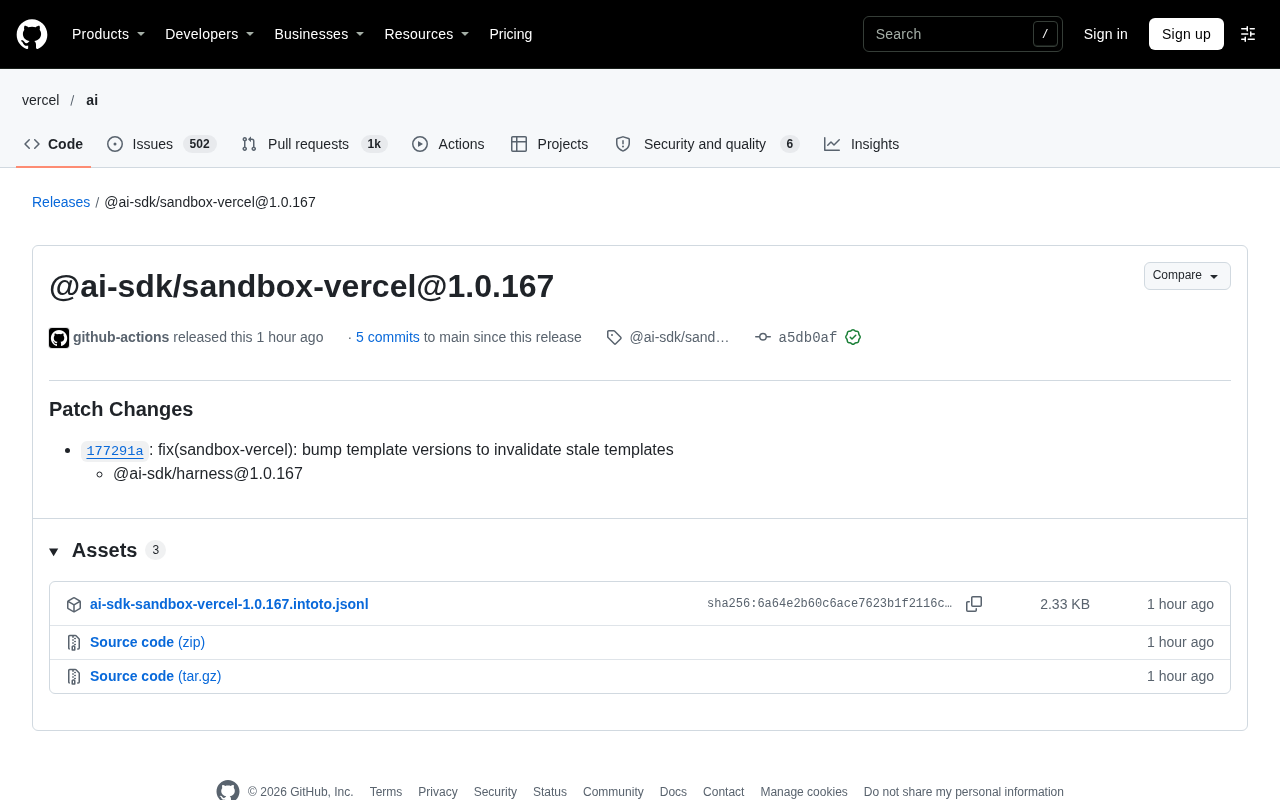
The @ai-sdk/sandbox-vercel package in the AI SDK ecosystem has released version 1.0.167. This is not a major feature update, but a highly targeted patch fix whose core goal is to address the risks posed by stale sandbox template versions.
Patch Content: A Fix That Trades "Version Number for Health"
According to the release record on GitHub, the only patch change in this version comes from commit 177291a, with the content: fix(sandbox-vercel): bump template versions to invalidate stale templates.
This sentence reveals a key piece of information: sandbox-vercel relies on preconfigured templates at runtime, and templates have version states. When old templates persist over time, they may continue to be reused, thereby introducing unwanted stale states. By bumping the template version number, the old templates are proactively invalidated, forcing the system onto a new template path.
Why "Invalidating Old Templates" Deserves Its Own Release
The characteristic of sandbox infrastructure is that "environment consistency" affects stability more than "feature richness." Template version numbers are often part of cache keys, configuration validation, or resource location. When the version number stays at an old value, it means old templates may continue to be hit, and problems manifest in intermittent, hard-to-reproduce forms. Using a patch release to force a refresh of the template identifier clears out potential environment drift in one go without changing the public API.
A sandbox is an isolated runtime environment that provides controlled execution space for untrusted or temporary code, typically used for code execution, plugin execution, CI tasks, and similar scenarios. In toolchains like the AI SDK, sandboxes often preconfigure base images and configurations in the form of "templates"—packaging the operating system, runtime, dependency libraries, and so on into a quickly replicable baseline unit. The template version number serves as the identity marker for this baseline unit.
Template version numbers are typically used as part of cache keys, configuration validation fields, or resource location paths. When the version number remains unchanged, the system assumes the template content is also unchanged and continues to reuse existing caches or already-fetched resources; once the version number is bumped, the cache key changes accordingly, old cache entries no longer hit, and the system is forced to re-resolve, re-fetch, or rebuild the template. This is the technical principle behind "bump template versions to invalidate stale templates"—it does not delete old templates, but rather changes the identifier so that old templates naturally become invalid along the resolution path.
Engineering Signals Behind the Version Number
This release also involves @ai-sdk/harness@1.0.167, with both package version numbers aligned. This indicates that this group of packages shares the same release cadence, and harness, as a companion layer, is coupled with sandbox-vercel's template mechanism. For consumers, upgrade attention should be paid to the consistency of the two versions, avoiding upgrading only one of them and causing behavioral misalignment.
Release Entity and Process Details
The release was automated by github-actions, initiated from the main branch, with a total of 5 commits, and carries a GitHub verified signature (GPG key ID: B5690EEEBB952194). The standardization of such release processes is itself a reflection of project maturity—the patch is small, but traceable and verifiable.
Semantic Versioning (SemVer) specifies version numbers in the form major.minor.patch, corresponding respectively to incompatible API changes, backward-compatible feature additions, and backward-compatible bug fixes. 1.0.167 is a patch number increment, indicating that this change does not include public API adjustments and can theoretically be upgraded by direct replacement.
In the monorepo (single repository, multiple packages) release model, multiple interdependent packages often adopt a "fixed versioning" strategy, where the same release pipeline uniformly increments version numbers to ensure that dependency relationships between packages remain aligned. The fact that harness and sandbox-vercel share the same version number of 1.0.167 is an embodiment of this strategy. If consumers upgrade only one of the packages, dependency resolution may point to an old companion package version, causing the template version to be inconsistent with the companion layer's expectations. Therefore, confirming in the lockfile that both versions are updated in sync is a necessary check during upgrades.
GPG signature verification is a common practice in open-source supply chain security. Publishers sign commits or release artifacts with a private key, and consumers can verify the signature with the corresponding public key, thereby confirming that the artifact indeed comes from a trusted source and has not been tampered with. The GPG key ID mentioned in the article is the short identifier of the public key, making it easy for users to retrieve and import the corresponding public key for verification.
Automated releases via github-actions mean that steps such as version building, packaging, and pushing to npm are executed by the CI pipeline according to predefined processes, reducing the uncertainty brought by manual operations. Combining the two points of "initiated from the main branch" and "signed," it can be seen that the release process has the characteristics of traceable origin, verifiable content, and reproducible process—which is also one of the reference dimensions for judging whether a dependency package is trustworthy.
Practical Impact on Developers
If you use @ai-sdk/sandbox-vercel in your project to build Vercel-based sandbox capabilities, this version is worth including as a routine upgrade. It does not change your existing calling patterns, but it will change the resolution results of the underlying templates, thereby eliminating behavioral inconsistencies caused by residual old templates.
After upgrading, it is recommended to pay attention to changes in the time taken for the sandbox's first startup—template version changes are usually accompanied by a one-time resource re-fetch or rebuild, which is an expected cost.
Conclusion
Treating a "bump template versions" as the sole release content reflects the maintenance team's emphasis on sandbox environment cleanliness. Such patches are inconspicuous, yet they are often a key part of long-term stable operation.
Related articles

Zero-Cost Local Jarvis: Open-Source Voice Cloning and Task Automation in Practice
AI Workshop shows how to build a zero-cost local Jarvis with Ollama and Voice Studio: local model switching, open-source voice cloning, file retrieval, and tool-calling tests, with setup steps and hardware trade-offs.

Mistral Large 4 Released: 1T-Parameter MoE Tops Western Open-Source Leaderboard
Mistral releases its flagship Mistral Large 4: a 1T-parameter MoE architecture activating only 49B parameters at inference, trained from scratch on 3,800 Grace Blackwell GPUs, topping the Western open-weight leaderboard with third-party endorsements in law, finance, and cybersecurity.

Mistral Large 4 Review: Can Europe's Strongest Open-Source Model Challenge the US and China?
Mistral Large 4 (L-Charm) review: trillion-parameter MoE, standout cybersecurity benchmarks but behind Kimi K3 in software engineering, 3,800 GPUs, a key step for European sovereign AI.