Mistral Large 4 Released: 1T-Parameter MoE Tops Western Open-Source Leaderboard

Mistral releases Large 4, a 1T-parameter native multimodal MoE model that tops the Western open-weight leaderboard.
Mistral launches Mistral Large 4 (Lutronk), a 1T-parameter native multimodal MoE model activating only 49B parameters at inference, trained from scratch on 3,800 Grace Blackwell GPUs at its European data center. It ranks first among Western open-weight models with an AA Intelligence Index score of 38, more than double its predecessor's 14, and surpasses GPT-6 Extra on legal and financial tasks in Wealth.ai evaluations. However, the leaderboard top is still held by Chinese models MiniMax, GLM, and Timmy, so 'strongest in the West' is a regional first rather than global open-source No. 1. The strategy centers on open weights plus self-hosting, with real-world red-team testing conducted before release and training data covering 160+ languages.
French AI company Mistral has officially launched its new flagship model Mistral Large 4, nicknamed Lutronk. With a 1-trillion-parameter native multimodal MoE architecture, the model has taken first place among Western open-weight models on multiple benchmarks, making it the new benchmark for the Western open-source camp.
Specs and Training: The Sparse-Activation Path to 1T Parameters
The most eye-catching number for Mistral Large 4 is its parameter scale—1 trillion parameters, but only 49 billion are activated at inference time. This sparse MoE design lets the model maintain extremely large capacity while keeping inference costs under control, and it is also the mainstream engineering approach for current frontier models.
Training was done from scratch on 3,800 NVIDIA Grace Blackwell GPUs at Mistral's own European data center. This detail is worth noting: training was conducted entirely on domestic European compute, which both validates its self-built infrastructure capabilities and gives concrete support to the "European sovereign AI" narrative.
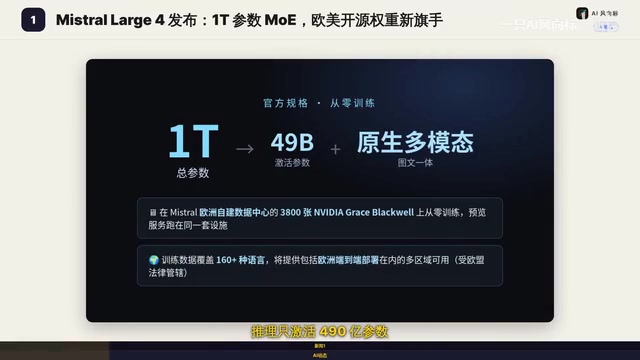
The model is positioned as natively multimodal. A public preview is already live on Mistral Studio, with full weights planned for release at the end of this month.
MoE (Mixture of Experts) architecture is the key to understanding how 1 trillion parameters can activate only 49 billion. The model internally consists of multiple "expert" subnetworks, and each token is routed by a gating network to only a few experts for computation. Thus the total parameter count determines the capacity ceiling, while the activated parameter count determines the actual compute cost of a single inference. Sparse activation allows the model to scale parameters without proportionally increasing inference costs, but the trade-off is that memory usage still approaches the total parameter count, and training details such as routing balance and expert load distribution can significantly affect convergence quality. This is also why frontier models from different companies, despite all taking the MoE route, can differ greatly in actual efficiency.
Benchmark Performance: First Among Western Open-Source Models, With Third-Party Endorsement in Specialized Domains
According to results disclosed in the briefing, Mistral Large 4 performs best among U.S. and European open-weight models on multiple benchmarks, and its visual grounding capability even surpasses some frontier closed-source models.
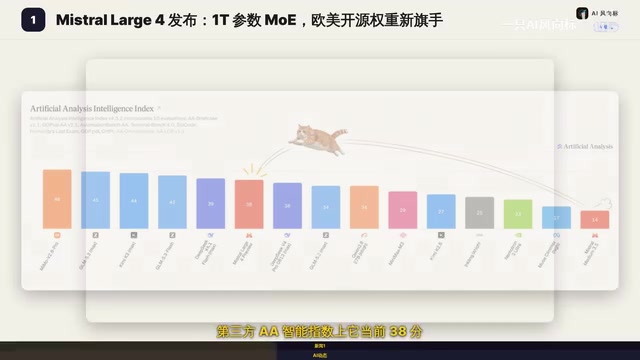
On the third-party AA Intelligence Index, Large 4 currently scores 38 points, compared with 14 points for its own previous-generation Medium 3.5—more than double the improvement. This generational leap better illustrates the shift in positioning for this generation than simply "topping the Western leaderboard."
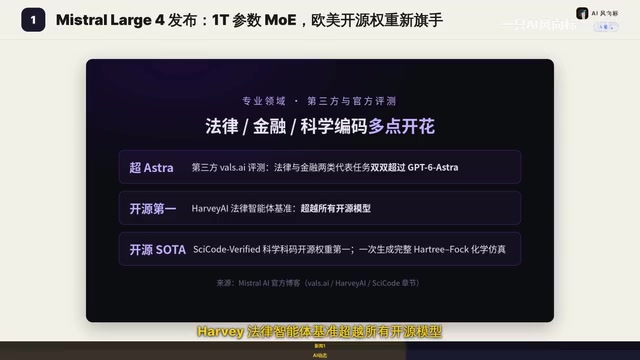
In specialized domains, Mistral Large 4 has received third-party endorsements: in Wealth.ai evaluations, it surpassed GPT-6 Extra on both legal and financial tasks; in the Harvey legal agent evaluation, it outperformed all open-source models; and on the Sycode scientific coding benchmark, it also ranks first among open weights.
However, the top of the leaderboard is still occupied by Chinese models MiniMax, GLM, and Timmy. So the accurate meaning of "strongest in the West" is a regional first place among open-weight models, not the absolute global No. 1 among open-source models.
The AA Intelligence Index (Artificial Analysis Intelligence Index) is a comprehensive leaderboard maintained by third-party evaluator Artificial Analysis, which converts multiple reasoning, knowledge, coding, and math benchmarks into a single score for easy cross-model comparison. Its value lies in unified evaluation criteria and frequent updates, and it is often used to observe generational leaps in models; its limitation is that a single score can obscure differences between task types, and the question sets and weights of different index versions may be adjusted, so cross-time comparisons should be made with caution. Therefore, the 38-versus-14 comparison in this article is better understood as a relative improvement under the same evaluation system rather than a precise measure of absolute capability multiples.
Self-Hosting and Security: Delivering Autonomy Along With Capability
Mistral Large 4 continues the core selling point of self-hosting. The company explicitly states that large providers may block legitimate vulnerability research and incident response, while open weights plus self-deployment can deliver both capability and autonomy to customers.
Cybersecurity is the most aggressive move this time. Before the official release, Mistral is conducting real-world red-team testing with leading cybersecurity vendors, vetted partners, and government agencies, using the same model that extends cyber capabilities.

Training data covers more than 160 languages, and multilingual capability continues Mistral's long-standing advantage in the European market.
Open-weight and open-source models are not the same concept. The former releases the trained parameter files, which users can deploy, fine-tune, and quantize themselves, but usually does not include training data, data mixtures, or full training code, and therefore does not meet the OSI definition of open source. This distinction matters to the argument in this article: open weights are sufficient to support compliance requirements such as "self-hosting and keeping data in-domain," but not sufficient for external parties to reproduce the training process or independently audit data sources. When evaluating such models, enterprises need to confirm both license terms (commercial scope, redistribution restrictions) and whether supporting components beyond the weights (inference frameworks, fine-tuning toolchains) are complete.
Red teaming refers to independent teams actively probing model vulnerabilities, jailbreak paths, and potential abuse from an adversarial perspective. In cybersecurity, it also includes evaluating the model's own attack surface (prompt injection, unauthorized tool invocation, weight leakage). The article's mention of "using the same model that extends cyber capabilities for real-world red teaming" means that offensive and defensive capabilities and protection testing share the same capability foundation. This is both an efficiency choice and a risk consideration regarding capability spillover—if the same cyber capability lacks access controls, it could be used for unauthorized penetration. This is also why Mistral emphasizes participation by "vetted partners and government agencies": to limit testing of highly capable models to accountable entities.
A Few Observations
From a product strategy perspective, Mistral Large 4 ties together the two labels of "open weights + self-hosting" and "strongest in the West," targeting enterprise and government customers with hard requirements for data sovereignty and deployment autonomy. The named domains of finance, law, and cybersecurity are precisely compliance-sensitive industries.
From a competitive landscape perspective, the gap between the Western open-weight leaderboard and Chinese open-source models remains a reality this company must face. An AA index score of 38 is a good starting point, but the top spot on the leaderboard has not changed hands.
After the weights are released at the end of the month, real-world self-hosted deployment feedback and community fine-tuning results will better indicate the actual level of this generation of models than benchmark scores during the preview period.
One-line Summary
Mistral releases Large 4, a 1T-parameter native multimodal MoE model that tops the Western open-weight leaderboard.
Paragraph Summary
Mistral has launched its new flagship model Mistral Large 4 (nicknamed Lutronk), featuring a 1-trillion-parameter native multimodal MoE architecture that activates only 49 billion parameters during inference. It was trained from scratch on 3,800 Grace Blackwell GPUs at Mistral's own European data center. On benchmarks, it ranks first among Western open-weight models, with an AA Intelligence Index score of 38—more than double the 14 of its predecessor Medium 3.5; it surpasses GPT-6 Extra on legal and financial tasks in Wealth.ai evaluations and outperforms all open-source models in the Harvey legal agent evaluation. However, the top of the leaderboard is still occupied by Chinese models MiniMax, GLM, and Timmy, so "strongest in the West" means a regional first place rather than global open-source No. 1. Strategically, it centers on open weights plus self-hosting, and before release it conducted real-world red-team testing with cybersecurity vendors and government agencies; training data covers more than 160 languages.
Related articles

WebMCP Security Guide: Three Hints That Make AI Agents Safer
The Chrome team demonstrates three security hints for WebMCP tools: readOnlyHint eliminates invalid confirmation dialogs, consequentialHint forces human confirmation for high-risk operations, and untrustedContentHint defends against indirect prompt injection—improving AI agent security with one or two lines of code.

Why Turbulence Is the Hardest Problem in Fluid Mechanics — and How AI Could Crack It
Why is turbulence the hardest problem in fluid mechanics? This article, based on a Lex Fridman podcast conversation, explores turbulence's multi-scale nature, comparisons with classical thermodynamics, and how AI might simplify turbulence description by discovering coordinate transformations — examining the intersection of vortex formation with mathematics and physics.

R.L. Stine Google Talk: How the Master of Horror Ignites Kids' Passion for Reading
At a Google talk, R.L. Stine shares his accidental pivot from comedy to horror, his principles for children's horror, how phones impact storytelling, and how Goosebumps motivates kids to read.