@ai-sdk/svelte 5.0.137 Released: A Minor Dependency Update Iteration

@ai-sdk/svelte 5.0.137 is a low-risk patch update that syncs the core dependency to ai@7.0.137.
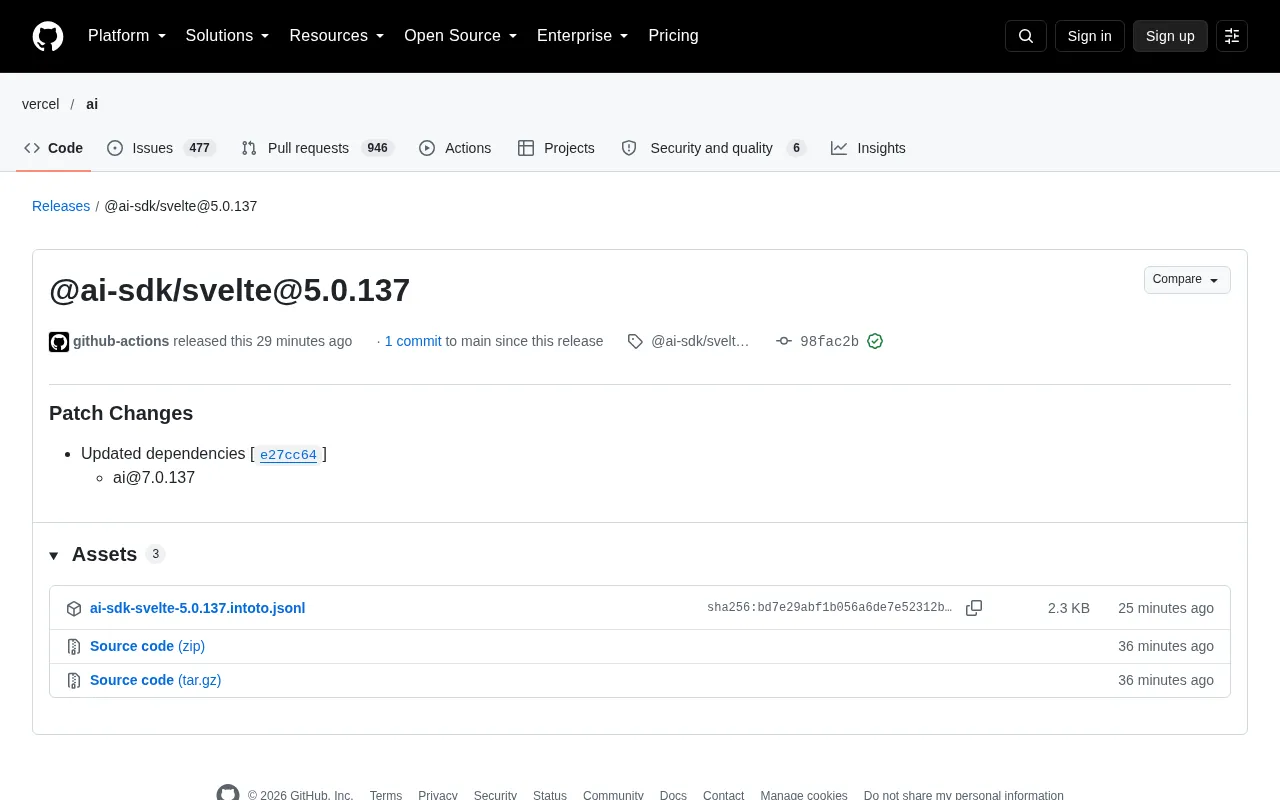
@ai-sdk/svelte 5.0.137 is a patch-level maintenance release for the Svelte framework adapter in the Vercel AI SDK ecosystem, automatically published by GitHub Actions with GPG signature verification for supply chain security. The only substantive change is upgrading the core dependency to `ai@7.0.137`, following the typical monorepo co-release pattern. For Svelte/SvelteKit developers, this update introduces no breaking changes and is safe to adopt — though it's advisable to review the core package changelog and run basic regression tests on streaming output logic.
Version Overview
@ai-sdk/svelte version 5.0.137 was automatically published by GitHub Actions, making it a typical patch-level update. Based on the release notes, the core change in this update is a dependency synchronization — no new features or breaking changes are included.
The release commit hash is 98fac2b, verified with GitHub's GPG signature (key ID: B5690EEEBB952194), ensuring the trustworthiness of the published artifact. For developers who care about supply chain security, this signature verification mechanism is worth noting.
What Changed
This release contains only one Patch Change:
- Dependency update [
e27cc64]:ai@7.0.137
In other words, @ai-sdk/svelte — the Svelte framework adapter within the Vercel AI SDK ecosystem — has been bumped in sync with the core package ai@7.0.137. This kind of version alignment is common in monorepo-managed SDK projects: once the core library releases, each framework adapter (React, Vue, Svelte, etc.) follows with its own release to stay compatible.
For developers who have already integrated this SDK into their projects, this means upgrading is relatively safe — patch versions typically don't introduce any API-level changes.
What is a Monorepo? A monorepo (single repository) is an architectural pattern where multiple related packages or projects are managed together in one codebase. The Vercel AI SDK uses this structure to centrally maintain the core
aipackage, framework adapters (@ai-sdk/react,@ai-sdk/svelte,@ai-sdk/vue, etc.), and utility packages. The main advantage is that when core logic changes, all adapter packages can be published atomically, avoiding version fragmentation and compatibility issues. Changesets is a popular version management tool in monorepos — developers attach a changeset file when submitting changes to describe the scope of impact, and the CI/CD pipeline uses this to automatically calculate the appropriate version bump (major/minor/patch) for each package before batch publishing. This explains why@ai-sdk/svelte's version number stays closely aligned with the coreaipackage — it's the natural result of coordinated monorepo publishing, not a coincidence.
What It Means for Svelte Developers
@ai-sdk/svelte provides a wrapper for integrating large language model capabilities into Svelte/SvelteKit projects, including streaming responses, conversation state management, and other common features. Keeping in sync with the core ai package helps ensure stability and consistency when using the latest features in a Svelte environment.
Recommendations for teams using this SDK:
- If you've pinned a specific version of
ai, upgrade the Svelte adapter to 5.0.137 at the same time to maintain alignment; - Check the Vercel AI SDK main repository changelog to understand what underlying changes
ai@7.0.137specifically includes; - Run basic regression tests after upgrading, especially for interaction logic involving streaming output.
What is Streaming Response? Streaming response is a key UX optimization technique in LLM applications. Since large models often take seconds or more to generate a complete answer, waiting for the full response before returning it would leave users staring at a blank screen. Streaming leverages HTTP chunked transfer encoding or Server-Sent Events (SSE) to push text fragments to the client as they are generated, creating a "typewriter effect."
@ai-sdk/sveltewraps this functionality with reactive stores or hooks, allowing Svelte components to bind to streaming output state declaratively — no need for developers to manually handle low-level stream reading, error retries, or state synchronization. This is also why regression testing streaming interaction logic after upgrading is important: streaming state management involves async timing and is the part most likely to be affected by underlying dependency changes.
Summary
5.0.137 is a low-risk maintenance release whose core value lies in aligning with the ai@7.0.137 dependency. It doesn't change how developers use the SDK, but it reflects the ongoing maintenance cadence of the AI SDK ecosystem across multiple framework integrations. For production projects that prioritize stable dependencies, this kind of small, incremental patch update is actually a welcome sign.
Related articles

AI Comic Drama with WorkBuddy from Scratch: A Step-by-Step Skill Pack Installation Guide
Learn how to create AI comic dramas with WorkBuddy from scratch. This guide covers installation, Skill pack import and invocation, plus a script generation demo with manual revision tips to get you through the first step from script to storyboard.

WorkBuddy Agent Runs the Entire GEO Database Mining Pipeline with a Single Prompt
WorkBuddy agent automates GEO database mining: from data search and curation to batch correction, differential analysis, co-expression networks, feature gene screening, and immune infiltration—a single prompt generates a complete bioinformatics report, greatly lowering the barrier to bioinformatics analysis.

PC Memory Wasted? Hacker News Debates Centralized Data Centers
Hacker News users argue that personal computer memory is wasted and should be centralized in data centers, sparking debate on centralized vs. distributed computing resource allocation. This article analyzes the logic behind the claim, the costs of centralization, and new tensions in memory resource allocation in the AI era.