AI SDK Tool bash 1.0.20 Release Update Analysis
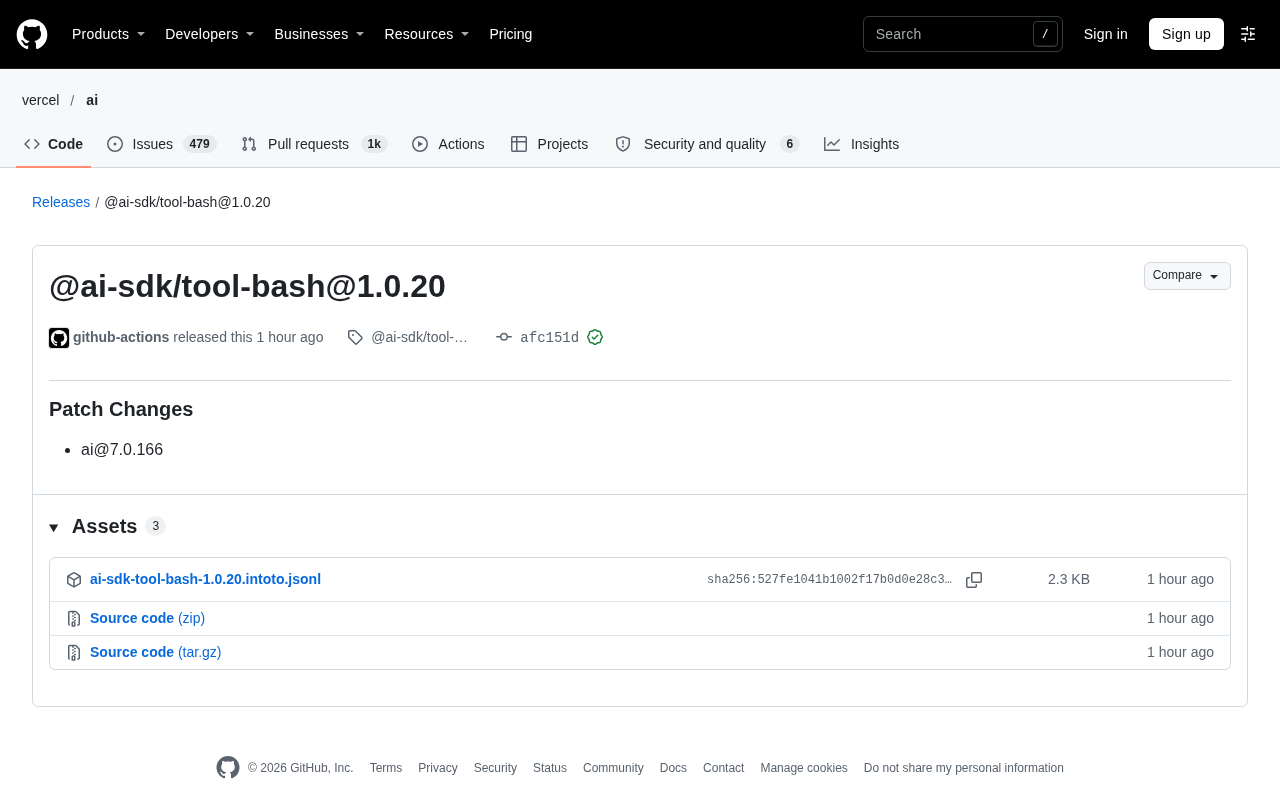
@ai-sdk/tool-bash releases patch 1.0.20, linked with ai@7.0.166.
The @ai-sdk/tool-bash package in the AI SDK ecosystem has released version 1.0.20, a patch update containing only Patch Changes, with the release notes referencing the core package ai@7.0.166. A patch version increment typically means bug fixes or minor adjustments rather than new features, carrying relatively low risk. The article notes that the AI SDK uses a modular design with version linkage between toolkits and the core ai package, and developers should check that both versions match when upgrading to avoid runtime issues. This version was automatically released via GitHub Actions with GPG signature verification, providing a certain level of security and traceability. Since the release notes do not list specific fix details, it is recommended to check the repository's commit history or related issues before upgrading to confirm the scope of impact.
The @ai-sdk/tool-bash package in the AI SDK ecosystem has released version 1.0.20, a patch update. According to the GitHub release notes, this update is primarily a patch change and is associated with version ai@7.0.166.
What a Patch Change Means
An increment in the patch version number (the third digit) typically indicates that known issues have been fixed or minor adjustments made, rather than the introduction of new features. Version 1.0.20 of @ai-sdk/tool-bash falls into this category. The release notes only mention "Patch Changes" and reference ai@7.0.166, indicating a version linkage between this toolkit and the core ai package.
For developers building applications with the AI SDK, such updates usually require attention to whether they affect the behavior of existing tool calls. Although patch updates generally carry low risk, it is still advisable to verify in a test environment before upgrading in production.
The Semantic Versioning (SemVer) specification defines version numbers as MAJOR.MINOR.PATCH: the major version increments for incompatible API changes, the minor version for backward-compatible new features, and the patch number only for backward-compatible bug fixes. Therefore, the last digit changing from 19 to 20 in 1.0.20 should, by convention, not include breaking changes or new APIs. It is worth noting that SemVer is a community convention rather than a mandatory constraint; especially for packages in the 0.x stage, maintainers often place breaking changes in the minor version. For a package like @ai-sdk/tool-bash that is in the 1.x range, patch upgrades can theoretically be considered safe, but the actual impact should still be judged by reviewing the changelog and commit history.
Version Linkage with the Core ai Package
The release notes reference ai@7.0.166, suggesting that this release of @ai-sdk/tool-bash may have been synchronized with a fix or adjustment in the core ai package. The AI SDK adopts a modular design, and version compatibility between toolkits and the core package is particularly important for developers.
When a toolkit releases a patch, it often means that its dependent core package has also undergone corresponding changes. When upgrading @ai-sdk/tool-bash, developers should check whether the version of the ai package in their project matches, to avoid runtime issues caused by version inconsistency.
The AI SDK uses a monorepo with coordinated multi-package releases: the core ai package defines the common interfaces for language model invocation, streaming responses, and tool calls, while toolkits like @ai-sdk/tool-bash encapsulate specific capabilities (such as executing shell commands) into tools that conform to that interface. The two are coupled through shared type definitions and runtime protocols, and toolkits typically declare their dependency on the core package via peer dependencies or fixed version ranges. Therefore, when the core package adjusts the parameter structure or return value format of tool calls, toolkits often need to release synchronously to stay consistent. This is also why ai@7.0.166 appears in the release notes—it identifies the core package version against which this toolkit build and testing were aligned.
How to Get the Update
This version was automatically released via GitHub Actions, with the commit carrying GPG signature verification, indicating that the release process has a certain level of security and traceability. Developers can install the latest version via package managers such as npm or pnpm.
Since the release notes are relatively brief and do not list specific fixes or change details, developers are advised to check the repository's commit history or related issues before upgrading to understand the specific scope of impact of this patch.
GPG signature verification is a common security measure in open-source release pipelines: maintainers sign commits or tags with a private key, and users can verify the authenticity of the source and the integrity of the content using the public key, preventing packages from being tampered with or falsely published. Automated release via GitHub Actions means that version number increments, building, packaging, and pushing to npm are all handled by the CI pipeline, typically using tools like changesets that automatically determine the version level and generate release notes based on merged change descriptions. This process reduces human error, but also explains why release notes may be brief—their content is mostly automatically aggregated from changed files, and details still need to be found in the repository's commit and PR records.
Summary
@ai-sdk/tool-bash@1.0.20 is a routine patch update, primarily involving version coordination with ai@7.0.166. For developers using the AI SDK toolchain, keeping the toolkit and core package versions consistent is key to stable operation.
Related articles

Seven Years of Evolution: How Far Has the Foldable Come From the First Generation?
From the first foldable to today's latest models, what has seven years changed? Shallower creases, higher brightness, thinner bodies, and smoother software migration—has the foldable crossed the chasm from enthusiasts to ordinary users? This article discusses the question based on a video comparison.

When Did Humans Start Eating Salt? A 10,000-Year History of Salt
When did humans start eating salt? From salt use at the dawn of agriculture 11,000 years ago to ancient seawater evaporation and rock salt mining, and on to the salt trade, salt taxes, and Gandhi's Salt March, this article traces salt's key role in human civilization.
Microsoft Paza Research: How African Language Speech Recognition Breaks Through Architecture and Data Bottlenecks
Microsoft's Paza research evaluates 53 speech models across 39 African languages, revealing architecture choice matters more than pre-training coverage, 200-300 hours is the practical data threshold, and language typology deeply influences recognition performance.