AI SDK Topaz 2.0.6 Patch Release: Dependency Update Analysis
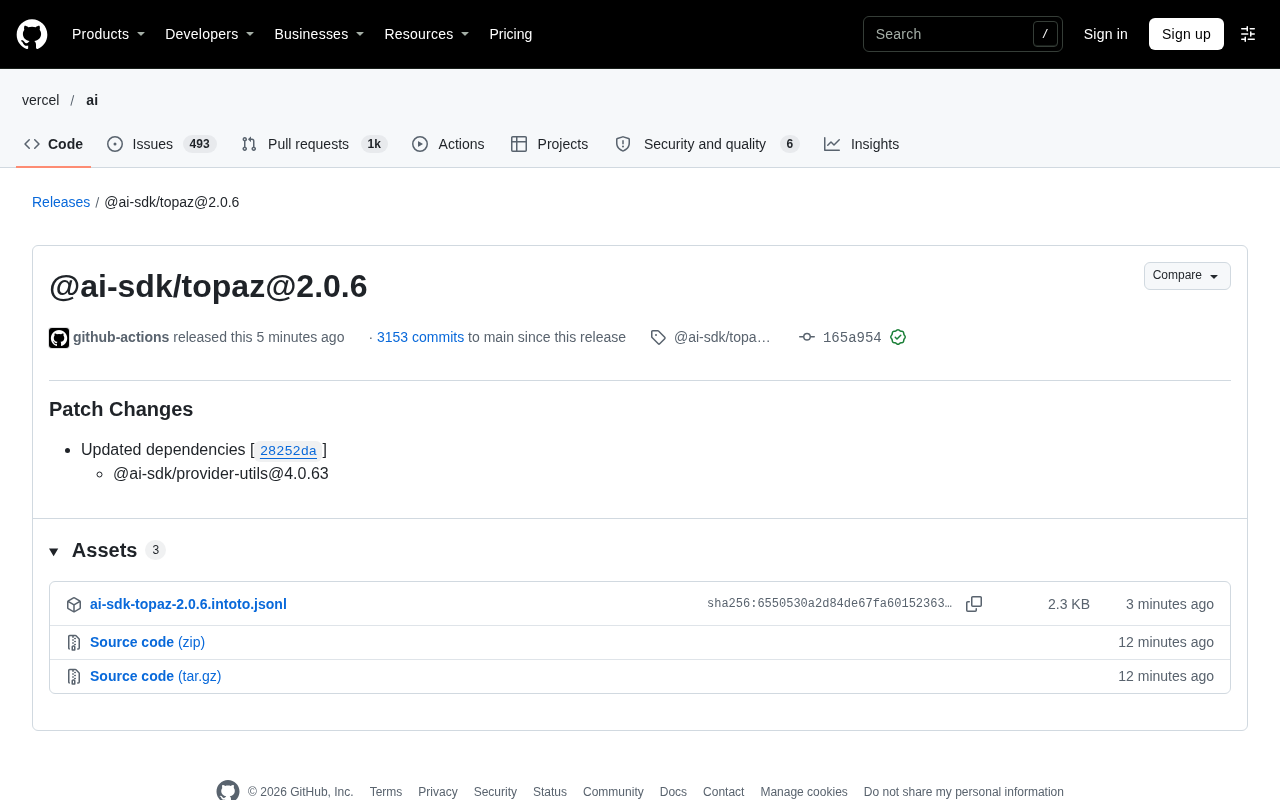
@ai-sdk/topaz 2.0.6 is a patch update that only bumps the provider-utils dependency to 4.0.63.
@ai-sdk/topaz released version 2.0.6, a typical patch-level update whose only core change is updating the dependency @ai-sdk/provider-utils to 4.0.63. It was auto-published by GitHub Actions with a verified GPG signature, associated with commit 28252da, making the release process traceable. The article notes that provider-utils handles the foundational utility responsibilities of the provider adapter layer, and its patches typically include bug fixes, edge-case handling, and minor type adjustments — not changing the API surface but possibly affecting runtime behavior consistency. Ordinary users can upgrade smoothly without modifying business code; projects that strictly pin the dependency tree should first check the provider-utils changelog. The article also mentions 3153 commits accumulated on the main branch since the previous version, reflecting the project's high-frequency iteration.
The AI SDK ecosystem moves fast, and even patch releases often affect the stability of downstream dependency chains. Recently, @ai-sdk/topaz released version 2.0.6 — a typical patch-level update whose core change is concentrated in its dependencies.
Patch Contents: A Chain of Dependency Version Updates
According to the release notes on GitHub, the changelog for @ai-sdk/topaz@2.0.6 is very brief — just one Patch Changes entry: an update to the @ai-sdk/provider-utils dependency, bumped to version 4.0.63. The commit history shows this update was performed automatically by GitHub Actions, with the associated commit being 28252da.
This kind of automated dependency bump is already quite common in the AI SDK release process. It means the upstream package @ai-sdk/provider-utils has published a new patch version, and topaz as a downstream package follows suit to ensure consumers get the latest utility function implementations when installing.
Why Dependency Updates Deserve Attention
For developers who use @ai-sdk/topaz directly, patch-level dependency updates usually don't introduce breaking changes, but they're still worth noting. @ai-sdk/provider-utils handles the foundational utility responsibilities of the provider adapter layer, and its patch versions often include bug fixes, edge-case handling, or minor type definition adjustments. These changes don't alter the API surface but may affect runtime behavior consistency.
Judging from the version number 4.0.63, this utility package has gone through a large number of patch iterations and is maintained at a high frequency. For projects that pin dependency versions in production environments, it's advisable to check the corresponding changelog of provider-utils before upgrading to confirm there are no behavior changes relevant to your use case.
Semantic Versioning and Patch-Level Updates
The patch-level update mentioned in the original text corresponds to the third number in Semantic Versioning (SemVer). SemVer represents version numbers as major.minor.patch, where an increment in the patch position indicates only backward-compatible bug fixes — no new features and no changes to the public API. @ai-sdk/topaz jumping from 2.0.x to 2.0.6 means the package's own source code is essentially untouched; the changes mainly come from the dependency graph. Note that SemVer's compatibility promise only constrains the package's own API surface and does not cover the transitive effects of its dependency upgrades — which is precisely why the original text reminds projects that pin dependencies to check the provider-utils changelog.
Dependency Bumps and Lockfiles
A dependency bump refers to raising the version range or exact version of a dependency in package.json, typically initiated automatically by Dependabot, Renovate, or a repository's own GitHub Actions workflow. An automated bump only modifies the declaration file; which version is actually installed is still determined by the lockfile (package-lock.json, pnpm-lock.yaml, yarn.lock). So for consumers, whether you actually get provider-utils@4.0.63 depends on whether your own lockfile gets updated. If you use a range declaration like ^4.0.0, a reinstall may passively upgrade you; if you pin an exact version, you'll need to explicitly run an update command. This is also the mechanical background behind the original text's emphasis on projects that "strictly pin the dependency tree" needing extra attention.
Provider Adapter Layer and Utility Function Packages
In the AI SDK's layered design, a provider refers to the adapter implementation for a specific model service vendor, unifying each vendor's different request formats, authentication methods, and streaming protocols into the SDK's internal standard interface. @ai-sdk/provider-utils is the shared low-level toolbox for these adapters, typically carrying common logic such as streaming response parsing, SSE event handling, JSON schema validation, error normalization, and AbortSignal propagation. Because it's reused by all provider packages, a single patch can simultaneously affect the behavior of multiple downstream packages. So when reading this package's changelog, pay particular attention to entries related to stream interruption, retries, timeouts, and type narrowing — these are the areas patch versions most easily touch and where problems most easily surface in edge-case scenarios.
The Automation Signal in the Release Process
This release was published by the github-actions bot with a verified GPG signature, and the commit history shows 3153 commits accumulated on the main branch since the previous version. This number itself reflects the overall activity of the repository rather than the change volume of a single package, but it indirectly indicates that the AI SDK project is in a state of high-frequency iteration.
Automated releases combined with signature verification are a mature practice in today's open-source infrastructure. For users, this means version provenance is trustworthy and the release process is traceable, reducing supply chain risk.
GPG Signatures and Supply Chain Trustworthiness
Git's GPG signing is a cryptographic signature over a commit or tag; successful verification means the commit was indeed produced by the party holding the corresponding private key and that the content has not been tampered with since signing. GitHub displays a badge in the UI for verified signatures, and the npm ecosystem also has provenance and signing mechanisms to prove a package was produced from a specific repository and pipeline. Combined, these turn "who released this version and in what environment" into a verifiable fact rather than a matter of trust. For automated releases, the private key is usually stored in CI secrets and used by GitHub Actions to sign at release time, so a valid signature also indirectly proves the release went through the established pipeline rather than being manually packaged locally — which is the substantive meaning of the original text's claim of reducing supply chain risk.
Upgrade Recommendations
If you use @ai-sdk/topaz in your project, 2.0.6 is a patch version you can upgrade to smoothly. Just run your normal dependency update — no need to modify business code. If your project strictly pins the dependency tree, focus on the differences in @ai-sdk/provider-utils between the old version and 4.0.63.
For teams that haven't yet adopted this package but are evaluating the AI SDK toolchain, this kind of high-frequency minor-version release cadence is a reality check: AI infrastructure is still evolving rapidly, and dependency management strategies need to leave enough flexibility.
Related articles

DeepSeek Harness: A Beginner's Installation and Testing Guide
A DeepSeek Harness tutorial for test engineers: set up Node.js, launch with one NPX command, configure official and third-party models, and explore web search, file I/O, and trace-view agent observability.
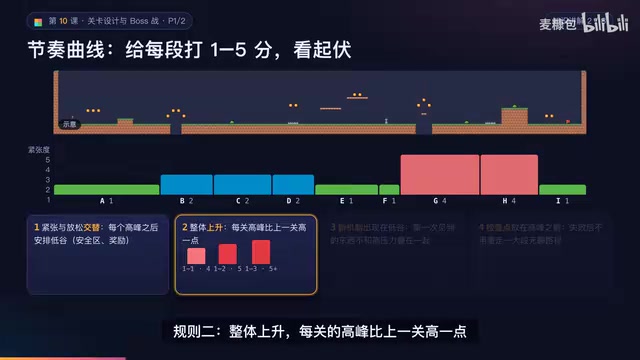
AI Game Development in Practice: Designing Levels with the Four-Step Method and Pacing Curves
AI game development lesson 10: design levels with the four-step method (teach, practice, combine, test) and a 1-5 pacing curve, plus sightline guidance and safety zones—implement Animatable Body 2D moving platforms and generate ASCII sketches for 1-2 Underground Cavern and 1-3 Guard Hall.

AI Game Development in Practice: Two-Phase Boss State Machines and Death Heatmap Tuning
AI game development lesson 10: implement a two-phase Boss with a state machine, guarantee fairness with color signals and a 0.4-second warning floor, locate difficulty cliffs with a death heatmap, and apply lightest-to-heaviest fixes one at a time, with an acceptance checklist and common pitfalls.