@ai-sdk/typesafe-ai 3.0.31 Released: Async Credential Resolution Takes the Spotlight

@ai-sdk/typesafe-ai 3.0.31 supports async credential resolution for greater multi-tenant flexibility.
@ai-sdk/typesafe-ai has released patch version 3.0.31. The core change is that credential configuration now supports Promise and synchronous/asynchronous callbacks and resolves credentials per request while preserving existing authentication behavior and synchronous serialization. Developers can dynamically fetch keys from remote key management services, databases, or multi-tenant configuration centers without hardcoding them at initialization. The experimental OpenAI Live module's getServerWebSocketConfig() is now asynchronously resolvable and requires await, an implicit breaking change. The update also upgrades @ai-sdk/provider-utils to 5.0.72 and @ai-sdk/provider to 4.0.35 to keep the type-safe wrapper aligned with the abstraction layer. This version is more practical for dynamic credential scenarios such as multi-tenancy and key rotation; static credential users face low upgrade risk.
Vercel's AI SDK ecosystem has seen another minor version iteration. @ai-sdk/typesafe-ai has released patch version 3.0.31. Although the version number change is small, the changelog shows that this update touches the core mechanism of credential management, which is significant for scenarios requiring multi-tenancy or dynamic keys.
Small Patch, but Credential Resolution Logic Has Changed
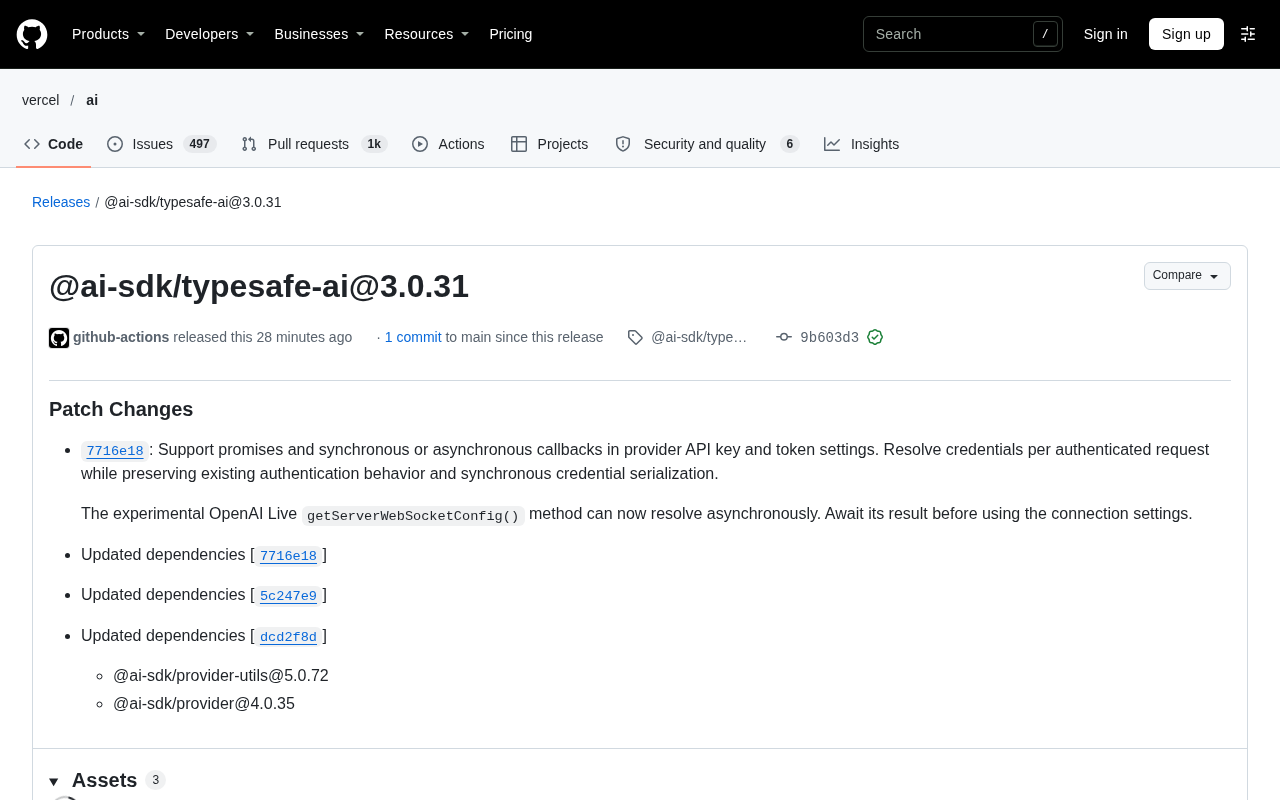
According to the release records on GitHub, 3.0.31 is a patch-level update, released by the github-actions bot on October 30, associated with one commit and carrying a GPG-verified signature. The version is positioned as a patch fix, but the actual changes go beyond the scope of a regular bugfix.
The core change is concentrated in commit 7716e18: the provider's API key and token configuration now support Promise, as well as synchronous or asynchronous callback functions. More importantly, credentials are now resolved per authenticated request, while preserving the original authentication behavior and synchronous credential serialization capability.
This means developers can make key retrieval logic asynchronous—for example, dynamically fetching keys from a remote key management service, database, or multi-tenant configuration center—without hardcoding credentials at initialization time. For AI applications that need to distinguish keys by user or by session, this is a tangible experience improvement.
Asynchronous WebSocket Configuration
The same commit also adjusts the experimental OpenAI Live module. The getServerWebSocketConfig() method can now be resolved asynchronously, and the official guidance notes that callers need to await its result before using the connection settings. This is a behavioral change, and projects relying on this experimental API need to modify their invocation accordingly.
Dependency Chain Upgraded in Sync
This release also updates three underlying dependencies: @ai-sdk/provider-utils to 5.0.72, @ai-sdk/provider to 4.0.35, and another dependency update introduced by commits 5c247e9 and dcd2f8d. This kind of bundled upgrade is common in the AI SDK's layered architecture—typesafe-ai, as the type-safe wrapper layer, needs to stay version-aligned with the provider abstraction layer.
From an engineering perspective, keeping dependencies in sync reduces type errors caused by version mismatches. Especially in TypeScript projects, version drift in provider-utils often leads to hard-to-locate type inference issues.
@ai-sdk/provider is the abstraction layer in Vercel AI SDK that defines a unified interface for model providers. It specifies the standardized methods that language models, embedding models, and others need to implement, enabling models from different vendors to be called in a consistent way. @ai-sdk/provider-utils provides commonly used utility functions and type definitions for building these providers, such as streaming response handling, error wrapping, and request validation. typesafe-ai, as the type-safe wrapper layer, depends on the interfaces and utilities provided by these two packages. When the provider abstraction layer is updated, the wrapper layer needs to be upgraded in sync to maintain type compatibility and avoid type errors or inconsistent runtime behavior caused by interface changes.
Practical Impact on Developers
The value of this update is not in the number of new features, but in the fact that it acknowledges a reality: credentials are not always static. Cloud deployment, key rotation, and multi-tenant SaaS are all common scenarios. Pushing credential resolution down to the request level and allowing asynchronous retrieval makes typesafe-ai closer to production requirements in the authentication chain.
One thing to note is the backward compatibility wording—the log explicitly states that existing authentication behavior and synchronous serialization are preserved, so existing synchronous usage should theoretically be unaffected. However, the OpenAI Live WebSocket configuration now possibly requiring await is an implicit breaking change, and users of the experimental API should check it first.
As a patch release, the scope of changes in 3.0.31 is clear and the intent is explicit. If your project is handling dynamic keys or planning to integrate asynchronous key sources, this version is worth following up on; if you only use static credentials in the usual way, the upgrade risk is low, but it is still recommended to run authentication-related tests.
In a multi-tenant SaaS architecture, each tenant usually has its own API key or credentials, which may be stored in a database, configuration center, or key management service (such as HashiCorp Vault or AWS Secrets Manager). The traditional approach is to load all tenants' keys into memory at application startup, but this can cause memory pressure when the number of tenants is large, and key rotation requires restarting the service. Per-request credential resolution allows keys to be dynamically obtained based on tenant identity on each request, enabling lazy loading and real-time updates of keys. Key rotation refers to the security practice of periodically changing keys to reduce the risk of leakage. Dynamic resolution makes rotation possible without downtime, as new requests automatically use the new key.
One-line Summary
@ai-sdk/typesafe-ai 3.0.31 supports asynchronous credential resolution, improving flexibility in multi-tenant scenarios.
Paragraph Summary
@ai-sdk/typesafe-ai has released patch version 3.0.31. The core change is that credential configuration now supports Promise and synchronous/asynchronous callbacks, and credentials are resolved per request, while preserving the original authentication behavior and synchronous serialization capability. This allows developers to dynamically obtain keys from remote key management services, databases, or multi-tenant configuration centers without hardcoding them at initialization. In addition, the experimental OpenAI Live module's getServerWebSocketConfig() method is now asynchronously resolvable and must be awaited before use, which is an implicit breaking change. This update also upgrades @ai-sdk/provider-utils to 5.0.72 and @ai-sdk/provider to 4.0.35 in sync to keep the type-safe wrapper layer aligned with the abstraction layer. This version is more practical for dynamic credential scenarios such as multi-tenancy and key rotation; for static credential users, the upgrade risk is low.
Related articles

AI Comic Drama with WorkBuddy from Scratch: A Step-by-Step Skill Pack Installation Guide
Learn how to create AI comic dramas with WorkBuddy from scratch. This guide covers installation, Skill pack import and invocation, plus a script generation demo with manual revision tips to get you through the first step from script to storyboard.

WorkBuddy Agent Runs the Entire GEO Database Mining Pipeline with a Single Prompt
WorkBuddy agent automates GEO database mining: from data search and curation to batch correction, differential analysis, co-expression networks, feature gene screening, and immune infiltration—a single prompt generates a complete bioinformatics report, greatly lowering the barrier to bioinformatics analysis.

PC Memory Wasted? Hacker News Debates Centralized Data Centers
Hacker News users argue that personal computer memory is wasted and should be centralized in data centers, sparking debate on centralized vs. distributed computing resource allocation. This article analyzes the logic behind the claim, the costs of centralization, and new tensions in memory resource allocation in the AI era.