@ai-sdk/valibot 3.0.69 Released: AI SDK Dependency Update and Ecosystem Coordination

@ai-sdk/valibot 3.0.69 patch released, synchronously upgrading provider-utils to 5.0.69.
@ai-sdk/valibot in the Vercel AI SDK ecosystem has released patch version 3.0.69, with the only change being the upgrade of the shared dependency @ai-sdk/provider-utils to 5.0.69, with no new APIs or behavioral changes. The article notes that this kind of "follow-up release" is common in monorepo projects, aiming to ensure that downstream users install a verified dependency combination and avoid type mismatches or serialization anomalies caused by version drift. As an adapter for the Valibot validation library, @ai-sdk/valibot embodies AI SDK's design philosophy of decoupling and modularity. The aligned trailing version numbers reflect a coordinated release strategy that makes dependency conflicts easier to troubleshoot. Direct dependents can safely follow the patch upgrade, indirect dependents should wait for upstream declarations, and attention should be paid to the uniqueness of shared dependencies in the lockfile.
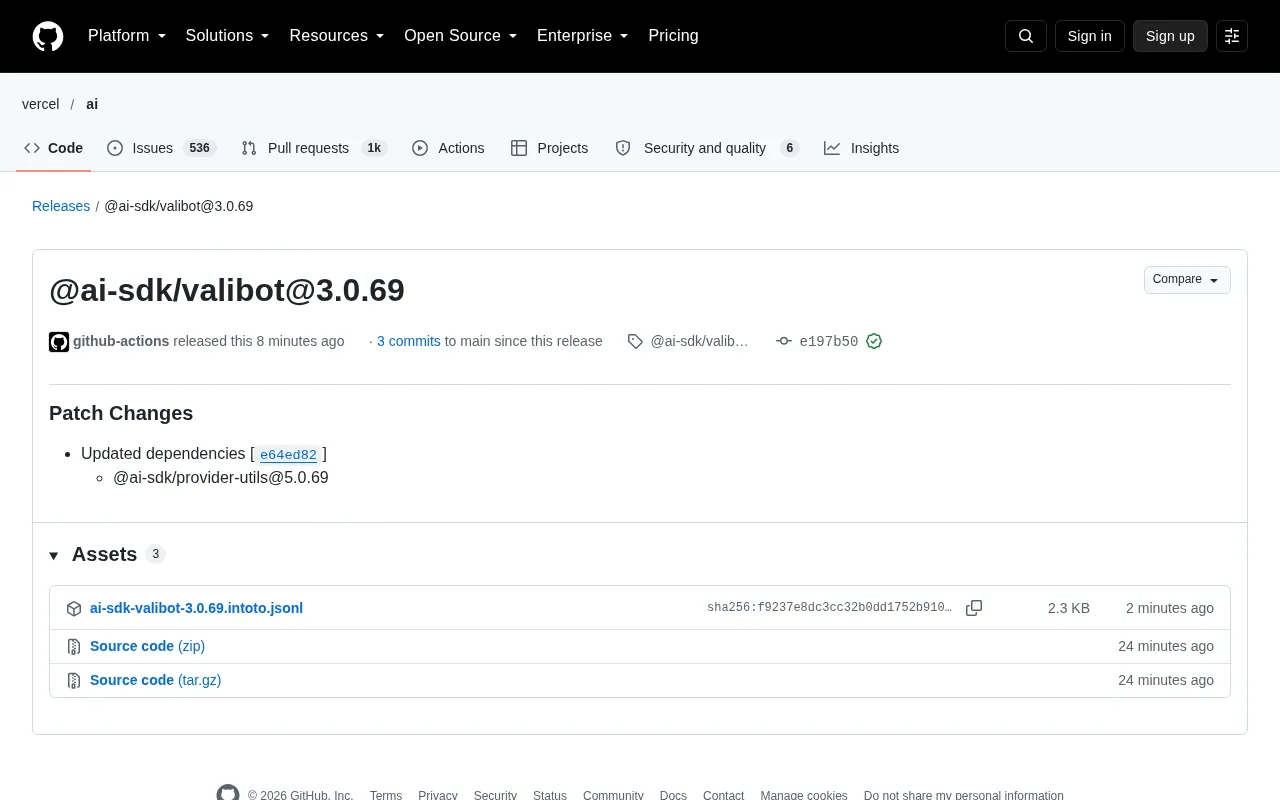
Vercel's AI SDK ecosystem has once again received a fine-grained update. @ai-sdk/valibot@3.0.69 has been released as a patch version (Patch Changes), and its core action is synchronously upgrading its dependency on @ai-sdk/provider-utils to version 5.0.69. For developers unfamiliar with the modular architecture of AI SDK, this may appear to be just a routine version number increment, but within the entire dependency chain of AI application development, it reflects the toolchain maintainers' ongoing commitment to compatibility and stability.
What exactly changed in this update
According to the record on the GitHub Releases page, this version was automatically published by the github-actions bot, is associated with a single commit (e197b50), and carries a verified GitHub signature (GPG key ID: B5690EEEBB952194). The changelog explicitly lists only one item: Updated dependencies, upgrading @ai-sdk/provider-utils to 5.0.69.
In other words, @ai-sdk/valibot itself introduces no new APIs or behavioral changes; it follows the release cadence of the underlying utility package. This kind of "follow-up release" is very common in open source projects managed as monorepos: when shared dependencies are fixed or adjusted, upper-layer adapter packages need to declare the new version synchronously to ensure that the dependency combination installed in users' projects has been verified.
Why patch versions are also worth paying attention to
Patch versions are usually ignored by developers, but in a rapidly iterating ecosystem like AI SDK, dependency misalignment is often the source of runtime errors. As the shared foundation layer for multiple AI provider adapters, provider-utils can cause hidden problems such as mismatched type definitions and abnormal serialization of request parameters once version drift occurs. Publishing synchronized versions in a timely manner is, in effect, the maintainers clearing away a class of "avoidable" failures for downstream users.
Semantic Versioning (SemVer) divides version numbers into three parts: major.minor.patch, and an increment in the patch number usually indicates a backward-compatible bug fix. However, in the JavaScript ecosystem based on monorepos, even if the adapter package's own code has not changed, as long as a shared dependency is upgraded, a new patch number still needs to be released to update the dependency range it declares. This is because npm's dependency resolution is based on the semver range declared by each package individually; if the upper-layer package does not publish a release, downstream users may remain locked to the old shared dependency for a long time. Therefore, a patch release that "only updates dependencies" is not formalism, but a standard means of pushing the dependency combination verified by maintainers to users.
Where @ai-sdk/valibot fits in AI SDK
Valibot is a lightweight, tree-shakable schema validation library, often compared with Zod. The existence of @ai-sdk/valibot means that developers building applications with AI SDK can choose Valibot as the validation layer in scenarios such as tool calling and structured output, without being bound to a single validation library.
The value of this adapter pattern lies in decoupling: AI SDK handles model invocation and streaming, the validation library handles data shape constraints, and the two are combined through independent packages. When the validation library or the underlying utility package is updated, the adapter package is released separately, and users upgrade as needed without being forced into a full migration. The release of 3.0.69 is a routine manifestation of this design philosophy.
Tool calling refers to the model outputting structured function call requests when generating responses. The application side must parse these requests and validate parameters according to a predefined schema before they can be safely executed. Structured output requires the model to return data that conforms to a specific JSON Schema. Both rely on runtime validation libraries to ensure correct data shapes, and AI SDK abstracts the validation library into a replaceable layer through adapter packages—Zod, Valibot, and others each have their own adapter and share the same calling interface. This makes the choice of validation library a pure implementation detail that does not affect model invocation and streaming logic.
Reading the maintenance cadence from version numbers
A small detail: the version number of this package has reached 3.0.69, while provider-utils is at 5.0.69. The matching trailing numbers are not a coincidence, but the result of a version alignment strategy in the release process. This alignment reduces the cognitive cost for users when troubleshooting dependency conflicts: seeing that the trailing numbers match is basically enough to conclude that this is a coordinated release.
For teams using pnpm or npm, it is recommended to also check the resolved version of @ai-sdk/provider-utils in the lockfile when upgrading, to ensure that multiple copies do not coexist. If the project also uses other AI SDK adapters (for example, packages for different providers), it is even more important to upgrade them uniformly to the same batch of versions to avoid fragmentation of shared dependencies.
Practical advice for developers
This update does not involve breaking changes and falls within the range that can be safely followed. If your project directly depends on @ai-sdk/valibot, a routine patch upgrade is sufficient; if it is only an indirect dependency, no proactive intervention is needed—it will take effect naturally after the upstream package declares the new version.
What really deserves attention is the reliability of the release channel. In the screenshot, the GitHub Releases page shows a resource loading error ("There was an error while loading"). This is a page rendering issue and does not affect the fact that the package itself has already been published to npm. Developers should rely on the actual version in the npm registry rather than the display status of the release page.
Conclusion
@ai-sdk/valibot@3.0.69 is a typical ecosystem-coordination patch release: no new features, yet it keeps the dependency chain tidy. For applications built on top of AI SDK, such seemingly unremarkable version updates are precisely the cornerstone of long-term maintainability.
Related articles

Last Week Tonight Exposé: The Dangerous Ties Between Politicians and White Supremacy
Last Week Tonight investigates Georgia Senate candidate Mike Collins and Florida candidate Marshall Rawson, exposing their multiple ties to white supremacists and the Republican Party's silent response.
AI Buzz Weekly: GPT-6.5 Leak, New Claude Model, and MiniMax's Cost-Effectiveness
This week's AI buzz roundup: suspected GPT-6.5 leak, Microsoft configs showing GPT-6.1 Tera, Anthropic's new model that can identify entire classes of bugs, disappointing early Gemini 4 Carbon results, and MiniMax M3.1 Flash beating Claude Opus 5 and GPT-5.6 Sol in benchmarks at extremely low cost.

AI Briefing: Gemini 4 Carbon Released, Ant Open-Sources Ling-3.1
AI Briefing: Google releases Gemini 4 Carbon qubit model, claiming to surpass Opus 5.5 with half-price tokens; Ant open-sources Ling-3.1-1019 for real-task Personal Agents; domestic AI drug discovery succeeds in 18 of 19 projects, hitting all 6 GPCR targets; zero-revenue company valued at $20B raises another $1B; Sichuan convenience store robot sales fail.