@ai-sdk/voyage@2.0.57 Released: A Dependency-Update Patch Version
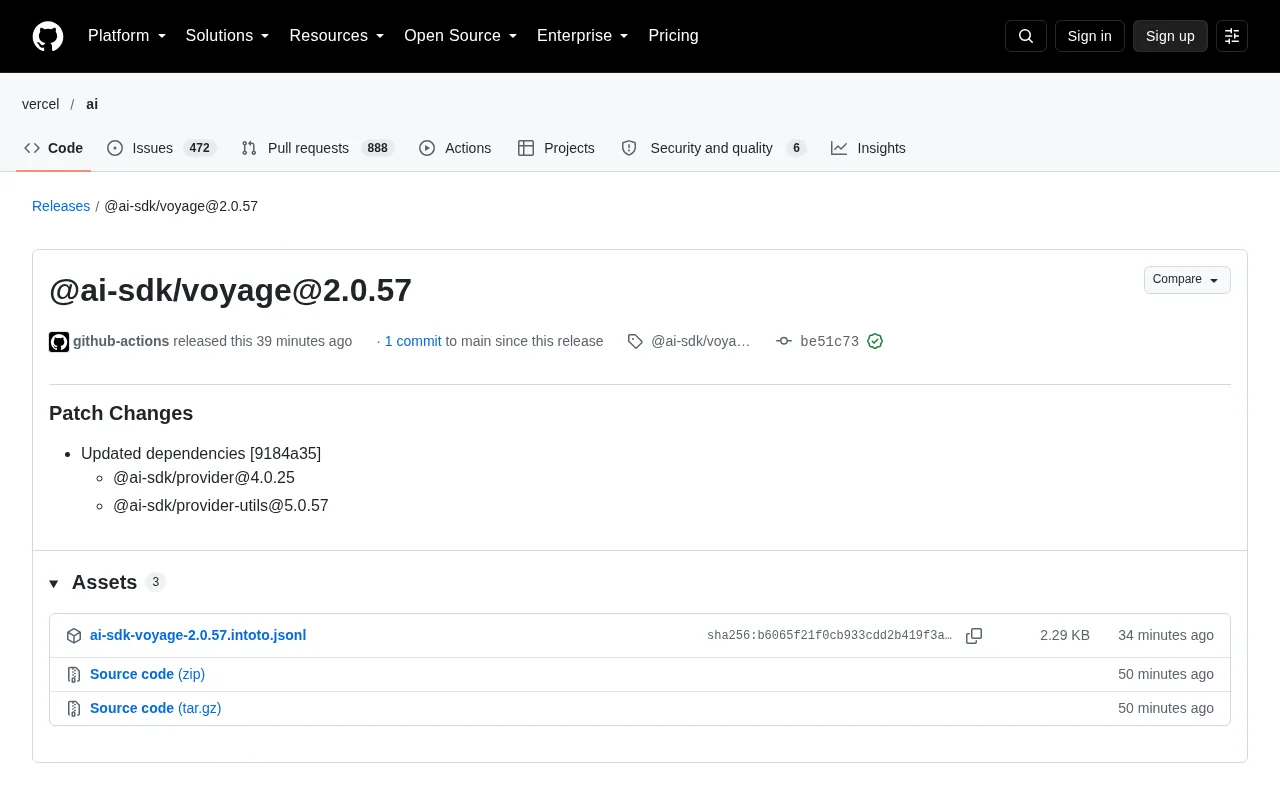
@ai-sdk/voyage 2.0.57 patch release syncs underlying dependencies with no functional changes.
@ai-sdk/voyage@2.0.57 is a purely dependency-driven patch release, upgrading `@ai-sdk/provider` to 4.0.25 and `@ai-sdk/provider-utils` to 5.0.57 with no new features or breaking changes. This package is the adapter layer in Vercel's AI SDK for integrating Voyage AI embedding models. The release was automatically triggered by GitHub Actions, verified with a signature, and represents routine provider package versioning within a monorepo architecture. It's a safe upgrade — update on your normal schedule and run integration tests afterward to confirm embedding behavior is unaffected.
The Voyage provider package in the AI SDK ecosystem has released @ai-sdk/voyage@2.0.57. This is a patch-level update focused on internal dependency upgrades, with no new developer-facing features or breaking changes.
What's in This Update
According to the release notes, the core change in this version is a dependency update (Updated dependencies [9184a35]), specifically affecting two underlying packages:
@ai-sdk/provider@4.0.25@ai-sdk/provider-utils@5.0.57
This type of patch release is typically triggered and published automatically by CI pipelines. The release record shows it was executed by github-actions with a verified GitHub signature, ensuring the integrity and trustworthiness of the release process.
What This Means
@ai-sdk/voyage is the provider adapter package in the AI SDK used to integrate Voyage AI embedding models. It relies on the unified interface spec defined by @ai-sdk/provider and the utility functions provided by @ai-sdk/provider-utils. When these two underlying packages are updated, the higher-level provider packages (including voyage) publish new patch versions to keep the dependency tree in sync.
For most users, this kind of update qualifies as a "safe upgrade" — it doesn't change how you call the embedding API, but it helps you pick up underlying fixes, compatibility improvements, or utility-layer optimizations.
Do You Need to Upgrade Immediately?
Patch versions follow Semantic Versioning (SemVer) conventions and are theoretically backward-compatible. If your project uses Voyage embedding functionality, you can update on your usual dependency maintenance schedule. If you prefer extra stability, waiting for the next minor version cycle before upgrading in bulk is also perfectly fine. It's recommended to run integration tests after upgrading to confirm that embedding call results behave as expected.
Voyage AI is an AI company specializing in embedding models, with strong performance in text retrieval, semantic similarity computation, and RAG (Retrieval-Augmented Generation) use cases. Embedding models convert text into high-dimensional vectors so that semantically similar texts are closer together in vector space, enabling similarity search. @ai-sdk/voyage serves as an adapter layer that wraps Voyage's API into a form that conforms to the AI SDK's unified interface spec, allowing developers to use Voyage's embedding models (such as voyage-3, voyage-3-lite, etc.) through a standardized API without worrying about the underlying HTTP request details.
About AI SDK's Release Cadence
The version numbers reveal that AI SDK's provider packages maintain a high-frequency, incremental release cadence. provider is now at 4.0.x, provider-utils at 5.0.x, while voyage is independently maintained on the 2.0.x branch. This monorepo + independent versioning approach lets different providers evolve at their own pace while remaining unified through a shared provider interface.
For developers, understanding this dependency structure is useful for debugging: when a provider package exhibits unexpected behavior, you can often trace it back to changes in @ai-sdk/provider or @ai-sdk/provider-utils by following the dependency chain.
A monorepo is a project organization approach where multiple related packages are managed within a single code repository — Vercel's AI SDK uses this structure. Under this architecture, @ai-sdk/provider, @ai-sdk/provider-utils, and various provider adapter packages (such as voyage, openai, anthropic, etc.) share the same toolchain and CI pipeline, while each maintains its own independent semantic version number. When a foundational package (like provider-utils) publishes an update, all upstream packages that depend on it are triggered by automated scripts to release a patch version bump — which is exactly the typical trigger path for this @ai-sdk/voyage@2.0.57 release. This mechanism ensures ecosystem consistency while also resulting in a high release frequency. Developers can use ^ or ~ version range specifiers in package.json to balance automatically staying current versus maintaining stability.
Summary
This is a typical dependency-sync patch release — straightforward and focused: follow the underlying provider package upgrades. It contains no functional changes and is suitable to include as part of your routine dependency maintenance workflow.
Related articles

AI Comic Drama with WorkBuddy from Scratch: A Step-by-Step Skill Pack Installation Guide
Learn how to create AI comic dramas with WorkBuddy from scratch. This guide covers installation, Skill pack import and invocation, plus a script generation demo with manual revision tips to get you through the first step from script to storyboard.

WorkBuddy Agent Runs the Entire GEO Database Mining Pipeline with a Single Prompt
WorkBuddy agent automates GEO database mining: from data search and curation to batch correction, differential analysis, co-expression networks, feature gene screening, and immune infiltration—a single prompt generates a complete bioinformatics report, greatly lowering the barrier to bioinformatics analysis.

PC Memory Wasted? Hacker News Debates Centralized Data Centers
Hacker News users argue that personal computer memory is wasted and should be centralized in data centers, sparking debate on centralized vs. distributed computing resource allocation. This article analyzes the logic behind the claim, the costs of centralization, and new tensions in memory resource allocation in the AI era.