@ai-sdk/vue@2.0.272 Released: Dependency Sync Patch Update

Vercel AI SDK's Vue adapter releases v2.0.272, a patch sync with core package ai@5.0.272 — no API changes.
`@ai-sdk/vue@2.0.272` is a straightforward ecosystem-sync patch update, aligning with the core `ai@5.0.272` package without introducing any standalone API changes or new features. Published via GitHub Actions and verified with a GPG signature, the release ensures trustworthy artifacts. For Vue developers, this backward-compatible patch keeps composables like `useChat` in sync with the latest AI capabilities, preventing version-mismatch issues. It's recommended to also review the `ai` core changelog to understand what underlying improvements this update brings.
Release Overview
Vercel's AI SDK ecosystem continues to iterate at a steady pace, with the recent release of @ai-sdk/vue@2.0.272. This is a patch-level update focused on synchronizing dependency upgrades, targeting developers building AI applications with the Vue framework.
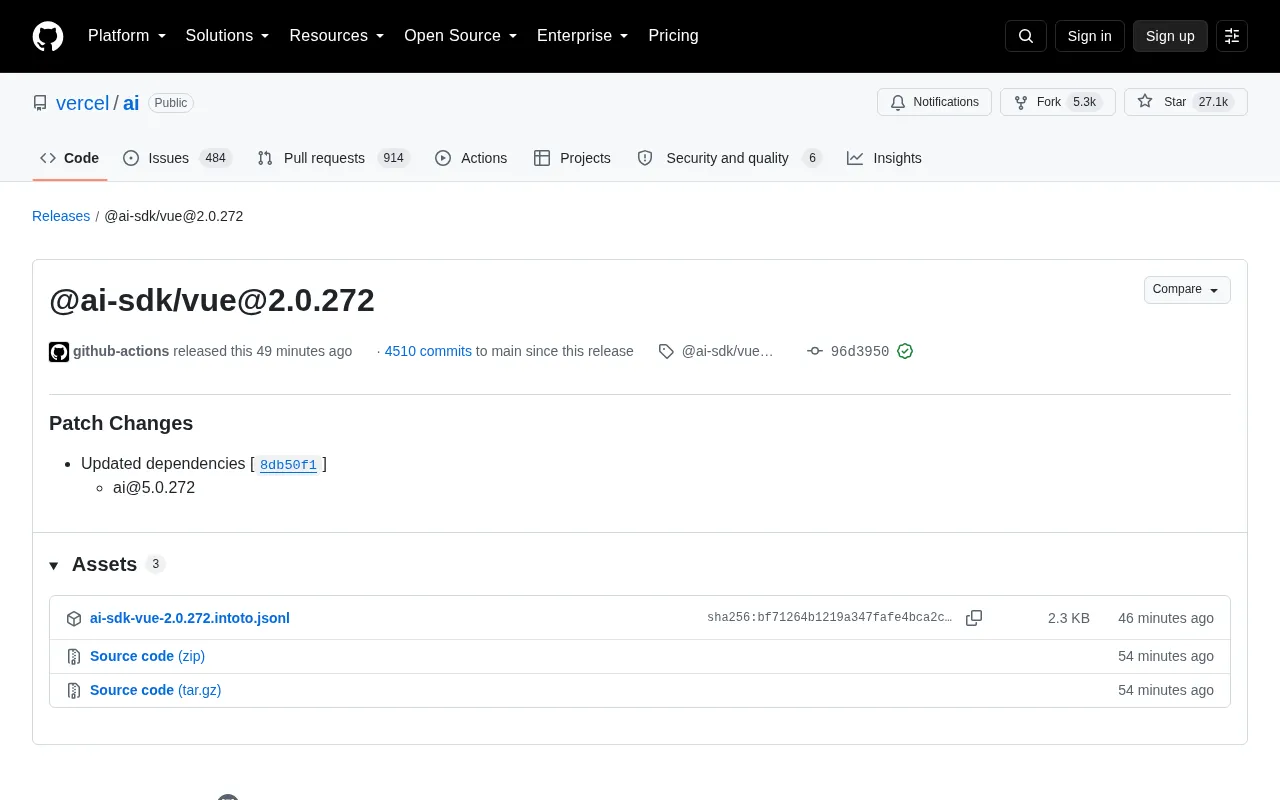
According to the release details, this version was published via an automated GitHub Actions workflow and verified with GitHub's GPG signature (key ID: B5690EEEBB952194), ensuring the integrity and authenticity of the release artifact. The vercel/ai repository has accumulated over 27.1k stars and 5.3k forks, making it one of the more active open-source projects in the AI application development space.
What's Changed
The changelog for 2.0.272 is concise, categorized under Patch Changes, with the following entry:
- Updated dependencies
- Core package
ai@5.0.272synced
This means @ai-sdk/vue, acting as the Vue adapter layer for the AI SDK, has not introduced any standalone feature changes or API adjustments. Instead, it simply aligns with the underlying core package ai@5.0.272. This kind of version-linked release is a common pattern in monorepo projects — when the core logic package is updated, each framework adapter (React, Vue, Svelte, etc.) publishes a corresponding patch release to maintain internal dependency consistency.
For developers, a patch release typically signals a backward-compatible, low-risk upgrade intended to fix issues or sync underlying improvements. Breaking changes are generally not a concern.
What is a Monorepo? A monorepo (single repository) is a code organization strategy where multiple related packages or projects are maintained in the same Git repository. The Vercel AI SDK uses this approach, managing the core
aipackage, framework adapters (@ai-sdk/vue,@ai-sdk/react, etc.), and utility packages all in one place. The key advantage is that cross-package changes can be made in a single commit, dependencies are easier to track, and version coordination can be automated with tools like Changesets. When the coreaipackage releases a new version, the CI/CD pipeline automatically triggers corresponding releases for all dependent adapter packages — keeping the entire ecosystem in sync and preventing developers from hitting dependency hell where the core package has updated but framework adapters lag behind.
What This Means for Vue Developers
@ai-sdk/vue gives Vue developers deep integration with the Vercel AI SDK, including abstractions for common AI interaction patterns such as streaming response handling and chat state management. Staying in sync with the core ai package ensures that Vue projects can use the latest AI capabilities without running into compatibility issues caused by version mismatches.
Developers currently using this SDK in Vue projects are encouraged to review the ai core package's changelog when upgrading, to understand the underlying improvements carried in this update. Since this is a patch release, the upgrade cost is minimal — you can update directly to 2.0.272 via your package manager.
A note on
@ai-sdk/vueinternals:@ai-sdk/vueexposes its core capabilities through Vue Composables, such asuseChatanduseCompletion. These composables encapsulate the complex logic of communicating with AI streaming endpoints — including incremental text reception via Server-Sent Events (SSE) orReadableStream, request abort control, and reactive tracking of loading and error states. Developers simply call these functions inside their components to get out-of-the-box chat or text completion functionality, without needing to manually handle low-level stream parsing. Keeping in sync with theaicore package ensures that the underlying parsing logic and type definitions these composables depend on remain consistent with the main package — preventing silent runtime errors caused by type mismatches or interface drift.
Summary
This is a typical ecosystem-sync patch release: minimal scope, high compatibility. It reflects Vercel AI SDK's high-cadence, fine-grained release rhythm, providing a stable and continuously updated AI development toolchain for downstream developers. Teams following this SDK can confidently apply patch updates like this one to benefit from ongoing improvements in the underlying dependencies.
Related articles

How Gen Turns Data into Decisions with ChatGPT Work
In an OpenAI user case, business leader Gen shares how ChatGPT Work turns data into decisions: within hours of launch, teams can judge whether integrations and onboarding flows work, shifting decision iteration from hundreds of trial-and-error attempts to a fast feedback loop.

ChatGPT vs. Claude In-Depth Comparison: Strong at Coding but Weak at Research — How to Bridge the Gap?
A user considers switching from ChatGPT to Claude, finding Claude stronger at coding but shallower at research. We analyze the differences and share tips to make Claude's research deeper.

Theranos Whistleblower Warns: The AI Boom Is "a Great Opportunity to Deceive"
Theranos whistleblower Tyler Shultz warns the AI boom is "a great opportunity to deceive" as never-profitable companies raise capital at trillion-dollar valuations. This article examines the real-world context, key differences between AI and Theranos, and practical criteria for investors and practitioners.