Theranos Whistleblower Warns: The AI Boom Is "a Great Opportunity to Deceive"

Theranos whistleblower warns the AI boom is fertile ground for deception due to excessive tolerance for grand narratives.
Theranos whistleblower Tyler Shultz warns that the current AI boom is "a great opportunity to deceive people." His core concern is not that a specific company is committing fraud, but that the industry's tolerance for grand narratives is too high. The backdrop is a cohort of unprofitable AI companies raising capital at extremely high valuations, with valuations growing far faster than revenue validation—creating a short-term incentive to "tell a story better than reality." The article also notes key differences between AI and Theranos: most AI systems genuinely can perform the tasks they claim, but capability boundaries are blurred by marketing, and AI applications face far less validation pressure than medical diagnostics. Shultz offers an environmental risk perspective, from which the article derives three criteria: focus on verifiable output, observe whether internal dissent is treated well, and distinguish technical feasibility from commercial viability.
Theranos scandal whistleblower Tyler Shultz recently issued a warning about the AI industry: the current AI boom is "a great opportunity to deceive people." Against the backdrop of never-profitable companies raising capital at trillion-dollar valuations, this statement—from someone who lived through Silicon Valley's most infamous fraud case—deserves a pause for thought from anyone paying attention to AI.
Why a Whistleblower's Perspective Deserves Attention
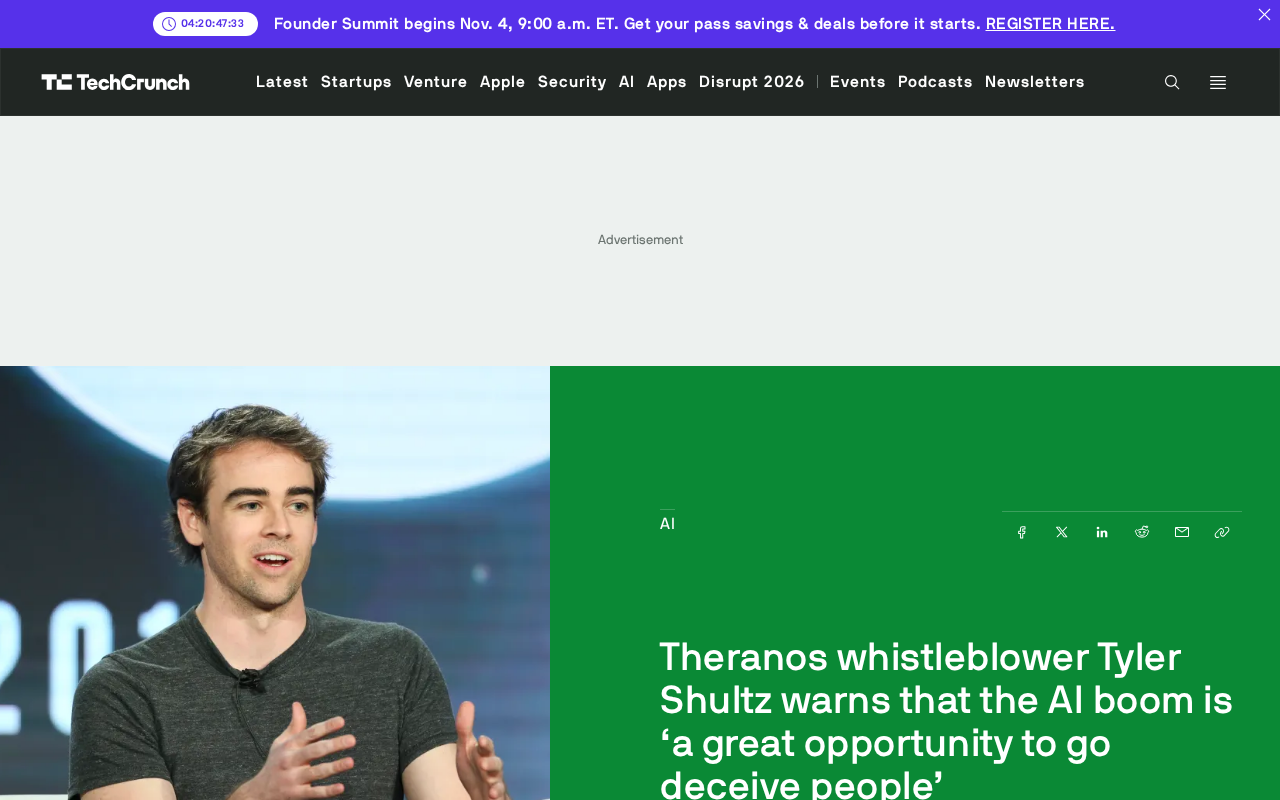
Tyler Shultz is not a casual commentator. He was a family friend of Theranos founder Elizabeth Holmes, worked inside the company, and witnessed firsthand how a device claiming to "run hundreds of tests on a single drop of blood" was packaged as a product that would disrupt the healthcare industry. When he discovered the technology fell far short of its claimed capabilities, he chose to report it to regulators rather than stay silent.
That experience made him acutely sensitive to "the gap between narrative and reality." The reason the Theranos story persisted for so long was not that the technology was sophisticated, but that there was a sufficiently compelling vision, a group of investors willing to believe, and an information environment that was not friendly to skepticism. Shultz sees a similar structural risk in the AI boom—not that any specific company is committing fraud, but that the entire industry's tolerance for grand narratives is becoming too high.
Theranos was an American blood-testing company founded in 2003. Its founder, Elizabeth Holmes, claimed that its proprietary device "Edison" could run hundreds of tests from a single finger-prick of blood, and the company's valuation once reached $9 billion. In 2015, Wall Street Journal reporter John Carreyrou launched an investigation based on leads provided by an internal whistleblower, revealing that the device's accuracy fell far short of standards and that many tests were actually performed using third-party instruments. The company dissolved in 2018, and Holmes and COO Sunny Balwani were later convicted of fraud. The case became the most iconic cautionary tale of Silicon Valley's "fake it till you make it" culture and brought widespread attention to the role of whistleblowers in the tech industry.
The Contrast Between Trillion-Dollar Valuations and Zero Profit
The real-world context for Shultz's warning is this: there is currently a cohort of AI companies whose business models remain unproven and whose paths to profitability remain unclear, yet which are already raising capital at extremely high valuations. The original article specifically highlights the phenomenon of "never-profitable companies raising capital at trillion-dollar valuations."
This does not automatically mean a bubble or fraud, but it does create an incentive structure: when valuations grow far faster than revenue, telling a story that sounds better than reality is "worth it" in the short term. The Theranos lesson is that once this kind of short-term advantageous narrative gets started, the cost of correction rises exponentially—the later the gap is acknowledged, the harder it becomes to turn back.
Shultz's wording is "a great opportunity to deceive people," not "the AI industry is systematically committing fraud." The distinction matters. He is pointing to an environmental risk, not leveling accusations at specific companies.
Valuations and funding rounds are the foundation for understanding this contrast. Startups typically raise capital in rounds (seed, Series A, Series B, and so on), each exchanging equity for capital; valuations reflect investors' expectations of future cash flows rather than current profitability. The so-called "trillion-dollar valuation" in AI usually refers to the combined market value or valuation expectations of leading companies or the sector as a whole, not the funding amount of a single unprofitable company. When valuations are driven mainly by narrative and growth expectations, the fundraising cadence itself creates a positive feedback loop: high valuations attract media attention and talent, further pushing up the next round's valuation. This mechanism appeared widely during the dot-com bubble, and its risk is that once growth falls short of expectations, valuation corrections transmit rapidly through layoffs, funding gaps, and other channels.
Key Differences Between AI and Theranos
Drawing a direct analogy between the AI boom and Theranos requires caution. The core of Theranos's problem was that a technology fundamentally unworkable at the physical and chemical level was packaged as a ready-to-use product. By contrast, most current AI systems genuinely can perform many of the tasks they claim—it's just that capability boundaries, reliability, and cost structures are often blurred by marketing rhetoric.
The difference also lies in the maturity of regulation and scrutiny. Medical diagnostics are subject to strict clinical validation requirements, whereas AI applications face far less validation pressure in most commercial contexts. This is both why AI deploys quickly and why risks are easily underestimated. Shultz's warning is less "AI is the next Theranos" and more a reminder: when an industry moves faster than its validation mechanisms, whistleblowing voices become scarcer—and more necessary to hear.
The difference in clinical validation and regulatory pathways is worth elaborating on. In the United States, in vitro diagnostic devices must go through FDA 510(k) or PMA approval, requiring submission of analytical performance and clinical validity data; laboratory-developed tests (LDTs) are subject to CLIA certification. Theranos operated for years precisely by exploiting the relatively loose gaps in LDT regulation. By comparison, most commercial AI applications are not medical devices and are not subject to equally rigorous pre-market validation requirements; even in high-risk scenarios such as finance and hiring, compliance review often lags behind product deployment. This "regulatory time lag" means AI capability claims rely more on corporate self-discipline and market reputation constraints than on mandatory third-party verification.
Practical Implications for Practitioners and Investors
From Shultz's perspective, there are several actionable judgment criteria.
Look at verifiable output, not the scale of the vision. Theranos was ultimately exposed because someone insisted on seeing the data the device actually produced. For AI companies, this means focusing on real users' depth of usage, task completion quality, and failure rates—not demo videos and funding news.
Watch whether internal dissent is treated well. Whether whistleblowing mechanisms are open is a leading indicator of organizational health. Before Theranos collapsed, internal doubts were systematically suppressed. An AI company that is highly defensive toward internal criticism deserves extra caution.
Distinguish "technically feasible" from "commercially viable." Many AI capabilities work in the lab, but deployment costs, the cost of errors, and maintenance overhead may make the business model unworkable. Valuation growth speed should not be treated as a substitute for commercial validation.
Whistleblower protection mechanisms are an institutional reference point for judging organizational health. The U.S. Dodd-Frank Act and the SEC whistleblower program provide rewards and anti-retaliation protections for reporting financial fraud; in healthcare and technology, reliance is more on internal compliance hotlines, audit committees, and external media investigations. In the Theranos case, internal employees' channels for seeking help from regulators and journalists ultimately worked, but the process was long and costly. For AI companies, whether independent ethics review is established and whether employees are allowed to express technical concerns outside internal channels are observable indicators of their "capacity for self-correction."
Conclusion
Shultz's warning names no specific companies and predicts no crash. Its value lies in offering an insider's perspective from a fraud case: deception often does not begin with blatant lies, but with excessive tolerance for a vision. Whether the AI industry will have its own Theranos moment depends on how high the industry can maintain its tolerance for skepticism.
Related articles

WebMCP Security Guide: Three Hints That Make AI Agents Safer
The Chrome team demonstrates three security hints for WebMCP tools: readOnlyHint eliminates invalid confirmation dialogs, consequentialHint forces human confirmation for high-risk operations, and untrustedContentHint defends against indirect prompt injection—improving AI agent security with one or two lines of code.

Why Turbulence Is the Hardest Problem in Fluid Mechanics — and How AI Could Crack It
Why is turbulence the hardest problem in fluid mechanics? This article, based on a Lex Fridman podcast conversation, explores turbulence's multi-scale nature, comparisons with classical thermodynamics, and how AI might simplify turbulence description by discovering coordinate transformations — examining the intersection of vortex formation with mathematics and physics.

R.L. Stine Google Talk: How the Master of Horror Ignites Kids' Passion for Reading
At a Google talk, R.L. Stine shares his accidental pivot from comedy to horror, his principles for children's horror, how phones impact storytelling, and how Goosebumps motivates kids to read.