@ai-sdk/vue 3.0.328 Patch Release: Interpreting the AI SDK Vue Binding Dependency Update

Vercel AI SDK releases a patch for Vue, syncing core dependencies and reflecting its layered architecture and automated release practices.
Vercel's AI SDK team has released the @ai-sdk/vue@3.0.328 patch version, with the core change being synchronized updates to dependency references on ai@6.0.328 and @ai-sdk/provider-utils@4.0.66. This version is automatically built by GitHub Actions and accompanied by GPG signature verification, and the main repository cumulatively involves 3,419 commits, reflecting its high-frequency iteration cadence. The article notes that AI SDK adopts a layered architecture of core package, framework binding packages, and provider utility package, with binding packages advancing alongside the core package version, so Vue developers only need to upgrade the binding package to get core-layer fixes, reducing dependency management costs. Upgrade recommendations include: first verifying key paths such as streaming conversations and tool calling in the development environment, ensuring that ai and @ai-sdk/vue are upgraded in sync to avoid interface mismatches, and assessing the scope of impact based on release records.
Vercel's AI SDK team has released a new patch version for the Vue ecosystem. This seemingly ordinary dependency update actually reflects the current iteration cadence and engineering approach of frontend SDKs for AI applications.
What the Patch Release Contains
According to the release record on GitHub, @ai-sdk/vue@3.0.328 is a standard patch release with commit hash a917e15, automatically built by GitHub Actions and accompanied by GPG signature verification. The changelog lists a concise set of changes: updated dependency references to ai@6.0.328 and @ai-sdk/provider-utils@4.0.66.
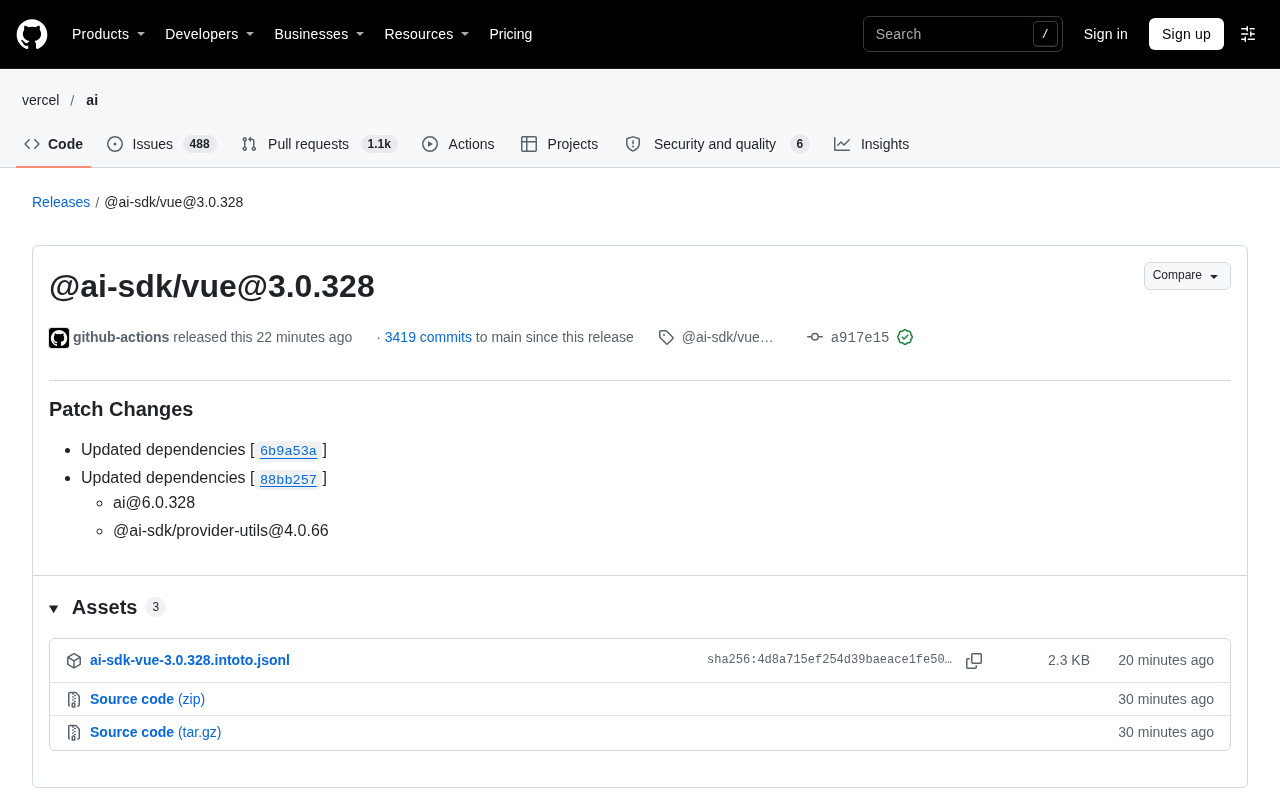
The release information also shows that this version cumulatively involves 3,419 commits merged into the main branch, indicating that the AI SDK main repository maintains a high-frequency iteration pace over the long term. For developers using Vue to build AI chat interfaces or intelligent applications, this type of patch usually means consistency fixes at the underlying behavior level rather than breaking changes.
Why Patch Updates Are Worth Watching
Looking only at the change in dependency numbers makes it easy to underestimate the significance of this kind of release. AI SDK adopts a layered architecture design with a core package and framework binding packages: the ai package provides general capabilities such as model invocation, streaming responses, and tool calling, while @ai-sdk/vue is responsible for adapting these capabilities into the compositional API form of Vue, and @ai-sdk/provider-utils consolidates the differentiated handling of various model providers.
The synchronized advancement of the three versions means that the Vue binding layer stays interface-aligned with the core layer. When upgrading, developers only need to bump @ai-sdk/vue to the corresponding patch version to get the latest fixes from the core layer, without having to manually coordinate multiple sub-dependencies. This versioning strategy of "binding packages following the core package" reduces the dependency management cost of frontend projects.
The Layered Architecture of AI SDK
AI SDK is maintained by the Vercel team and adopts a three-layer design of "core package + framework binding packages + provider utility package." The core package ai provides framework-agnostic low-level capabilities, including a unified model invocation interface, streaming response handling, tool calling, and structured output; framework binding packages (such as @ai-sdk/vue and @ai-sdk/react) encapsulate the core capabilities into idiomatic forms for the corresponding framework, which in Vue manifests as composables (such as useChat); @ai-sdk/provider-utils abstracts the protocol differences among various model providers (OpenAI, Anthropic, Google, etc.) and provides shared utilities such as request construction and stream parsing. This layering allows the same core logic to be reused across multiple frontend frameworks, with binding packages only needing to focus on framework adaptation, thereby reducing maintenance costs and ensuring behavioral consistency.
Upgrade Recommendations for Vue Developers
Since this is a patch-level release, the upgrade risk is low, but it is still recommended to follow the usual process: first update dependencies in the development environment and run through key paths such as existing streaming conversations and tool calling, then merge to the main branch. If the project locks versions of both ai and @ai-sdk/vue, note that the two need to be upgraded in sync to avoid a mismatch where the binding layer calls new interfaces of the core layer but the core package has not yet been updated.
For Vue teams that have not yet integrated AI SDK, this kind of high-frequency patch also provides an observation window: they can choose to follow the latest patch or pin to a verified minor version based on their own stability requirements. The commit links and dependency update notes included in the official release records are first-hand evidence for assessing the scope of impact.
Semantic Versioning and Patch Upgrades
AI SDK follows the Semantic Versioning (SemVer) specification: major version changes indicate incompatible API modifications, minor version increases indicate backward-compatible feature additions, and patch numbers contain only backward-compatible bug fixes. @ai-sdk/vue@3.0.328 is a patch release, so in theory it will not introduce breaking changes, and therefore the upgrade risk is low. However, note that multiple packages in AI SDK share a version advancement cadence, and the patch numbers of binding packages and the core package do not always correspond strictly one-to-one; when upgrading, refer to the dependency references listed in the release notes to ensure that the version combination of ai and @ai-sdk/vue has been officially verified, rather than assuming compatibility merely because the patch numbers are the same.
Conclusion
@ai-sdk/vue@3.0.328 itself does not introduce new features, but it reflects the engineering practice of multi-package coordination and automated releases in AI SDK. Paying attention to the dependency update chain is more useful for grasping the evolution direction of this SDK than focusing solely on feature announcements for a single package.
Related articles

Microsoft Open-Sources Token Economizer: Saving 18%-31% on AI Coding Agent Costs
Microsoft's free open-source plugin Token Economizer cuts AI coding agent costs through micro skills, tool pruning, and failure loop intervention. Tests show 18.4% to about 31% average savings with Claude Code, Codex, and more.
Running GLM-5.3 on Two DGX Stations: A vLLM Tensor Parallelism Hands-On
NVIDIA engineers show how to run the 753B-parameter GLM-5.3 locally on two DGX Stations using vLLM tensor parallelism, covering RDMA setup, launch args, NCCL checks, and performance baselines.
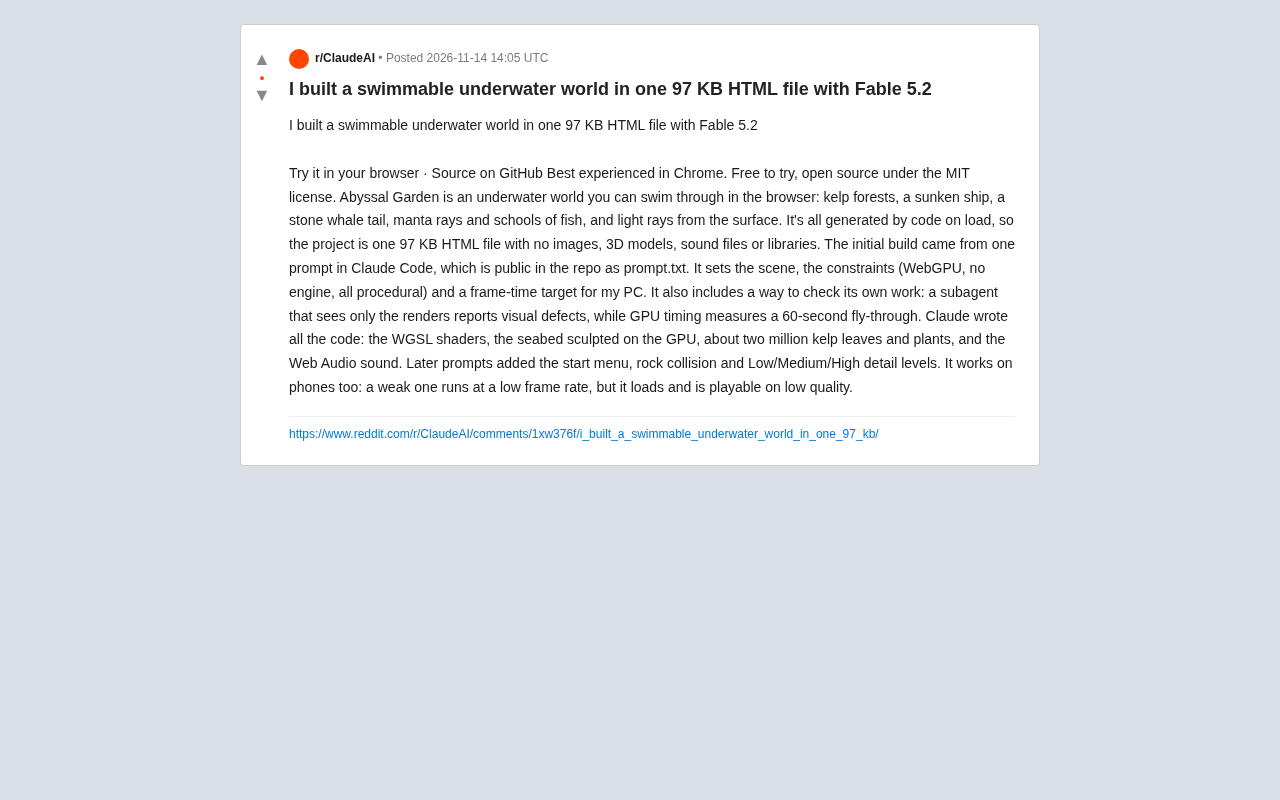
97KB Single-File HTML Underwater World: A WebGPU Experiment in AI Programming
A developer used a single prompt in Claude Code to generate a 97 KB single-file HTML underwater world, fully procedurally generated with WebGPU—kelp forests, a shipwreck, and fish, no images or model libraries, MIT-licensed, playable on mobile.