@ai-sdk/vue 4.0.153 Patch Release: Documentation and Dependency Sync Updates
@ai-sdk/vue 4.0.153 maintenance patch syncs the core package and docs.
The article explains the @ai-sdk/vue 4.0.153 patch: no new APIs or breaking changes, with changes focused on README formatting unification and dependency sync, bumping ai to 7.0.153 and @ai-sdk/provider-utils to 5.0.68 in the same batch. The release is auto-generated by github-actions with GitHub-verified signatures, reflecting a standardized release pipeline. The author notes that synchronized releases of the core and framework binding packages mean versions must stay matched when upgrading, and recommends pinning matching versions in package.json rather than using loose ^ ranges. Production projects can batch upgrades after several patches with regression testing, while exploratory projects can follow the latest version to gain provider-layer capabilities sooner. A single patch offers limited information; what's truly worth watching is the pace of ecosystem evolution reflected in the high-frequency iterations.
A Typical Patch Release
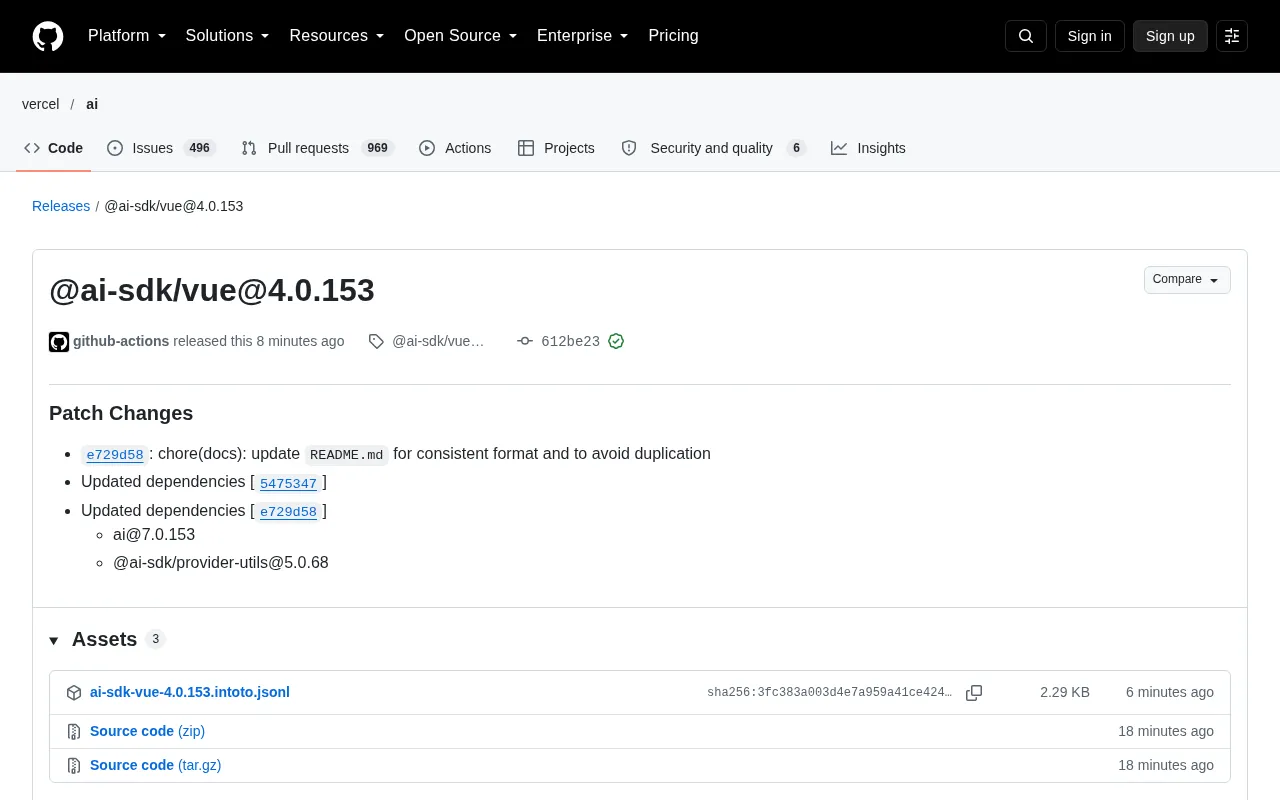
The AI SDK's Vue binding package @ai-sdk/vue has released version 4.0.153. Judging from the GitHub release record, this is a standard patch update with no new APIs or breaking changes—the core work centers on documentation cleanup and dependency synchronization.
For developers who have long tracked the AI SDK ecosystem, the value of these small releases often lies not in features but in what they reflect about the cadence of the upstream ai core package and @ai-sdk/provider-utils—both of which were updated together in the same release.
Breaking Down the Commits
The patch contains two types of changes. The first is at the documentation level: commit e729d58 updated README.md to unify formatting and eliminate duplicate content. The second is at the dependency level: driven by 5475347 and e729d58, the ai package was bumped to 7.0.153 and @ai-sdk/provider-utils to 5.0.68.
Releases like this are auto-generated by github-actions, with commits carrying GitHub-verified signatures—a common automated release workflow in Vercel-family open-source projects.
Semantic Versioning (SemVer) splits version numbers into three segments: major.minor.patch. The major version increments on incompatible API changes, the minor version on backward-compatible feature additions, and the patch number is reserved for backward-compatible bug fixes only. So a patch version like 4.0.153 should, by convention, not introduce new APIs or breaking changes—which is the basis for judging it a maintenance update in this article. Note that SemVer is a convention rather than an enforcement, and some projects don't follow it strictly; the actual impact still needs to be judged against the changelog.
ai is the core package of the AI SDK, encapsulating capabilities such as a unified model-calling interface, streaming responses, tool calls, and structured output; @ai-sdk/vue is the framework binding layer for Vue, providing composables like useChat that adapt the core package's capabilities into Vue's reactive usage. @ai-sdk/provider-utils belongs to the provider utility layer, carrying the shared utility functions and types used by the various model provider adapters. Together the three form a layered structure of "provider adapters—core abstraction—framework bindings," where the upper binding package depends on the core package, which in turn depends on the provider utility layer—hence they often ship together in the same batch.
Dependency Coordination Behind the Version Numbers
The matching trailing numbers across the three packages (.153, .68, and the coordination beyond .153) indicate that the AI SDK follows a synchronized release strategy for the core package and framework binding packages. For frontend teams building AI applications with Vue, this means that upgrading @ai-sdk/vue will drag the underlying ai package along, and the two versions need to stay matched—otherwise type or runtime behavior inconsistencies are easy to run into.
When actually upgrading, it's advisable to pin the corresponding versions of @ai-sdk/vue and ai, specifying explicit version ranges in package.json rather than simply writing ^ ranges. Although patch versions carry lower risk, after accumulating across multiple patches, dependency tree drift can still bring surprises.
In package.json, ^4.0.153 means the latest version within the 4.x range is allowed, ~4.0.153 only allows patch-level updates within 4.0.x, and writing exactly 4.0.153 fully locks it. For combinations like the core package and framework binding packages that require strict matching, exact pinning or using ~ is more reliable than ^. You can also use lockfiles together with commands like npm ls and pnpm why to verify the actually resolved versions. If multiple dependencies indirectly pull in the AI SDK, duplicate versions may appear—in which case the overrides/resolutions fields can enforce unification.
How to Assess the Practical Value of Such Releases
Looking at a single patch version in isolation offers limited information. What's truly worth watching is the release frequency—the AI SDK maintains a high iteration pace, indicating that its API is still evolving rapidly and that adjustments to documentation and the provider layer will keep happening.
For production projects, there's no need to chase every patch; you can upgrade in batches after accumulating several versions, paired with regression testing. For exploratory projects, following the latest version lets you take advantage of new provider-layer capabilities sooner. Changes like README formatting unification don't affect runtime themselves, but they usually signal that the documentation structure is being organized in a more standardized direction, lowering the cost of future reference.
The Significance of Automated Releases
Having releases completed automatically by CI with verified signatures attached shows that the project's release pipeline has been standardized. For consumers, this increases version credibility: commit origins are traceable, and signatures can be verified. As dependency supply chain security draws increasing attention, engineering practices like this are themselves a point in favor when choosing dependencies.
This update adds no new features and contains no record of fixing specific bugs—it's more of a maintenance release. Whether to upgrade depends on your project's current dependency versions and test coverage, not on the version number itself.
Related articles

Google Releases Gemini 4 Carbon: Its Strongest Model Yet, Debuting with a Cybersecurity Focus
Google releases Gemini 4 Carbon, calling it its strongest model, with a cybersecurity focus. It tops the third-party composite ranking at 59 points but leads by only one or two. This article analyzes its security test results, staged rollout, token pricing, and the divergence between self-reported and third-party tests on hallucinations.

LangChain Adds SchemagateRetriever: On-Demand Table Retrieval Cuts Text-to-SQL Prompts by 92.9%
LangChain docs add SchemagateRetriever: retrieves only the tables needed for text-to-SQL with permission filtering, cutting median prompt size by 92.9% on Spider 2.0 large schemas via offline BM25 selection with no model calls.

Multi-Step AI Agent Guardrail in Practice: Fact-Change Detection Drives False-Alarm Rate to 0%
Developer shares first version of a multi-step AI Agent guardrail: re-verifying dependency facts before irreversible actions cut false alarms from 50% to 17% across 23 scenarios, then to 0% via conservative normalization without lowering catch rate. Runs on local qwen2.5-7b.