AI SDK Vue 4.0.166 Release Update Explained
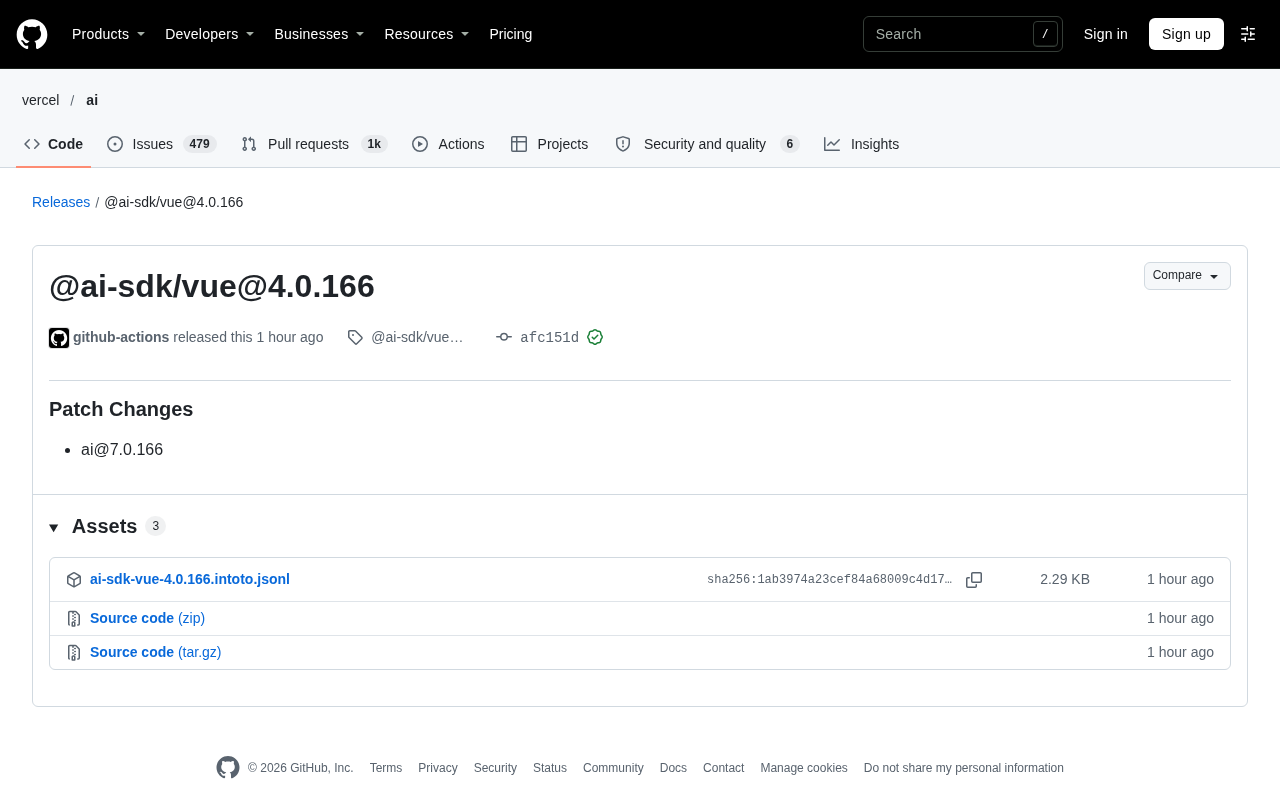
@ai-sdk/vue 4.0.166 patch released in sync with core package ai; rely on the diff.
@ai-sdk/vue released patch version 4.0.166, automatically published by GitHub Actions with a GPG-verified signature. The release notes are minimal, listing no new features or breaking changes, marked only as Patch Changes, and advanced in the same batch as the core package ai@7.0.166. The article notes that aligned patch numbers usually mean consistency fixes at the underlying dependency level rather than independent feature iteration at the Vue layer. The safest approach for developers is to check the complete diff of commit afc151d to confirm whether it touches the APIs in use, and to bind upgrades with regression testing. The article also discusses the two-sided nature of high-frequency patch releases: fixes come quickly, but teams must also establish repeatable upgrade and verification processes—incorporating dependency upgrades into CI is more valuable than chasing version numbers.
A Quiet Patch: What Changed in AI SDK Vue 4.0.166
@ai-sdk/vue has released version 4.0.166 on GitHub. Judging from the release notes, this is a standard patch update (Patch Changes), automatically published by github-actions, with the commit carrying a GitHub-verified signature. The release notes are extremely brief and do not list any developer-facing new features or breaking changes—a typical case of routine version cadence maintenance.
The Signal Behind the Version Number
The release notes mention only two version numbers: @ai-sdk/vue's 4.0.166, and ai@7.0.166 as the associated party of the patch change. This indicates that the Vue package and the core ai package are being advanced in the same batch, with both patch numbers aligned at 166. For frontend teams building Vue applications with the AI SDK, this kind of synchronized release usually means consistency fixes at the underlying dependency level, rather than independent feature iteration at the Vue layer itself.
You may not have noticed that the release process is entirely driven by GitHub Actions, and the commit record carries a GPG-verified signature (key ID B5690EEEBB952194). This combination of automation plus signature verification has become the standard configuration for the release pipeline of mainstream open-source projects, and can reduce supply chain risk to a certain extent.
Semantic Versioning (SemVer) is a specification in the open-source ecosystem that defines the meaning of version numbers, in the format MAJOR.MINOR.PATCH. An increment in the PATCH position represents backward-compatible bug fixes, a MINOR increment represents backward-compatible feature additions, and a MAJOR increment means there are breaking changes. Therefore, when you see a version number like 4.0.166, you can directly judge that this release does not involve breaking adjustments to the public API. However, SemVer is only a convention; whether it is actually compatible still needs to be determined in combination with the commit diff, especially for packages in the 0.x stage, whose rules are relatively lenient.
GPG-signed commits refer to the use of GNU Privacy Guard to cryptographically sign Git commit objects, with the signature and key ID attached to the commit record. Verifying the signature can confirm that the commit was indeed created by the person or automated system holding the corresponding private key, and that it was not tampered with during transmission. In the CI automated release scenario, the signature can prove that the release artifact comes from a trusted build pipeline, and is a basic line of defense for software supply chain security—but the signature itself does not guarantee code quality or logical correctness.
The Actual Impact of a Patch Version
A patch version (Patch) corresponds to backward-compatible bug fixes in the semantic versioning specification. Since the official release did not elaborate on the change details this time, the safest approach for developers is:
- Check the complete diff of commit afc151d in the repository to confirm whether it touches the APIs you are using;
- If the project adopts a version-locking strategy, it can be handled through the regular minor version upgrade process, and business code usually does not need to be modified;
- Pay attention to the synchronized changes in the core ai package 7.0.166, because the Vue package's patch is very likely related to the core package's fixes.
For production environments, it is recommended to bind upgrades with regression testing rather than judging safety solely by version number. Automated releases reduce the cost of releasing, but they also mean the release notes may not be detailed enough—the diff is the source of truth.
Version-locking strategy is a common practice in package management. Through a lockfile (such as npm's package-lock.json or pnpm's pnpm-lock.yaml), dependencies are pinned to exact versions, ensuring that different environments and different times install exactly the same dependency tree. The opposite of version locking is using ^ or ~ range symbols in package.json, which allows automatically receiving patch or minor version updates. For patch-level updates, if version locking is used, an explicit upgrade command must be executed for it to take effect; if range symbols are used, changes may be silently introduced during a routine install. Both strategies have pros and cons: the former offers strong controllability but requires active maintenance, while the latter is convenient but changes are unpredictable. Teams should choose based on their release cadence.
How to View High-Frequency Patch Releases
For a toolchain in a rapid evolution phase like the AI SDK, the patch number accumulating to 166 is itself information: the project maintenance cadence is intensive, with fixes and adjustments continuing. This is two-sided for users—on one hand, problem fixes can be obtained relatively quickly; on the other hand, teams are required to establish repeatable upgrade and verification processes.
Incorporating dependency upgrades into CI, together with routine review of changelogs and commit diffs, is more valuable than chasing version numbers.
Dependency upgrades in Continuous Integration (CI) usually rely on tools such as Dependabot and Renovate to automatically create upgrade PRs, and run unit tests, type checks, and builds in the pipeline to verify whether the upgrade introduces regressions. The value of incorporating dependency upgrades into CI lies in transforming the judgment of "whether it is safe" from manually looking at version numbers into repeatable automated verification. For fast-iterating projects whose patch numbers have accumulated to three digits, this mechanism is particularly necessary, because it can provide a consistent quality gate on each upgrade and avoid risk stacking during subsequent concentrated upgrades caused by dependencies lingering for a long time.
FAQ
Does 4.0.166 include breaking changes?
Judging from the Patch Changes marked in the release notes, this update is handled at the patch level, and semantically should be backward-compatible bug fixes. The specific changes still need to be based on the commit diff.
Do I need to upgrade the core ai package at the same time?
The release notes list ai@7.0.166 as the associated item of the patch change. It is recommended to check the dependency relationship between the two before deciding whether to upgrade in sync.
Related articles

Seven Years of Evolution: How Far Has the Foldable Come From the First Generation?
From the first foldable to today's latest models, what has seven years changed? Shallower creases, higher brightness, thinner bodies, and smoother software migration—has the foldable crossed the chasm from enthusiasts to ordinary users? This article discusses the question based on a video comparison.

When Did Humans Start Eating Salt? A 10,000-Year History of Salt
When did humans start eating salt? From salt use at the dawn of agriculture 11,000 years ago to ancient seawater evaporation and rock salt mining, and on to the salt trade, salt taxes, and Gandhi's Salt March, this article traces salt's key role in human civilization.
Microsoft Paza Research: How African Language Speech Recognition Breaks Through Architecture and Data Bottlenecks
Microsoft's Paza research evaluates 53 speech models across 39 African languages, revealing architecture choice matters more than pre-training coverage, 200-300 hours is the practical data threshold, and language typology deeply influences recognition performance.