@ai-sdk/workflow 2.0.62 Released: A Deep Dive into This Dependency-Driven Patch Update

@ai-sdk/workflow 2.0.62 is a pure dependency-sync patch update with no breaking changes.
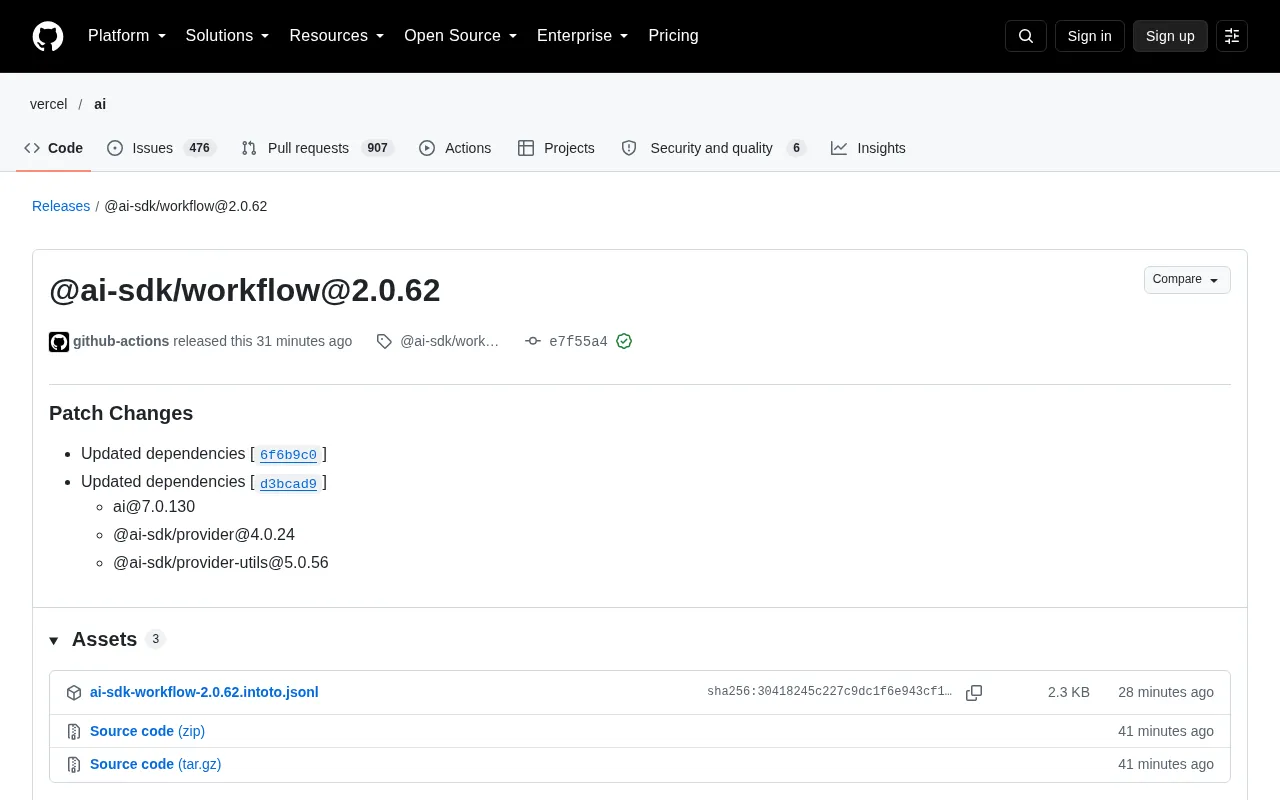
`@ai-sdk/workflow` 2.0.62 is a patch release with no independent logic changes — its sole purpose is to sync three upstream dependencies: `ai@7.0.130`, `@ai-sdk/provider@4.0.24`, and `@ai-sdk/provider-utils@5.0.56`. This "dependency-driven patch" pattern is common in monorepo SDK projects, where lower-level fixes need an explicit upstream version bump to be reliably resolved. The release was fully automated via `github-actions` with GPG signature verification. Upgrading is low-risk, but developers are advised to review the `ai@7.0.130` changelog and run regression tests to fully assess the impact of the underlying fixes.
Version Overview
Vercel AI SDK's @ai-sdk/workflow has shipped version 2.0.62 — a classic patch update. According to the release record on GitHub, this version was published via an automated github-actions workflow and verified with a GPG signature (key ID: B5690EEEBB952194), confirming the integrity of the release.
Under Semantic Versioning (SemVer), the incremented patch number in 2.0.62 signals a backward-compatible, non-breaking update — no new features, no breaking changes. For developers already running this package in production, upgrading is generally low-risk.
What Changed in This Release
The actual changes in this release are entirely focused on dependency synchronization. The release notes explicitly list two dependency updates (corresponding to commits 6f6b9c0 and d3bcad9), aligning the package with the broader AI SDK toolchain:
ai@7.0.130@ai-sdk/provider@4.0.24@ai-sdk/provider-utils@5.0.56
This means @ai-sdk/workflow itself has no independent logic changes — it simply tracks the upstream core packages (ai and the provider-related utilities) to stay version-aligned. This pattern of "dependency-driven patch releases" is common in highly modular SDK projects: when a fix lands in a lower-level provider or utility layer, packages that depend on it receive a version bump to ensure consistency across the entire toolchain.
Vercel AI SDK uses a monorepo architecture, with all sub-packages (ai, @ai-sdk/provider, @ai-sdk/provider-utils, @ai-sdk/workflow, etc.) living in a single repository and coordinated via Turborepo or a similar build orchestration tool. The benefit of this setup is that cross-package interface changes can be committed atomically — but it also means a fix in one lower-level package triggers a cascading version bump up the dependency chain. The github-actions automation detects these dependency version changes and automatically generates a new patch release for any affected upstream packages, then pushes them to the npm registry. That's exactly why @ai-sdk/workflow received a new version despite having no independent logic changes.
Why Dependency Alignment Matters
In a layered project like AI SDK, each layer has a distinct role: provider integrates with various LLM services, provider-utils supplies shared utility functions, ai serves as the developer-facing main entry point, and workflow provides orchestration capabilities. Strict version constraints exist between these layers.
If an upstream package doesn't promptly track downstream fixes, you risk version lock conflicts or subtle behavioral inconsistencies. So even when the workflow package code is unchanged, publishing a patch release for a dependency update is still worthwhile — it ensures that projects using @ai-sdk/workflow can properly resolve to the fixed versions of their underlying dependencies.
The orchestration capabilities of @ai-sdk/workflow rely on the provider layer to handle actual model calls. Specifically, @ai-sdk/provider defines the standardized interface abstractions for various LLM services (OpenAI, Anthropic, Google, etc.), while @ai-sdk/provider-utils encapsulates shared logic like request retries, streaming response parsing, and error normalization. When these two packages fix an edge-case behavior bug — say, how interrupted streaming responses are handled — if workflow's package.json is still locked to an older version range, the package manager may resolve to the older version when building the dependency tree, effectively making the fix invisible. While semver constraints like ^4.0.23 theoretically allow automatic patch updates, explicitly bumping the upstream package version is the most reliable way to guarantee version consistency, especially in monorepo setups or projects with peer dependencies.
What Should Developers Do?
For developers building workflow orchestration with Vercel AI SDK, patch releases like this are generally safe to upgrade. Here's the recommended approach:
- Check your lockfile to verify that the resolved versions of
ai,provider, andprovider-utilsmatch expectations; - Run a full integration test suite in a non-production environment to confirm your model calls and workflow orchestration logic behave as expected;
- Review the changelog for
ai@7.0.130to understand exactly what was fixed, so you can assess the real-world impact of the upgrade.
Since the release notes only reference commit hashes without elaborating on specific fixes, developers who want to dig deeper into the changes will need to trace commits 6f6b9c0 and d3bcad9 directly.
Summary
@ai-sdk/workflow@2.0.62 is a routine patch release centered on dependency synchronization. Its value lies in maintaining toolchain version consistency rather than introducing new capabilities. The high-frequency, incremental release cadence also reflects the currently active iteration pace of the Vercel AI SDK ecosystem. For most projects, the upgrade risk is manageable — but it's still worth cross-referencing the upstream package changelogs and running a regression check before deploying to production.
Related articles

How Gen Turns Data into Decisions with ChatGPT Work
In an OpenAI user case, business leader Gen shares how ChatGPT Work turns data into decisions: within hours of launch, teams can judge whether integrations and onboarding flows work, shifting decision iteration from hundreds of trial-and-error attempts to a fast feedback loop.

ChatGPT vs. Claude In-Depth Comparison: Strong at Coding but Weak at Research — How to Bridge the Gap?
A user considers switching from ChatGPT to Claude, finding Claude stronger at coding but shallower at research. We analyze the differences and share tips to make Claude's research deeper.

Theranos Whistleblower Warns: The AI Boom Is "a Great Opportunity to Deceive"
Theranos whistleblower Tyler Shultz warns the AI boom is "a great opportunity to deceive" as never-profitable companies raise capital at trillion-dollar valuations. This article examines the real-world context, key differences between AI and Theranos, and practical criteria for investors and practitioners.