AI SDK Workflow 2.0.77 Patch Released: A Low-Key Version Iteration

AI SDK's Workflow package releases 2.0.77 patch, a routine automated version maintenance.
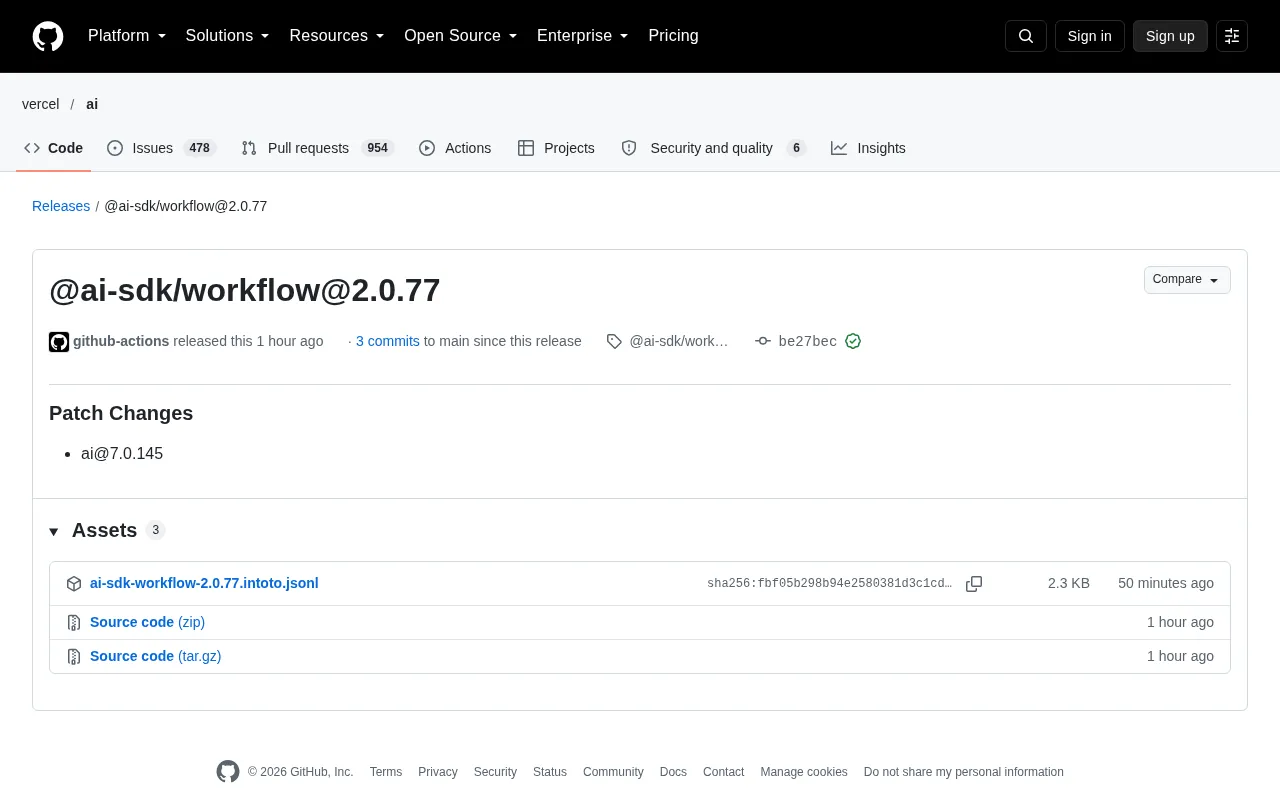
@ai-sdk/workflow has been updated to patch version 2.0.77, automatically published by the github-actions bot with 3 commits and a GitHub verified signature, making the release process traceable. This update is synchronized with ai@7.0.145, reflecting linked dependency version maintenance across packages. The release notes only mark Patch Changes without specific fixes or migration notes, typically meaning no public API changes. For developers, projects using range versions will receive the update automatically, while pinned versions can be upgraded as needed at low cost. Overall, this is a routine version maintenance action with limited information, but it can be seen as a signal that the AI SDK dependency chain is running healthily.
The AI SDK's Workflow package has just been updated to version 2.0.77, a minor patch release. Based on the release record, this update isn't flashy, but it nudges a small link in the overall dependency chain.
Basic Information About the Patch Release
According to the release record on the GitHub repository, @ai-sdk/workflow@2.0.77 was published by the github-actions bot, contains 3 commits, and was merged into the main branch. The commit hash is be27bec, and it carries a GitHub verified signature (GPG key ID: B5690EEEBB952194), indicating this was a verified automated release process.
Judging from the version number, 2.0.77 is a patch version, which typically means bug fixes or small internal adjustments rather than feature-level changes. The release notes only mark Patch Changes, without detailing specific change entries.
GitHub Actions Automated Publishing and GPG Signature Verification
The github-actions bot publishing means this version wasn't manually released by a person running npm publish, but was automatically completed by the CI workflow configured in the repository: after code is merged into the main branch, the pipeline automatically calculates the version number, generates release notes, tags, and pushes to the package registry. This approach reduces human error and makes the release cadence predictable.
The GPG signature in the release record (key ID: B5690EEEBB952194) is a verification signature generated by GitHub for automated commits, used to prove that the commit genuinely comes from the repository's trusted process rather than being forged. For supply chain security, this kind of traceability is especially important—downstream users can verify the origin and integrity of the package, and combined with npm's provenance mechanism, can further confirm the correspondence between build artifacts and source code.
Synchronized Updates of Associated Dependencies
This release is also associated with ai@7.0.145. In a monorepo or interdependent package structure, this kind of synchronized update is common: when a lower-level package receives a patch change, the upper-level package needs to upgrade its dependency version to maintain version consistency.
According to the release record, this change does not list explicit fixes, nor does it include migration notes. For users, this type of patch upgrade usually requires no code changes, and the upgrade cost is low.
What Are Monorepos and Inter-Package Dependency Linkage
Monorepo (single repository) refers to the engineering practice of placing multiple interrelated software packages in the same code repository for unified management. Ecosystem projects like AI SDK often adopt this structure: sub-packages such as @ai-sdk/workflow share the same build, test, and release pipeline. When a lower-level package changes, the upper-level packages that depend on it need to synchronously bump their dependency version numbers, otherwise "dependency drift" may occur—that is, different developers install inconsistent version combinations, leading to hard-to-reproduce issues.
Under the semantic versioning (SemVer) system, an increment in the patch number (such as 77 in 2.0.77) indicates a backward-compatible bug fix. The synchronized release of the upper-level package ai@7.0.145 and @ai-sdk/workflow@2.0.77 is exactly a common practice for ensuring dependency graph consistency through lockfiles, and a typical product of CI automated release processes.
Practical Impact on Developers
@ai-sdk/workflow is the module in the AI SDK used for orchestrating workflows. Patch version changes generally don't affect the public API, but the version in the dependency lockfile will change. If your project uses pinned versions, you can upgrade as needed; if you use range versions (such as ^2.0.0), you'll automatically receive this update.
From an engineering practice perspective, keeping AI SDK-related package versions aligned is a common way to avoid hidden conflicts. For teams currently using the Workflow module to build AI applications, it's recommended to check the full changelog before upgrading to confirm there are no unexpected behavioral adjustments.
A Routine Version Maintenance
This release comes with no feature descriptions or examples, and the information content is limited. It's more like a routine version maintenance action than a product event worth extensive coverage. For developers following the AI SDK ecosystem, it can be seen as a signal that the dependency chain is running healthily, but there's no need to adjust existing integration approaches because of it.
Related articles

Google Releases Gemini 4 Carbon: Its Strongest Model Yet, Debuting with a Cybersecurity Focus
Google releases Gemini 4 Carbon, calling it its strongest model, with a cybersecurity focus. It tops the third-party composite ranking at 59 points but leads by only one or two. This article analyzes its security test results, staged rollout, token pricing, and the divergence between self-reported and third-party tests on hallucinations.

LangChain Adds SchemagateRetriever: On-Demand Table Retrieval Cuts Text-to-SQL Prompts by 92.9%
LangChain docs add SchemagateRetriever: retrieves only the tables needed for text-to-SQL with permission filtering, cutting median prompt size by 92.9% on Spider 2.0 large schemas via offline BM25 selection with no model calls.

Multi-Step AI Agent Guardrail in Practice: Fact-Change Detection Drives False-Alarm Rate to 0%
Developer shares first version of a multi-step AI Agent guardrail: re-verifying dependency facts before irreversible actions cut false alarms from 50% to 17% across 23 scenarios, then to 0% via conservative normalization without lowering catch rate. Runs on local qwen2.5-7b.