AI SDK Workflow 2.0.84 Patch Released: ai Package Upgraded to 7.0.152

@ai-sdk/workflow 2.0.84 released, a patch update that only syncs the ai package to 7.0.152.
Vercel's @ai-sdk/workflow has released version 2.0.84, a patch-level update whose only change is synchronizing the underlying ai package dependency to 7.0.152, with no new APIs, behavioral changes, or independent bug fixes. The release was automated by the github-actions bot with a GPG-verified commit, reflecting a standardized CI release pipeline. The article notes that such dependency follow-along updates have a simple upgrade path with controllable risk, but patches may contain detail fixes for model compatibility, streaming responses, and token counting. The original text does not disclose the specifics of 7.0.152, so checking the changelog is advised. Before upgrading in production, confirm whether the changes touch the APIs you use, and verify critical paths such as multi-step tool calls and streaming output in a test environment.
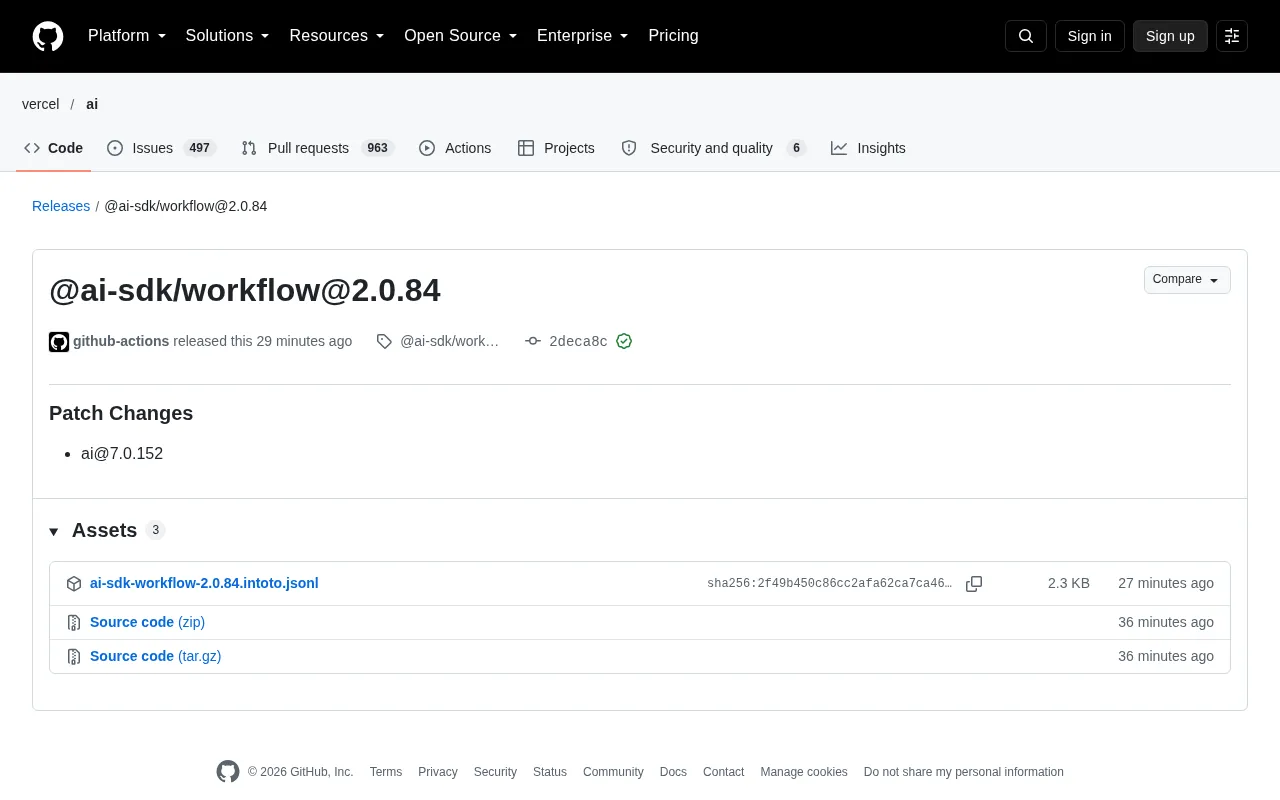
Vercel's AI SDK ecosystem has another minor iteration. @ai-sdk/workflow has released version 2.0.84, a patch-level update whose core change is synchronizing the dependent ai package to 7.0.152. According to the GitHub Releases page, this release was automated by github-actions, with commit hash 2deca8c and a GitHub-verified signature.
What the Version Number Signals: A Pure Dependency Sync
The Patch Changes section lists only one item: ai@7.0.152. This means 2.0.84 itself introduces no new APIs, no behavioral changes, and no fixes for independent defects within the workflow package—it simply pulls in the latest patch version of the underlying ai core package.
For developers building Agent workflows or multi-step generation pipelines with the AI SDK, this kind of update is typically passive follow-along: you pin the workflow version in package.json and indirectly get the latest fixes from the ai package. The upside is a simple upgrade path with relatively controllable risk; the trade-off is that if the ai package's patch contains a fix relevant to your project, you need to proactively upgrade workflow to get it.
Why Patch Versions Are Still Worth Watching
Many teams take a "when I get around to it" attitude toward patch updates. But in fast-evolving toolchains like the AI SDK, patches often carry fixes for details such as model invocation compatibility, streaming response handling, and token counting edge cases. The original text does not elaborate on what specifically changed in 7.0.152, so it's impossible to confirm whether this sync includes critical fixes. The prudent approach is to check the changelog for the corresponding version of the ai package before deciding when to upgrade.
Semantic Versioning (SemVer) breaks version numbers into three segments: major.minor.patch. A major version change represents incompatible API changes, a minor version represents backward-compatible new features, and a patch version is used only for backward-compatible bug fixes. Under SemVer conventions, patch upgrades should not break existing calling patterns, which is the basis for many teams letting their guard down. But SemVer only constrains the "interface contract," not "identical behavior"—fixing a streaming parsing bug or adjusting token counting logic are both legitimate patches, yet they can change a program's runtime behavior. With deep dependency chains (such as the workflow package embedding the ai package), the actual impact of an upstream patch also depends on how the intermediate layer wraps it, so judging risk by version number alone is unreliable.
Automation Characteristics of the Release Process
This release was triggered by the github-actions bot, with a timestamp of 23 Oct 19:40. The commit carries a GPG-verified signature (key ID B5690EEEBB952194), indicating the release pipeline follows a standardized CI process rather than manual tagging.
This pattern is common in monorepo-managed SDK projects: tools like changesets detect dependency changes and automatically generate version numbers and release records. For downstream users, a predictable release cadence is more valuable than the version content itself—you know patches will keep flowing, and you know they've passed through a signature-verified automated pipeline.
A monorepo means managing multiple related packages in a single code repository; Vercel's AI SDK family (ai, @ai-sdk/workflow, and other provider packages) uses this layout. It makes synchronized upgrades of cross-package dependencies simple, but it also brings version release management challenges, which is exactly what changesets was created for: when developers submit changes, they include a changeset file declaring which packages are affected and whether it's a patch/minor/major level; at release time, the tool uses this to automatically calculate version numbers, generate changelogs, and publish each package. This echoes the github-actions auto-triggering and GPG-signed commits mentioned in the article—release behavior is determined by CI based on changesets, not human judgment. The difference is that changesets often include human-facing change descriptions, whereas dependency-sync-only releases often leave only version number entries.
Upgrade Recommendations
If you're using @ai-sdk/workflow in production, do two things before upgrading: confirm whether the changes in ai package 7.0.152 touch the APIs you're using; and run your workflow's critical paths in a test environment, especially scenarios involving multi-step tool calls and streaming output.
For teams still in the evaluation phase, this release itself is not a reason to migrate, but it serves as a reminder: the AI SDK's release cadence is quite dense, and pinning versions with a regular upgrade window is more practical than chasing every patch.
One-line Summary
@ai-sdk/workflow releases 2.0.84, a patch update that only syncs the ai package to 7.0.152.
Paragraph Summary
Vercel's @ai-sdk/workflow has released version 2.0.84, a patch-level update whose only change is synchronizing the underlying ai package dependency to 7.0.152, introducing no new APIs, behavioral changes, or independent bug fixes. The release was automated by the github-actions bot with a GPG-verified commit, reflecting a standardized CI release pipeline. The article notes that such dependency follow-along updates have a simple upgrade path with controllable risk, but patches may contain detail fixes for model compatibility, streaming responses, and token counting. The original text does not disclose the specifics of 7.0.152, so checking the changelog is advised. Before upgrading in production, confirm whether the changes touch the APIs you use, and verify critical paths such as multi-step tool calls and streaming output in a test environment.
Related articles

AI Comic Drama with WorkBuddy from Scratch: A Step-by-Step Skill Pack Installation Guide
Learn how to create AI comic dramas with WorkBuddy from scratch. This guide covers installation, Skill pack import and invocation, plus a script generation demo with manual revision tips to get you through the first step from script to storyboard.

WorkBuddy Agent Runs the Entire GEO Database Mining Pipeline with a Single Prompt
WorkBuddy agent automates GEO database mining: from data search and curation to batch correction, differential analysis, co-expression networks, feature gene screening, and immune infiltration—a single prompt generates a complete bioinformatics report, greatly lowering the barrier to bioinformatics analysis.

PC Memory Wasted? Hacker News Debates Centralized Data Centers
Hacker News users argue that personal computer memory is wasted and should be centralized in data centers, sparking debate on centralized vs. distributed computing resource allocation. This article analyzes the logic behind the claim, the costs of centralization, and new tensions in memory resource allocation in the AI era.