AI SDK Workflow 2.0.93 Update Analysis
AI SDK's @ai-sdk/workflow releases patch 2.0.93 focused on synchronized dependency upgrades, with no new APIs.
The @ai-sdk/workflow package in the AI SDK ecosystem has released patch version 2.0.93, centered on dependency synchronization: the core ai package is upgraded to 7.0.161 and @ai-sdk/provider-utils to 5.0.73, with no new APIs or changes to public interface behavior. The article notes that patch versions are easily overlooked, but upstream fixes propagate along the dependency chain to the workflow layer, so such releases are essentially routine actions to keep the entire AI SDK toolchain version-consistent. For developers, the upgrade risk is relatively manageable; it is recommended to validate dependency compatibility in a test environment first, especially provider configuration and tool calling code, and to incorporate patch updates into a routine dependency inspection process.
The @ai-sdk/workflow package in the AI SDK ecosystem has released version 2.0.93. This is a patch-level release focused primarily on synchronized dependency upgrades: the core ai package is bumped to 7.0.161 and @ai-sdk/provider-utils to 5.0.73. For developers who follow the AI application development toolchain, understanding the significance of these small version updates is more valuable than simply chasing version numbers.
Core Contents of the Update
Dependency Synchronization Is the Main Theme
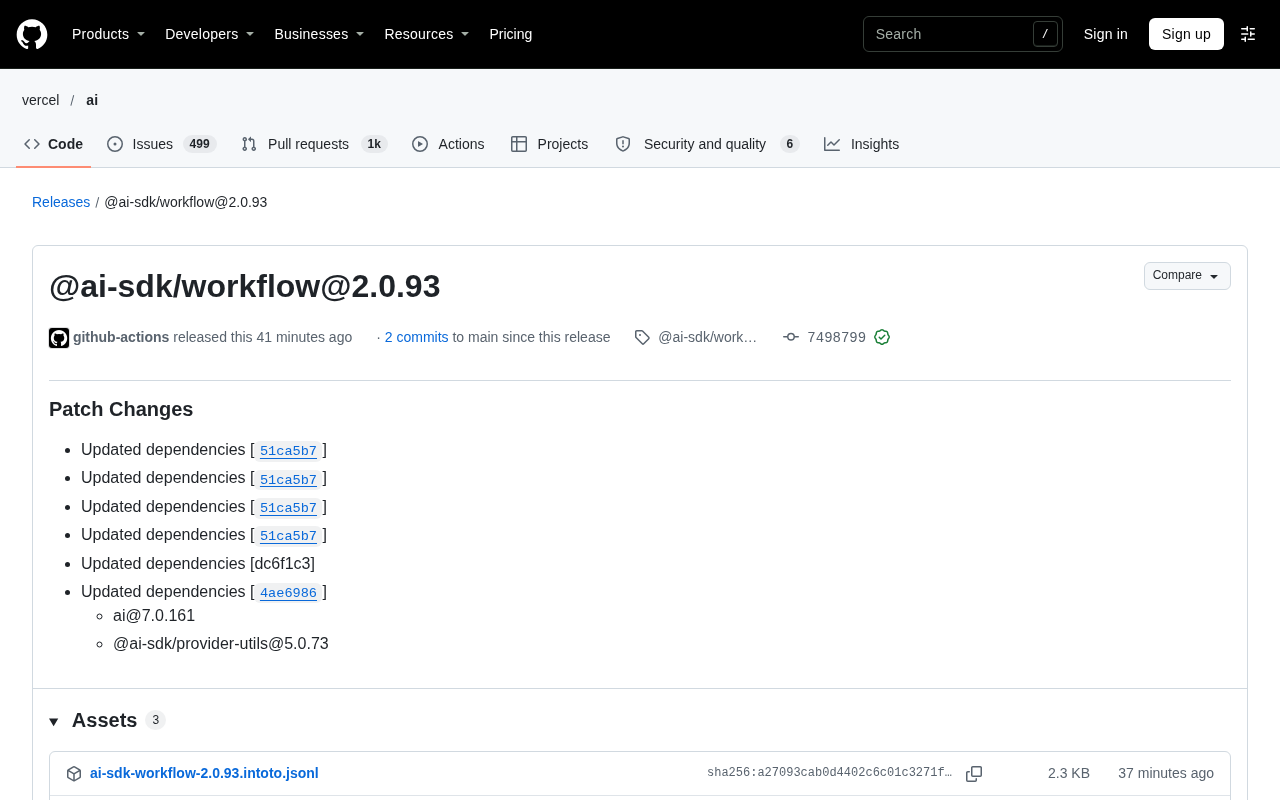
According to the release record on GitHub, version 2.0.93 is a Patch Change, with "Updated dependencies" appearing multiple times in the commit messages, indicating that the main action of this release is aligning several internal dependencies to new version numbers. The ai package is updated to 7.0.161 and @ai-sdk/provider-utils to 5.0.73. Such updates typically introduce no new APIs and do not change the behavior of public interfaces, but they do carry fixes and minor adjustments from upstream packages.
The ai package is the core AI SDK package led by Vercel, providing a unified model invocation abstraction layer, including high-level APIs such as generateText, streamText, and generateObject, as well as capabilities like tool calling, structured output, and multi-step reasoning. @ai-sdk/provider-utils is a low-level utility library for provider authors, encapsulating common logic such as HTTP request handling, streaming response parsing, error mapping, and schema validation; official and third-party providers (such as OpenAI, Anthropic, and Google) are all built on it. Together they form a layered structure of "core abstraction + provider adapters," with @ai-sdk/workflow performing workflow orchestration on top. Therefore, any fix in the upstream packages propagates through the dependency chain, and patch upgrades are essentially about keeping the entire chain aligned in version.
Why Patch Versions Deserve Attention
In many teams' practices, patch versions are easily overlooked until some upstream fix indirectly resolves a thorny problem. @ai-sdk/workflow depends on the two foundational packages ai and provider-utils: the former carries the core model invocation abstraction, while the latter handles common provider-level logic. Any fix along the dependency chain propagates to the workflow layer through patch versions. Thus, the 2.0.93 release can be understood as a routine action to keep the entire AI SDK toolchain version-consistent.
Under Semantic Versioning (SemVer), the three segments of MAJOR.MINOR.PATCH correspond respectively to incompatible changes, backward-compatible feature additions, and backward-compatible bug fixes. Patch versions theoretically do not change the contract of public APIs and contain only bug fixes, security patches, and internal implementation adjustments. In real-world engineering, however, "no change to public interfaces" does not equal "completely identical behavior"—subtle upstream adjustments to retry policies, default timeouts, streaming chunk boundaries, or error types can all manifest as observable differences at the business layer. This is why even for patch upgrades, it is still advisable to run key paths in a test environment rather than unconditionally trusting version-number semantics.
Practical Impact on Developers
Upgrade Recommendations and Risk Assessment
Since this is a patch version with changes concentrated in dependency updates, the upgrade risk is relatively manageable. Teams using @ai-sdk/workflow for workflow orchestration can first validate in a test environment, confirm that the dependency upgrades introduce no behavioral differences, and then merge into the main branch. If a project strictly pins the version of the ai package, it should also check the compatibility of 7.0.161 with its own code, especially the parts involving provider configuration and tool calling.
Lessons from a Version Management Perspective
This release also reflects a common engineering reality: the dependency layers of the AI application stack are becoming ever deeper, and a single workflow package often involves several foundational libraries. Keeping dependency versions aligned reduces hidden failures caused by "version mismatches within the same ecosystem." For long-term maintained projects, it is recommended to incorporate such patch updates into a routine dependency inspection process rather than dealing with them reactively only when compatibility issues arise.
Summary
@ai-sdk/workflow 2.0.93 is a patch release focused mainly on dependency synchronization, with the version updates of the ai package and @ai-sdk/provider-utils as the main content. It introduces no new features itself but reflects the AI SDK ecosystem's ongoing maintenance of version consistency. Developers can handle it through the standard patch upgrade process, with emphasis on compatibility verification after the dependency upgrades.
One-line Summary
AI SDK's @ai-sdk/workflow releases 2.0.93 patch version, mainly synchronized dependency upgrades, with no new APIs.
Paragraph Summary
The @ai-sdk/workflow package in the AI SDK ecosystem has released patch version 2.0.93. This update is centered on dependency synchronization, upgrading the core ai package to 7.0.161 and @ai-sdk/provider-utils to 5.0.73, without introducing new APIs or changing public interface behavior. The article points out that patch versions are easily overlooked, but upstream fixes propagate along the dependency chain to the workflow layer, so such releases are essentially routine actions to keep the entire AI SDK toolchain version-consistent. For developers, the upgrade risk is relatively manageable; it is recommended to validate dependency compatibility in a test environment first, paying special attention to code related to provider configuration and tool calling, and to incorporate patch updates into a routine dependency inspection process.
Related articles

Skykea Showdown: A Hilarious Variety Show Experience of a Minecraft Airship Building Competition
Skykea Showdown is a Minecraft airship building racing variety show. This article analyzes its two-phase build + hole race format, airship mod lift physics, secret mission design, and team confrontation dynamics—ideal for game content creators.

Did the US Midterms Vote No to AI Data Centers? A Map Reveals the Truth
After the US midterms, media claimed voters rejected AI data centers, but a map shows restrictive votes are concentrated in a few Ohio townships, affecting less than 1% of US towns—the national anti-AI wave is exaggerated.
ApexW Optimizer Benchmark: Matches 8-bit AdamW in Unsloth with Lower Memory Usage
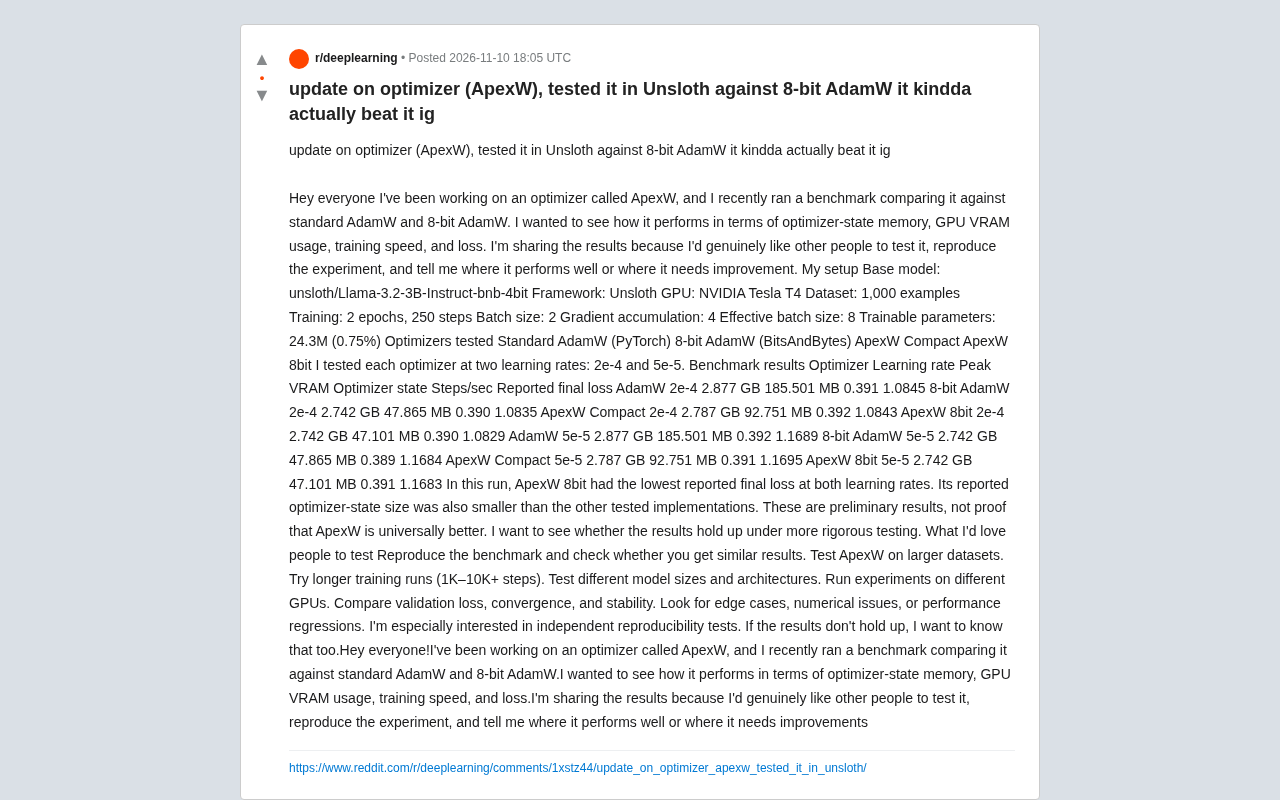
Developer shares benchmark of ApexW optimizer in Unsloth: ApexW 8bit has lower optimizer state memory (47.101 MB) and slightly better final loss than 8-bit AdamW, but similar speed. Needs independent reproduction.