@ai-sdk/workflow 2.0.94 Release: Comprehensive Telemetry Upgrade for WorkflowAgent
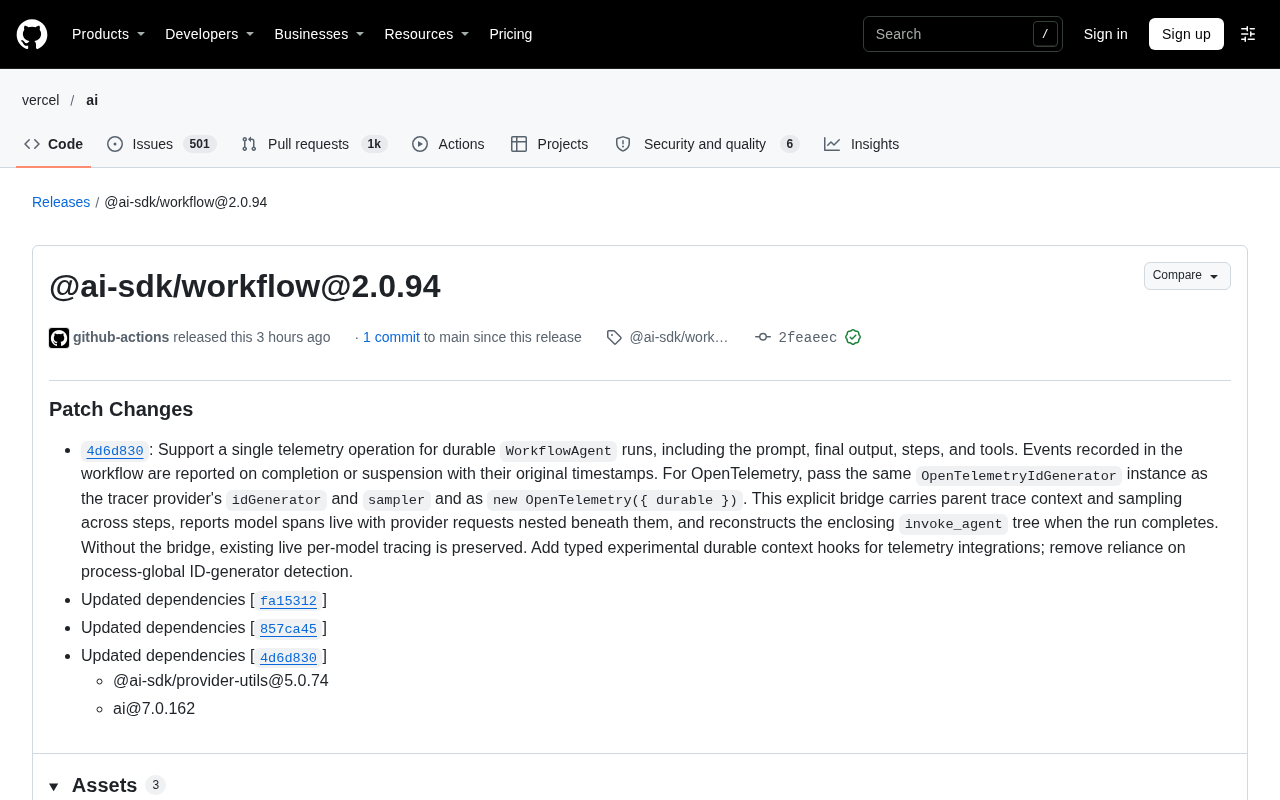
@ai-sdk/workflow 2.0.94 introduces a single telemetry operation for durable Agents, solving timeline and trace consistency challenges.
@ai-sdk/workflow@2.0.94 is a patch release with key observability improvements for durable WorkflowAgent. It supports a single telemetry operation per durable run, covering prompt, final output, steps, and tool calls, and reports events with original timestamps on completion or suspension, ensuring accurate timeline reconstruction across hours or days. OpenTelemetry integration requires explicitly passing the same OpenTelemetryIdGenerator instance; without it, behavior falls back to existing per-model real-time tracing, so the upgrade is non-breaking. It also removes process-global ID generator detection and adds typed experimental durable context hooks, making trace behavior more predictable in multi-instance and multi-tenant environments.
A "Low-Key" Patch That Solves the Observability Challenge of Durable Agents
@ai-sdk/workflow@2.0.94 is only a patch version by its version number, but looking at the changes, it touches on the most easily overlooked and most production-critical aspect of AI Agent engineering—telemetry for durable execution. This version introduces single telemetry operation support for durable WorkflowAgent runs, bringing prompts, final outputs, execution steps, and tool calls into a single trace.
For teams running Agents on long-running tasks and resume-from-checkpoint scenarios, this change is worth paying attention to.
Core Change: One Operation Covers an Entire Agent Run
From "Fragmented Tracing" to a Single Operation
Previously, the execution of a durable WorkflowAgent was more likely to be split into multiple independent trace records. This patch version supports generating a single telemetry operation for one durable run, covering:
- prompt
- final output
- steps
- tools
More importantly, it handles timeline reconstruction: events recorded in the workflow are reported when the run completes or is suspended, and they carry their original timestamps. This solves a real pain point—a durable Agent may complete hours or even days later, and if events are timestamped at report time, event ordering and duration analysis become completely garbled.
The key difference between durable Agents and ordinary synchronous Agents lies in their execution lifecycle. A regular Agent call typically completes within a single process, so trace data can be reported in real time. A durable Agent, however, may be suspended mid-execution (for example, waiting for an external event, human approval, or a scheduled trigger), the process may exit, and it may resume from persistent storage hours or even days later. If events are timestamped at real-time report time, the restored spans will appear in the tracing system with a new time baseline, causing event ordering to be scrambled and duration statistics to be distorted. Preserving original timestamps means each event records its actual occurrence time when it is generated, and that timestamp is carried when reporting to the tracing backend. This way, no matter how delayed the reporting is, the tracing system can reconstruct the correct causal order and actual duration distribution.
Explicit Bridging with OpenTelemetry
The original text specifically explains how to use it with OpenTelemetry: the same OpenTelemetryIdGenerator instance needs to be passed to both the tracer provider's idGenerator and sampler, as well as to new OpenTelemetry({ durable }).
This explicit bridge does several concrete things:
- Passes parent trace context and sampling decisions between steps
- Reports model spans in real time, with provider requests nested under them
- Reconstructs the complete
invoke_agentcall tree when the run completes
Without this bridge, behavior falls back to the existing per-model real-time tracing mode. In other words, the upgrade does not break existing integrations; the new capability is an optional enhancement rather than a mandatory migration.
In OpenTelemetry, IdGenerator is responsible for generating the Trace ID and Span ID for each span, while Sampler determines whether a trace is sampled and at what rate. In distributed tracing, for multiple services or steps in a single request chain to be associated under the same trace, all components must remain consistent in Trace ID generation and sampling decisions. OpenTelemetryIdGenerator is a custom ID generator implementation provided by the AI SDK that allows the same Trace ID generation logic to be reused across different execution phases of a durable Agent (including resumption after suspension), ensuring that spans across steps and across time are correctly attributed to the same trace. Injecting the same instance into both idGenerator and sampler essentially ensures that ID generation and sampling decisions share the same state, avoiding trace breaks or sampling inconsistencies caused by different instances.
Removing Dependence on Process-Level ID Generator Detection
The patch also adds typed experimental durable context hooks for telemetry integrations and removes dependence on process-global ID-generator detection. The latter is an engineering-quality improvement: implicit detection of process-global state is prone to hard-to-reproduce issues in multi-instance and multi-tenant environments. With explicit passing, chain behavior becomes more predictable.
Process-level global state detection refers to a library discovering available ID generators or tracing configuration at runtime by inspecting global variables or module-level singletons. This approach usually works well in single-process, single-tenant development environments, but in production scenarios with multi-instance deployments, multi-tenant isolation, or multiple independent Agents running in the same process, global state may be shared or overwritten by multiple logical units. This can cause traces from different tenants or different Agents to contaminate each other, and the problem is often difficult to reproduce reliably. With explicit passing (injection via parameters or context hooks), each Agent run can be clearly bound to its own telemetry context, making behavior more predictable and easier to test and isolate.
Related Dependency Updates
This version also updates dependencies: @ai-sdk/provider-utils@5.0.74 and ai@7.0.162. The release record shows this is a patch release containing a single commit.
Synchronized dependency version updates mean that telemetry-related capability improvements are likely spread across multiple packages in the SDK. Upgrading only the workflow package without synchronizing the underlying dependencies may not deliver the full effect.
What This Means for Developers
First, observability moves from "visible" to "reconcilable." The combination of a single operation and original timestamps gives durable Agents a reliable data foundation for cost attribution, latency analysis, and failure retrospection.
Second, adoption is gradual. Without configuring the bridge, behavior falls back to the old real-time tracing, which is friendly to systems already running in production.
Third, explicit beats implicit. Removing dependence on global ID generator detection may require only minor changes for users, but this design preference is worth affirming—especially when Agents need to maintain trace consistency across steps and execution environments, implicit conventions are often a source of failures.
One caveat: the capabilities in this version are mainly aimed at scenarios where OpenTelemetry is already in use and durable Agent tracing is needed. If you only make short synchronous Agent calls, the direct impact of this update is limited.
Background
Related Concept: Suspension and Resumption in Workflows
Durable workflow engines typically support suspension semantics: when a step needs to wait for an external condition, the engine serializes and saves the current execution state, releases compute resources, and resumes from the checkpoint once the condition is met. For Agent workflows, suspension points may occur when a tool call waits for an API response, waits for human confirmation, or waits for a scheduled task to trigger. This mechanism means that a single logical Agent run may span multiple process lifecycles, so telemetry systems cannot assume that all spans are produced continuously within the same process. The single telemetry operation design is precisely intended to produce a logically complete trace record under this non-continuous execution model.
Related articles

Skykea Showdown: A Hilarious Variety Show Experience of a Minecraft Airship Building Competition
Skykea Showdown is a Minecraft airship building racing variety show. This article analyzes its two-phase build + hole race format, airship mod lift physics, secret mission design, and team confrontation dynamics—ideal for game content creators.
Did the US Midterms Vote No to AI Data Centers? A Map Reveals the Truth
After the US midterms, media claimed voters rejected AI data centers, but a map shows restrictive votes are concentrated in a few Ohio townships, affecting less than 1% of US towns—the national anti-AI wave is exaggerated.
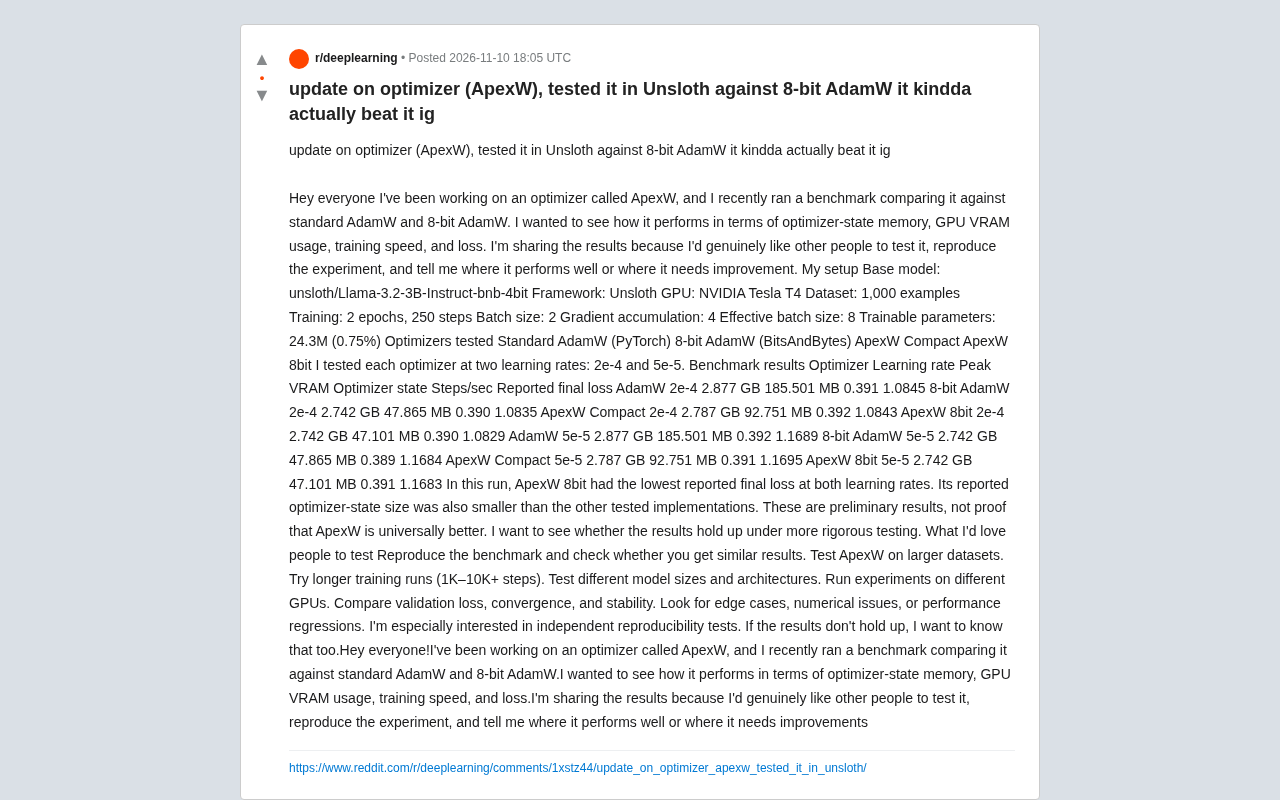
ApexW Optimizer Benchmark: Matches 8-bit AdamW in Unsloth with Lower Memory Usage
Developer shares benchmark of ApexW optimizer in Unsloth: ApexW 8bit has lower optimizer state memory (47.101 MB) and slightly better final loss than 8-bit AdamW, but similar speed. Needs independent reproduction.