@ai-sdk/workflow 2.0.98 Patch Released: AI SDK Workflow Capabilities Upgraded Again
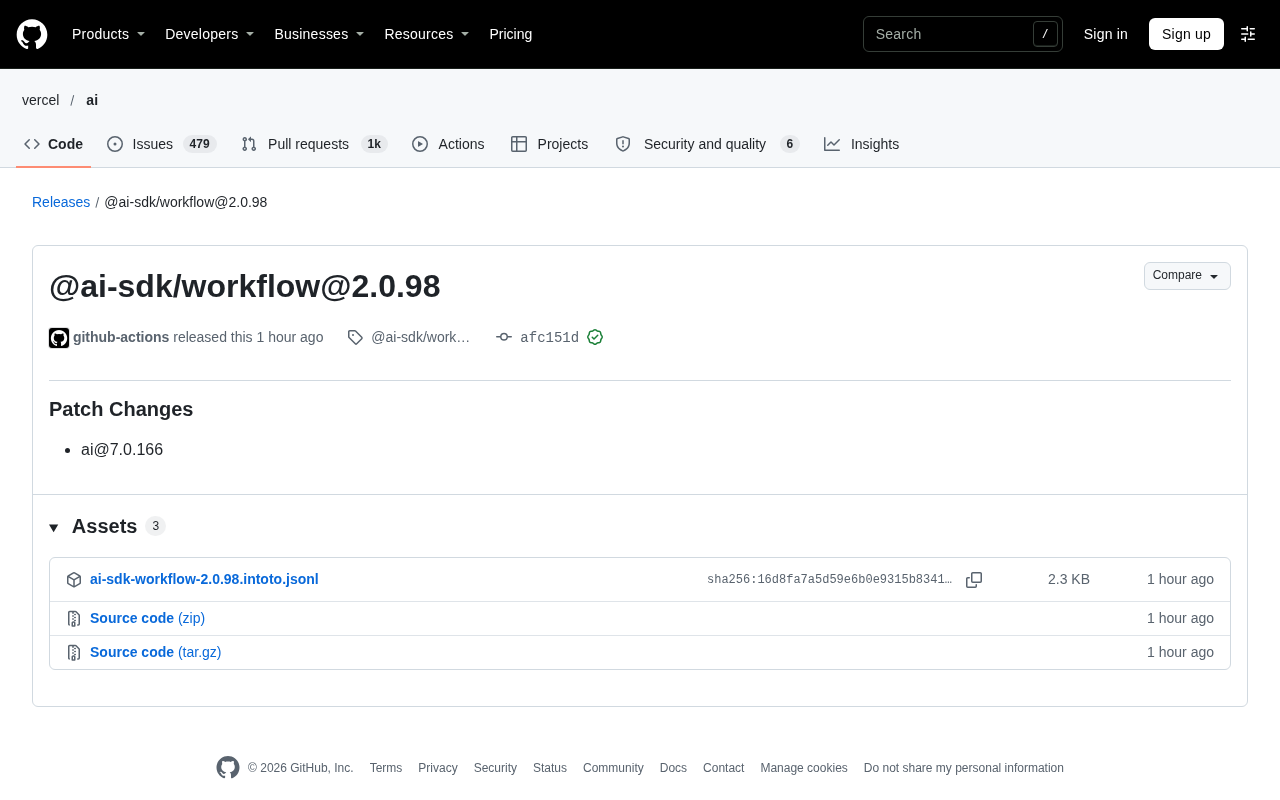
@ai-sdk/workflow releases patch 2.0.98, syncing the ai package to 7.0.166 and emphasizing paired version upgrades.
@ai-sdk/workflow has released patch version 2.0.98, with the core change being syncing the underlying ai package dependency to 7.0.166—a typical dependency alignment update. The article notes that the workflow package is tightly bound to the core AI SDK version, and partial upgrades can easily cause type or runtime inconsistencies. It recommends that developers record and upgrade both in pairs in their dependency manifest, and verify the multi-step call chain after upgrading. The package has entered a stable maintenance phase, and future orchestration semantics and version binding trends are worth watching. For projects already locked to older versions, this update can be included in the next round of dependency cleanup; new projects are advised to use the latest patch version directly.
Vercel's AI SDK ecosystem has seen another minor iteration. @ai-sdk/workflow has released patch version 2.0.98, while syncing the underlying ai package dependency to 7.0.166. Although the official changelog is brief, for developers building workflows with the AI SDK, this type of patch release often signals subtle fixes in the dependency chain and version alignment—making it worth paying attention to.
What the Patch Updates: Primarily Dependency Alignment
Based on the change notes published on GitHub, 2.0.98 is a typical Patch Change: no new APIs, no breaking changes—the core action is bumping the ai package version to 7.0.166. In other words, @ai-sdk/workflow's release cadence is tied to the AI SDK mainline, and the workflow module needs to stay version-consistent with the core SDK to avoid type-level or runtime incompatibilities.
For users, this brings a very practical recommendation: if your project includes both ai and @ai-sdk/workflow, you should try to update both versions together rather than touching only one. The patch version number may be small, but mixing across versions can easily cause problems with type inference and package export structures.
Where Workflows Fit in the AI SDK Ecosystem
The AI SDK was originally positioned to unify the calling interfaces of different model providers, letting developers switch models, handle streaming output, and build structured output with a single API. As application complexity has grown, needs around multi-step task orchestration, tool-calling chains, and conditional branching have gradually emerged—and the workflow-related packages serve as supplementary capabilities for these scenarios.
Splitting workflow capabilities into a separate package has the benefit of more flexible version evolution: the core SDK can maintain a relatively stable release cadence, while the workflow module can iterate according to its own needs. The cost is a more complex version matrix—which is exactly why the dependency alignment action in a patch release deserves serious attention. Its practical impact on users is often greater than the literal length of the changelog suggests.
"Workflow" in the AI SDK does not refer to some standardized specification, but rather a programming abstraction for orchestrating multi-step AI tasks (such as chained model calls, tool calls, conditional branches, loops, etc.). Before @ai-sdk/workflow appeared, developers typically had to manually write state machines or rely on third-party orchestration libraries to manage these steps. This package attempts to encapsulate common orchestration patterns (such as serial, parallel, and branching) into composable APIs, deeply integrated with AI SDK features like streaming output and tool calling. Its design goal is to reduce the implementation complexity of multi-step AI applications while maintaining type consistency with the core SDK.
Practical Impact of This Release on Developers
For projects already locked to older versions, 2.0.98 is not a mandatory update to follow immediately, but it can be included in the next round of dependency cleanup. For projects just getting started, using the latest patch version directly helps avoid known minor issues.
The real concern is partial upgrade operations like "upgrading only the workflow package without upgrading the core SDK." AI SDK packages have relatively tight type dependencies between them, and partial upgrades may let TypeScript type checks pass while exposing inconsistencies at runtime. The safer approach is to check the release page to confirm the corresponding ai package version, then upgrade them together and run your existing tests.
In semantic versioning (SemVer), a patch version (such as 2.0.98) typically contains only backward-compatible bug fixes, without introducing new features or breaking changes. However, in the npm ecosystem, patch versions may also include subtle adjustments to dependency ranges—bumping the ai package to 7.0.166 in this release is one such case. Since JavaScript package managers by default install the highest available version that satisfies the version range, if a project has not pinned exact versions, npm install or yarn upgrade may automatically pull in the new patch version, indirectly introducing dependency changes. Therefore, even if a patch version appears harmless, it is recommended to pin the lockfile in CI and periodically audit the dependency tree to avoid uncontrolled automatic upgrades.
Usage Recommendations and What to Watch Next
Judging from the shape of this release, @ai-sdk/workflow has entered a stable maintenance phase, with releases consisting mainly of patches and minor-version fixes. Two directions are worth watching going forward: first, whether the workflow package will introduce more complex orchestration semantics; second, whether its version binding with the core SDK will tighten further.
For most teams, the most practical action right now is to lock in a version management strategy: record the versions of both ai and the workflow package in your dependency manifest, handle them as a pair when upgrading, and verify the multi-step call chain after upgrading. That way, even if patch versions are released frequently, dependency chaos can be avoided.
One-line Summary
@ai-sdk/workflow releases patch 2.0.98, syncing the ai package to 7.0.166 and emphasizing paired version upgrades.
Paragraph Summary
@ai-sdk/workflow has released patch version 2.0.98, with the core change being syncing the underlying ai package dependency to 7.0.166—a typical dependency alignment update. The article notes that the workflow package is tightly bound to the core AI SDK version, and partial upgrades can easily cause type or runtime inconsistencies. It recommends that developers record and upgrade both in pairs in their dependency manifest, and verify the multi-step call chain after upgrading. The package has entered a stable maintenance phase; going forward, it is worth watching the evolution of orchestration semantics and version binding trends. For projects already locked to older versions, this update can be included in the next round of dependency cleanup; new projects are advised to use the latest patch version directly.
Related articles

Seven Years of Evolution: How Far Has the Foldable Come From the First Generation?
From the first foldable to today's latest models, what has seven years changed? Shallower creases, higher brightness, thinner bodies, and smoother software migration—has the foldable crossed the chasm from enthusiasts to ordinary users? This article discusses the question based on a video comparison.

When Did Humans Start Eating Salt? A 10,000-Year History of Salt
When did humans start eating salt? From salt use at the dawn of agriculture 11,000 years ago to ancient seawater evaporation and rock salt mining, and on to the salt trade, salt taxes, and Gandhi's Salt March, this article traces salt's key role in human civilization.
Microsoft Paza Research: How African Language Speech Recognition Breaks Through Architecture and Data Bottlenecks
Microsoft's Paza research evaluates 53 speech models across 39 African languages, revealing architecture choice matters more than pre-training coverage, 200-300 hours is the practical data threshold, and language typology deeply influences recognition performance.