AI SDK workflow-harness 1.0.156 Patch Released: Harness Updated in Sync

@ai-sdk/workflow-harness releases 1.0.156 patch, harness aligned in sync, automated signed release.
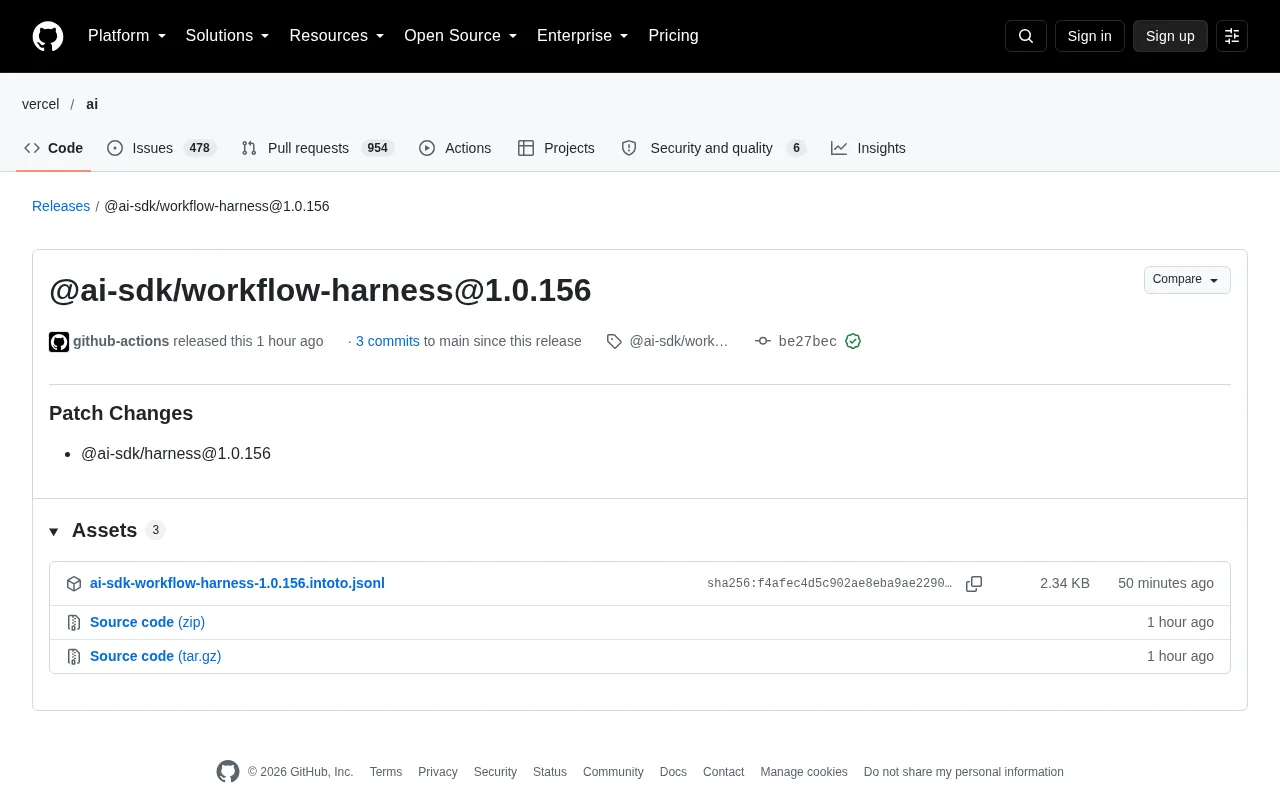
Based on GitHub Release information, the article reports that `@ai-sdk/workflow-harness` released a 1.0.156 patch version, with the underlying `@ai-sdk/harness` bumped to the same version in sync. The release was automatically completed by github-actions and includes 3 commits with GitHub GPG verified signatures, indicating a highly automated and trustworthy release process. Since the Release Notes only list the version number without specific fixes, the author infers it is likely internal consistency and dependency alignment maintenance rather than a functional change. The article further analyzes the value of such minor versions: version alignment reduces peer dependency conflict risks, automated releases compress the fix cycle, and it offers practical recommendations such as paired upgrades and pinning versions in CI.
A low-key patch release reveals the iteration cadence of the AI SDK toolchain
According to the GitHub Release information published via RSS feed, @ai-sdk/workflow-harness has released version 1.0.156. This is a Patch Changes-level update, and @ai-sdk/harness has also been bumped to 1.0.156 in sync. From the release page, this update was automatically published by github-actions, contains 3 commits in total, and the commits carry GitHub verified signatures.
For developers unfamiliar with this toolchain, workflow-harness is a workflow orchestration and testing support component in the AI SDK ecosystem, while harness is the underlying runtime/testing skeleton. The two share the same version number, indicating that this release is more of an internal consistency maintenance rather than a major functional change.
The signal behind the version number: automated releases and engineering discipline
The automated release process has matured
The Release record clearly labels the publisher as github-actions and includes a GPG verified signature (key ID: B5690EEEBB952194). Such details indicate that the project's release process is highly automated: after code is merged into main, CI triggers the version release, generates the tag, and completes signature verification. For teams using this SDK, this means the version source is trustworthy and traceable, providing a certain level of supply chain security.
GPG signature verification plays a key role in the software supply chain. When publishing via GitHub Actions, the GPG private key configured by the repository maintainers can be used to sign the tag or commit; users verify the signature with the public key to confirm that the version was indeed produced by a trusted CI process rather than forged by a third party. The key ID B5690EEEBB952194 appearing in the article is the short identifier of the signing key, and developers can verify it using git tag -v or the "Verified" badge in the GitHub interface. For the npm ecosystem, the signature alone cannot completely prevent malicious package poisoning, but it provides a traceable chain of evidence; combined with lockfiles and integrity hashes, it can significantly improve dependency security.
The positioning of Patch Changes
Patch versions are typically used for bug fixes, dependency synchronization, documentation, or internal refactoring, and do not involve breaking changes. In this Release Notes, only the version number change is listed without specific fixes being detailed, which is not uncommon in the high-frequency iteration of emerging toolchains—many minor versions simply keep the dependency tree aligned.
Semantic Versioning (SemVer) splits the version number into three parts: major.minor.patch. A major version change indicates incompatible API changes, a minor version indicates backward-compatible feature additions, and a patch version corresponds to backward-compatible bug fixes. The term Patch Changes is commonly seen in release management tools like Changesets, which require each PR to include a change description, automatically aggregate them to generate a changelog, and increment the version number upon release. Therefore, seeing a Patch-level update generally means the upgrade will not break existing usage; however, note that SemVer is a convention rather than a mandate, and actual projects may still include behavioral adjustments in minor versions—especially in 0.x or high-frequency iteration packages, where extra caution is warranted.
Why such minor versions deserve attention
Version alignment reduces the risk of dependency conflicts
@ai-sdk/workflow-harness and @ai-sdk/harness are both at 1.0.156. This synchronized release approach can reduce peer dependency warnings caused by version misalignment among sub-packages in monorepos or large projects. If you use both packages in your project, it is recommended to update them in pairs to avoid version drift.
Peer dependency is a way of declaring dependencies in npm, indicating that the current package requires the host project to provide a specific version of a dependency rather than installing its own copy. When multiple sub-packages have inconsistent version ranges for the same peer dependency, npm 7+ will issue peer dependency warnings or even fail installation, and pnpm and yarn handle this slightly differently. In monorepos, if sub-package versions drift, such conflicts are particularly common. Locking coupled packages to the same version number (i.e., "version alignment" or fixed versioning) keeps the dependency tree to a single instance, avoiding hidden issues such as type mismatches and singleton failures caused by loading the same module multiple times.
Automated releases mean faster fix cycles
A release cadence driven by github-actions typically means the time between problem discovery and version availability is greatly compressed. For teams building agent workflows or test pipelines on the AI SDK, this means they don't have to wait long for a manual release when encountering blocking issues.
Practical recommendations
Developers using this toolchain can take the following actions: check whether the versions of @ai-sdk/workflow-harness and @ai-sdk/harness in package.json are consistent; pin versions in CI to avoid automatically pulling the latest patch and introducing unexpected changes; and follow the project repository's Release page, because this release note is fairly brief—if there are behavioral changes later, they are usually supplemented in the changelog or related PRs.
It should be noted that the release information itself is quite concise and does not disclose specific fixes, so the above analysis is mostly inferred from version management conventions and release metadata; the actual changes should still be based on the repository commit records.
Release information at a glance
| Item | Content |
|---|---|
| Package name | @ai-sdk/workflow-harness |
| Version | 1.0.156 |
| Change type | Patch Changes |
| Publisher | github-actions |
| Signature status | GitHub verified signature (GPG B5690EEEBB952194) |
| Commit count | 3 commits |
One-line Summary
@ai-sdk/workflow-harness releases 1.0.156 patch, harness aligned in sync, automated signed release.
Paragraph Summary
Based on GitHub Release information, the article reports that @ai-sdk/workflow-harness has released a 1.0.156 patch version, with the underlying @ai-sdk/harness bumped to the same version number in sync. The release was automatically completed by github-actions and includes 3 commits with GitHub GPG verified signatures, indicating that the project's release process is highly automated and its source is trustworthy and traceable. Since the Release Notes only list the version number without disclosing specific fixes, the author infers that this update is more likely maintenance for internal consistency and dependency alignment rather than a functional change. The article further analyzes the value of such minor versions: version alignment can reduce the risk of peer dependency conflicts, and automated releases compress the cycle from problem discovery to fix availability, and provides practical recommendations such as paired upgrades and pinning versions in CI.
Related articles

Last Week Tonight Exposé: The Dangerous Ties Between Politicians and White Supremacy
Last Week Tonight investigates Georgia Senate candidate Mike Collins and Florida candidate Marshall Rawson, exposing their multiple ties to white supremacists and the Republican Party's silent response.
AI Buzz Weekly: GPT-6.5 Leak, New Claude Model, and MiniMax's Cost-Effectiveness
This week's AI buzz roundup: suspected GPT-6.5 leak, Microsoft configs showing GPT-6.1 Tera, Anthropic's new model that can identify entire classes of bugs, disappointing early Gemini 4 Carbon results, and MiniMax M3.1 Flash beating Claude Opus 5 and GPT-5.6 Sol in benchmarks at extremely low cost.
AI Briefing: Gemini 4 Carbon Released, Ant Open-Sources Ling-3.1
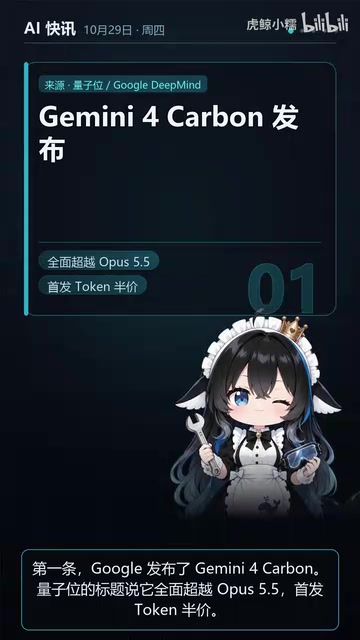
AI Briefing: Google releases Gemini 4 Carbon qubit model, claiming to surpass Opus 5.5 with half-price tokens; Ant open-sources Ling-3.1-1019 for real-task Personal Agents; domestic AI drug discovery succeeds in 18 of 19 projects, hitting all 6 GPCR targets; zero-revenue company valued at $20B raises another $1B; Sichuan convenience store robot sales fail.