AI SDK Workflow Harness 1.0.163 Patch Released, Stability Improved Again

@ai-sdk/workflow-harness releases 1.0.163 patch, focusing on workflow execution stability fixes.
The @ai-sdk/workflow-harness in the AI SDK ecosystem has released patch version 1.0.163, and the related @ai-sdk/harness has also been updated in sync. This package orchestrates multiple model calls, data processing, and conditional logic into reusable AI workflows and is an important tool for building multi-step AI applications. This update is at the patch level, and the official release does not list the fixed content item by item, but the high-frequency small-version iterations reflect the team's rapid response to community feedback and fixes for edge-case issues. The article recommends that developers upgrade through npm or yarn, check the changelog before upgrading and verify compatibility in a test environment, and when using a monorepo, also pay attention to version consistency of related packages to ensure the stable operation of production-grade workflows.
The @ai-sdk/workflow-harness package in the AI SDK ecosystem has recently released version 1.0.163. This is a patch update that mainly fixes several detailed issues in workflow execution, further improving the stability and reliability for developers building AI workflows.
Patch Update Focuses on Stability
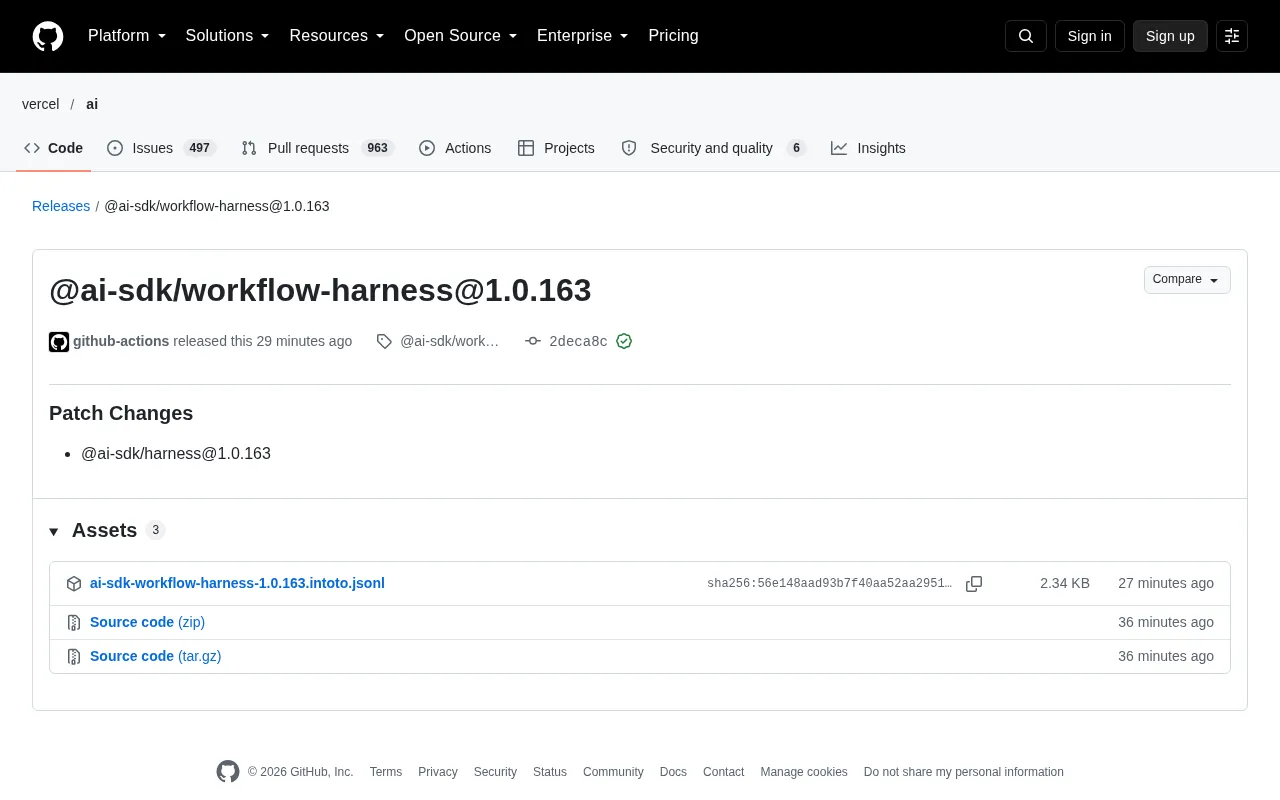
According to the release records on GitHub, this update is at the patch level, and @ai-sdk/harness has also been updated to 1.0.163 in sync. Although the official release does not list all fixed items in detail, such frequent patch releases usually indicate that the team is actively collecting community feedback and rapidly iterating to resolve issues in edge cases. For developers relying on AI SDK to build production-grade workflows, keeping dependencies up to date helps avoid potential execution errors.
The Role of Workflow Harness in AI Development
@ai-sdk/workflow-harness is part of the AI SDK, designed to provide developers with the ability to orchestrate complex AI tasks. It can combine multiple model calls, data processing steps, and conditional logic into reusable workflows, thereby simplifying the development of multi-step AI applications. As AI applications shift from simple conversational interfaces to more complex automation processes, the value of such toolkits is becoming increasingly prominent.
AI SDK (formerly Vercel AI SDK) is an open-source toolkit for TypeScript/JavaScript developers, with the core goal of unifying the calling interfaces of different large model providers, allowing developers to access models such as OpenAI, Anthropic, and Google through the same set of APIs, with built-in capabilities such as streaming responses, tool calling, and structured output. It is typically used in conjunction with frontend frameworks such as Next.js and serves as a high-level abstraction layer for building AI applications. @ai-sdk/workflow-harness is an extension package under this ecosystem. The term "harness" in the name refers to a "test/run harness," that is, a peripheral wrapper that provides execution, scheduling, and validation capabilities around workflows, rather than model invocation itself. Understanding this positioning helps determine that when problems occur in this package, what is affected is the orchestration and execution of workflows, not the underlying model inference.
Version Iteration and Ecosystem Building
From the version number 1.0.163, it can be seen that the project adopts a high-frequency small-version iteration strategy. This model facilitates rapid bug fixes and performance optimization, and also reflects a high level of community activity. Developers can follow the releases page on GitHub for the latest updates and upgrade dependencies in their projects in a timely manner.
Semantic Versioning (SemVer) specifies that version numbers take the form MAJOR.MINOR.PATCH: a major version change indicates incompatible API modifications, a minor version indicates backward-compatible feature additions, and a patch number indicates only backward-compatible bug fixes. Therefore, 1.0.163 is at the patch level and theoretically will not introduce breaking changes, so the upgrade risk is low. However, such a high patch number also indicates that the project has not yet released 1.1.0 or 2.0.0, and its feature evolution may still be at a relatively conservative stage. In the npm ecosystem, frequent patch releases are a common feature of early-stage projects and actively maintained projects; developers can declare version ranges such as ^1.0.163 to let the package manager automatically obtain subsequent compatible patches, while using a lockfile to pin the actual installed version to ensure reproducible builds.
How to Obtain and Upgrade
Developers can install or upgrade this package through package managers such as npm or yarn. It is recommended to check the changelog before upgrading and verify workflow compatibility in a test environment. For projects using a monorepo, pay attention to checking version consistency of related packages (such as @ai-sdk/harness).
A monorepo (a single repository containing multiple packages) refers to managing multiple interdependent software packages in the same code repository, with unified building and publishing through tools such as pnpm workspace, npm workspaces, or Turborepo. The AI SDK ecosystem is exactly this structure: @ai-sdk/workflow-harness and @ai-sdk/harness and other packages share the underlying code and release process, so version numbers often move in sync. In a monorepo, packages may reference each other through the workspace protocol; if only one package is manually upgraded, version mismatches or duplicate installations are likely to occur. It is recommended to use batch upgrade commands such as pnpm up --latest or similar, check whether multiple copies of the same package exist in the lockfile, and then run tests to confirm consistent workflow behavior.
Outlook
As the demand for AI workflows grows, AI SDK and its surrounding tools are expected to continue evolving. Although this patch is small, it is a small step toward greater ecosystem maturity. Developers should keep an eye on version updates to fully leverage the latest improvements and fixes.
One-line Summary
@ai-sdk/workflow-harness releases 1.0.163 patch, focusing on workflow execution stability fixes.
Paragraph Summary
The @ai-sdk/workflow-harness in the AI SDK ecosystem has released patch version 1.0.163, and the related @ai-sdk/harness has also been updated in sync. This package is used to orchestrate multiple model calls, data processing, and conditional logic into reusable AI workflows and is an important tool for building multi-step AI applications. This update is at the patch level, and the official release does not list the fixed content item by item, but the high-frequency small-version iterations reflect the team's rapid response to community feedback and fixes for edge-case issues. The article recommends that developers upgrade through npm or yarn, check the changelog before upgrading and verify compatibility in a test environment, and when using a monorepo, also pay attention to version consistency of related packages to ensure the stable operation of production-grade workflows.
Related articles

Google Releases Gemini 4 Carbon: Its Strongest Model Yet, Debuting with a Cybersecurity Focus
Google releases Gemini 4 Carbon, calling it its strongest model, with a cybersecurity focus. It tops the third-party composite ranking at 59 points but leads by only one or two. This article analyzes its security test results, staged rollout, token pricing, and the divergence between self-reported and third-party tests on hallucinations.

LangChain Adds SchemagateRetriever: On-Demand Table Retrieval Cuts Text-to-SQL Prompts by 92.9%
LangChain docs add SchemagateRetriever: retrieves only the tables needed for text-to-SQL with permission filtering, cutting median prompt size by 92.9% on Spider 2.0 large schemas via offline BM25 selection with no model calls.

Multi-Step AI Agent Guardrail in Practice: Fact-Change Detection Drives False-Alarm Rate to 0%
Developer shares first version of a multi-step AI Agent guardrail: re-verifying dependency facts before irreversible actions cut false alarms from 50% to 17% across 23 scenarios, then to 0% via conservative normalization without lowering catch rate. Runs on local qwen2.5-7b.