@ai-sdk/workflow-harness 1.0.164 Released: Documentation Updates and Dependency Sync

@ai-sdk/workflow-harness releases 1.0.164 patch update, only involving documentation formatting and dependency sync.
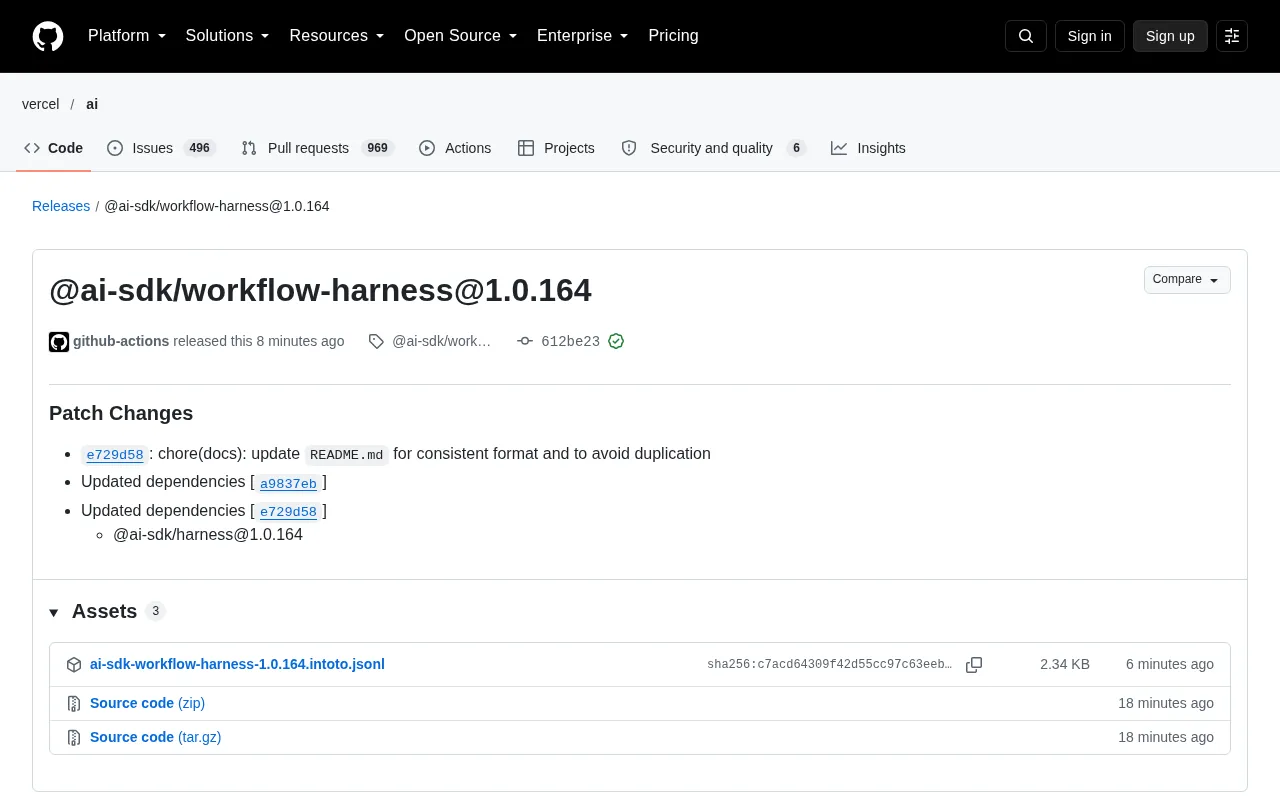
@ai-sdk/workflow-harness releases patch version 1.0.164, which includes no new features or critical bug fixes. It mainly contains two commits: one adjusts README.md formatting to maintain consistent style and avoid duplication; the other syncs the underlying dependency @ai-sdk/harness to the same version 1.0.164. The version is auto-published by GitHub Actions with GPG signature verification. The article notes that documentation standardization helps lower the entry barrier for new users, dependency sync avoids compatibility issues from version mismatches, and recommends teams monitor such patch updates in CI/CD. Community reaction is muted, typical for patch updates.
AI development toolchain iterations often happen quietly, but every version update can affect developers' workflows. Recently, @ai-sdk/workflow-harness released version 1.0.164, a patch update focusing primarily on documentation maintenance and dependency synchronization.
Version Update Details
According to the release notes on GitHub, this 1.0.164 version is classified as a Patch Change and includes two main commits:
- Documentation Update: Commit
e729d58adjusted the formatting ofREADME.mdto maintain consistent documentation style and avoid content duplication. - Dependency Update: Synchronized
@ai-sdk/harnessto the same version number 1.0.164.
These changes were automatically published by GitHub Actions, with commits accompanied by GPG signature verification, ensuring the reliability of the code source.
Semantic Versioning (SemVer) is the basis for classifying this update as a "patch version." According to the SemVer specification, the version number MAJOR.MINOR.PATCH corresponds to incompatible API changes, backward-compatible feature additions, and backward-compatible bug fixes, respectively. 1.0.164 only incremented the PATCH position, meaning the maintainers believe this change does not involve breaking changes to the public API, and the upgrade risk is low. For projects with deep dependency chains, this signal helps determine whether they can upgrade directly without modifying calling code.
GitHub Actions automatic publishing and GPG signatures are the common process for each release of this package. GitHub Actions can automatically execute builds, tests, and npm publish when tags are created or merged into the main branch, reducing version mismatches caused by manual operations. The GPG signatures attached to commits are used to verify the committer's identity and content integrity: Git generates cryptographic signatures for commits, and other developers can use the public key to verify that the commit indeed comes from the claimed author and has not been tampered with. For projects sensitive to supply chain security, this mechanism is an important basis for judging the trustworthiness of dependency sources.
Significance for Developers
Although this update introduces no new features or critical bug fixes, documentation standardization is crucial for the long-term maintenance of open-source projects. A clear README can lower the entry barrier for new users and reduce repetitive questions. Dependency synchronization ensures version consistency between workflow-harness and the underlying harness package, avoiding potential compatibility issues.
For teams using this toolchain, it is recommended to monitor such patch updates in CI/CD processes and synchronize promptly to obtain the latest documentation and dependency fixes.
Dependency synchronization in multi-package repositories (monorepos) is the context for updating both package version numbers simultaneously. When one package (workflow-harness) strongly depends on another package (@ai-sdk/harness) in the same repository, if the two versions remain inconsistent for a long time, hidden failures such as type definition mismatches and internal interface behavior differences may occur. Locking the dependency version to the same version number as itself is a common "version alignment" strategy that can reduce compatibility risks introduced by separate changes to the underlying package.
How to Upgrade
Developers can obtain the new version through commonly used package managers:
npm install @ai-sdk/workflow-harness@1.0.164
Or use tools like yarn or pnpm to update. After upgrading, it is recommended to consult the updated README for the latest usage instructions.
Community Reaction
As of publication, this version has not sparked widespread discussion on GitHub, with zero reactions. This is typical for patch updates—most developers focus more on feature versions. However, the maintenance team's continued investment in documentation quality is commendable.
Future Outlook
As a workflow tool in the AI SDK ecosystem, the stability of @ai-sdk/workflow-harness has a direct impact on upper-layer application development. We look forward to future versions bringing more feature enhancements and performance optimizations.
Related articles

Last Week Tonight Exposé: The Dangerous Ties Between Politicians and White Supremacy
Last Week Tonight investigates Georgia Senate candidate Mike Collins and Florida candidate Marshall Rawson, exposing their multiple ties to white supremacists and the Republican Party's silent response.
AI Buzz Weekly: GPT-6.5 Leak, New Claude Model, and MiniMax's Cost-Effectiveness
This week's AI buzz roundup: suspected GPT-6.5 leak, Microsoft configs showing GPT-6.1 Tera, Anthropic's new model that can identify entire classes of bugs, disappointing early Gemini 4 Carbon results, and MiniMax M3.1 Flash beating Claude Opus 5 and GPT-5.6 Sol in benchmarks at extremely low cost.
AI Briefing: Gemini 4 Carbon Released, Ant Open-Sources Ling-3.1
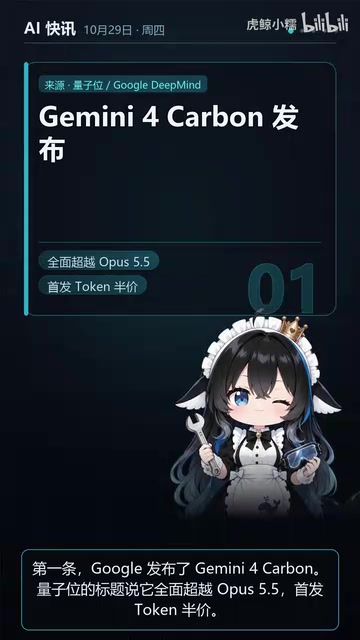
AI Briefing: Google releases Gemini 4 Carbon qubit model, claiming to surpass Opus 5.5 with half-price tokens; Ant open-sources Ling-3.1-1019 for real-task Personal Agents; domestic AI drug discovery succeeds in 18 of 19 projects, hitting all 6 GPCR targets; zero-revenue company valued at $20B raises another $1B; Sichuan convenience store robot sales fail.