AI SDK Workflow Harness 1.0.165 Patch Release

@ai-sdk/workflow-harness releases patch 1.0.165, a low-risk automated maintenance update.
@ai-sdk/workflow-harness has released patch version 1.0.165, automatically built and pushed to main by github-actions, with commit hash e197b50 and GPG signature verification. Under SemVer, a patch change typically means bug fixes, dependency updates, or internal adjustments with no breaking changes. The release notes list only @ai-sdk/harness@1.0.165, indicating this update mainly aligns the underlying harness package version; keeping version numbers in sync helps reduce dependency resolution complexity in monorepos. For developers, it's a low-risk maintenance update—verify existing workflow test cases in a test environment before pushing to production; for specific fix details, review the corresponding commit's diff.
A Low-Key Patch Update
@ai-sdk/workflow-harness in the AI SDK ecosystem has released version 1.0.165. According to the GitHub Releases page, this is a standard patch release (Patch Changes), automatically built and pushed to the main branch by github-actions, with commit hash e197b50 and a GitHub-verified signature.
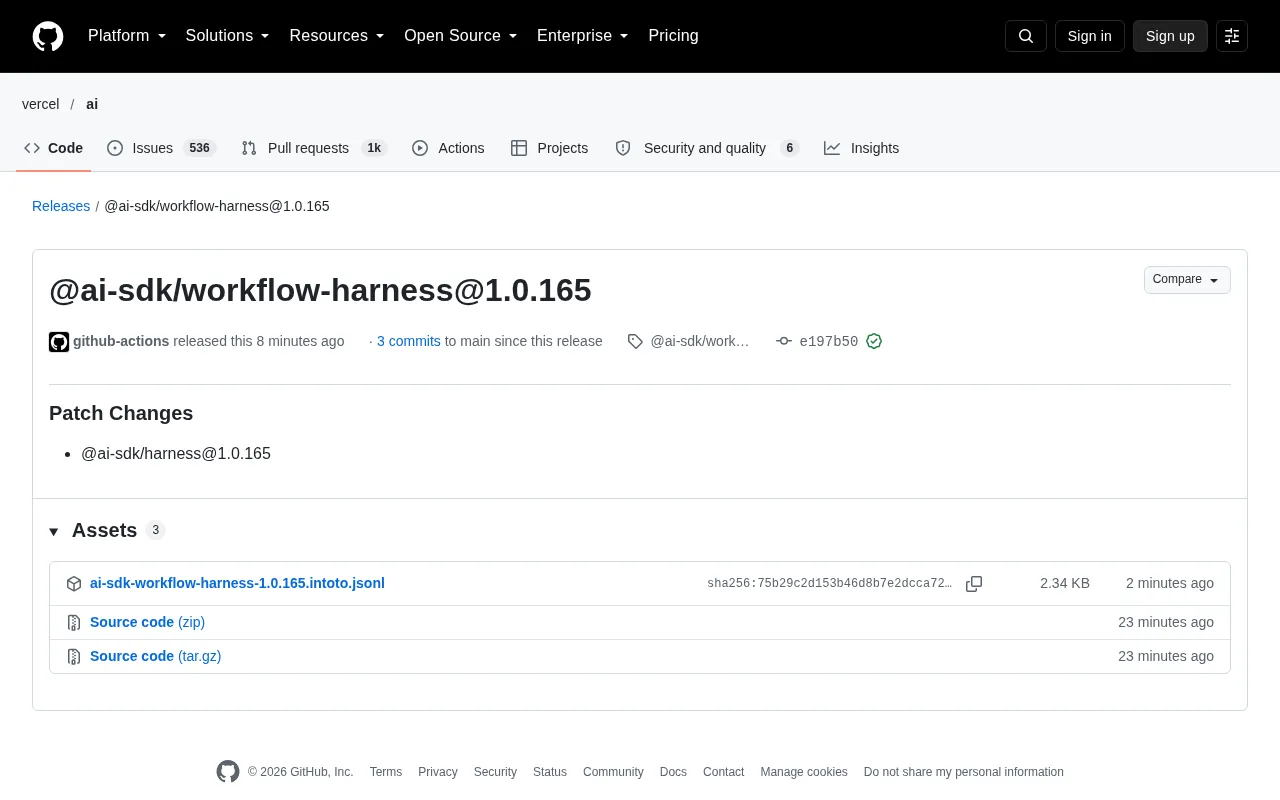
This kind of automated release process is very common in mature open-source projects: the CI system automatically packages, tags, and generates changelogs after code is merged. It's worth noting that under the "Patch Changes" entry in the release notes, only @ai-sdk/harness@1.0.165 is listed, meaning this update likely mainly involves version alignment of the underlying harness package rather than introducing new features.
What a Patch Version Means
In the Semantic Versioning (SemVer) system, a patch number change typically corresponds to bug fixes, dependency updates, or internal implementation adjustments—it contains no breaking changes and adds no new public APIs. For developers building Agent workflows with the AI SDK, these versions can be upgraded with relative confidence, though it's still advisable to pay attention to the specific changes in the harness package.
From the release page, this version is synchronized with @ai-sdk/harness version 1.0.165, indicating that workflow-harness is likely a wrapper layer on top of harness, and keeping the two version numbers in sync helps reduce dependency resolution complexity. This version alignment strategy is fairly common in monorepo-managed SDK projects.
Semantic Versioning (SemVer) is a widely adopted version numbering convention with the format MAJOR.MINOR.PATCH. The MAJOR version increments when incompatible API changes are introduced, MINOR increments when functionality is added in a backward-compatible manner, and PATCH increments for backward-compatible bug fixes. The core value of this rule is that it lets dependents predict upgrade risk based solely on the version number: a patch number change theoretically won't break existing code. The default version ranges in package managers like npm (e.g., ^1.0.165) are also based on this convention, so correctly following SemVer is crucial to ecosystem health. In practice, however, some projects classify dependency updates or even internal refactoring as patch releases, so "patch means safe" is only a probabilistic conclusion and still requires checking the changelog.
Monorepo refers to an engineering pattern where multiple related packages are managed in a single code repository. In a monorepo, sub-packages typically share build configuration, unified testing and release processes, and coordinate version numbers through tools (such as Changesets, Lerna). There are two common versioning strategies: fixed mode keeps all package versions consistent, while independent mode allows each package to evolve separately. The version synchronization between workflow-harness and harness mentioned in the article is a typical manifestation of fixed mode or coordinated releases—the benefit is that dependencies are clear at a glance, at the cost that a small change in one package also bumps all packages.
Automation Characteristics of the Release Process
This release was completed by the github-actions bot, with the page showing "1 commit to main since this release," and the commit verified via GPG signature (key ID ending in B5690EEEBB952194). This reflects the project's emphasis on supply chain security—signed commits allow code provenance to be traced and prevent the release pipeline from being tampered with.
The release page also provides Compare and Assets download entries, but some sections showed error messages when the page loaded. This is usually related to GitHub's frontend dynamic loading and does not affect the availability of the version itself.
GPG-signed commit refers to a developer using a private GPG key to generate a digital signature for Git commit content, so that others can use the corresponding public key to verify that the commit genuinely came from the claimed author and that the content has not been tampered with. GitHub displays a "Verified" badge next to the commit, and enterprise environments can configure branch protection rules to reject unsigned commits from being merged. The key ID is the last segment of the public key fingerprint, used to locate the corresponding public key on a key server. In automated release scenarios, CI bots (such as github-actions) can also hold dedicated signing keys, so that machine-generated commits also have a verifiable source. This is part of software supply chain security: from source commit, build, to artifact distribution, every link is auditable, effectively reducing the risk of the release pipeline being hijacked or poisoned. Several npm package poisoning incidents in recent years were precisely caused by the lack of such verification.
Practical Impact on Developers
For teams building applications on the AI SDK, the direct impact of this patch update is limited. The recommended approach is: first upgrade in a test environment and run existing workflow test cases to confirm there are no unexpected behavior changes at the harness layer, then push to production. If the project has pinned a specific version number, evaluate whether to follow up as needed.
Since the release notes do not detail the specific fixes, developers who need to understand the change details can review the diff of the corresponding commit e197b50 or watch for a more complete version announcement later.
Summary
@ai-sdk/workflow-harness@1.0.165 is a routine patch release that reflects the AI SDK project's automated release process and version linkage strategy. For most users, this is a low-risk maintenance update that can be handled through the normal dependency upgrade process.
One-line Summary
@ai-sdk/workflow-harness releases patch version 1.0.165, a low-risk automated maintenance update.
Paragraph Summary
@ai-sdk/workflow-harness has released patch version 1.0.165, automatically built and pushed to the main branch by github-actions, with commit hash e197b50 and GPG signature verification. Under Semantic Versioning, a patch number change typically corresponds to bug fixes, dependency updates, or internal adjustments, with no breaking changes. The release notes list only @ai-sdk/harness@1.0.165, indicating this update is mainly version alignment of the underlying harness package; keeping the two version numbers in sync helps reduce dependency resolution complexity in monorepo projects. For developers, this is a low-risk maintenance update—it's recommended to verify existing workflow test cases in a test environment before pushing to production; if you need to understand the specific fix details, you can review the diff of the corresponding commit.
Related articles

How Gen Turns Data into Decisions with ChatGPT Work
In an OpenAI user case, business leader Gen shares how ChatGPT Work turns data into decisions: within hours of launch, teams can judge whether integrations and onboarding flows work, shifting decision iteration from hundreds of trial-and-error attempts to a fast feedback loop.

ChatGPT vs. Claude In-Depth Comparison: Strong at Coding but Weak at Research — How to Bridge the Gap?
A user considers switching from ChatGPT to Claude, finding Claude stronger at coding but shallower at research. We analyze the differences and share tips to make Claude's research deeper.

Theranos Whistleblower Warns: The AI Boom Is "a Great Opportunity to Deceive"
Theranos whistleblower Tyler Shultz warns the AI boom is "a great opportunity to deceive" as never-profitable companies raise capital at trillion-dollar valuations. This article examines the real-world context, key differences between AI and Theranos, and practical criteria for investors and practitioners.