AI SDK workflow-harness 1.0.174 Patch Update Analysis
AI SDK's workflow-harness releases a dependency-sync patch, reflecting its modular layering and automated release process.
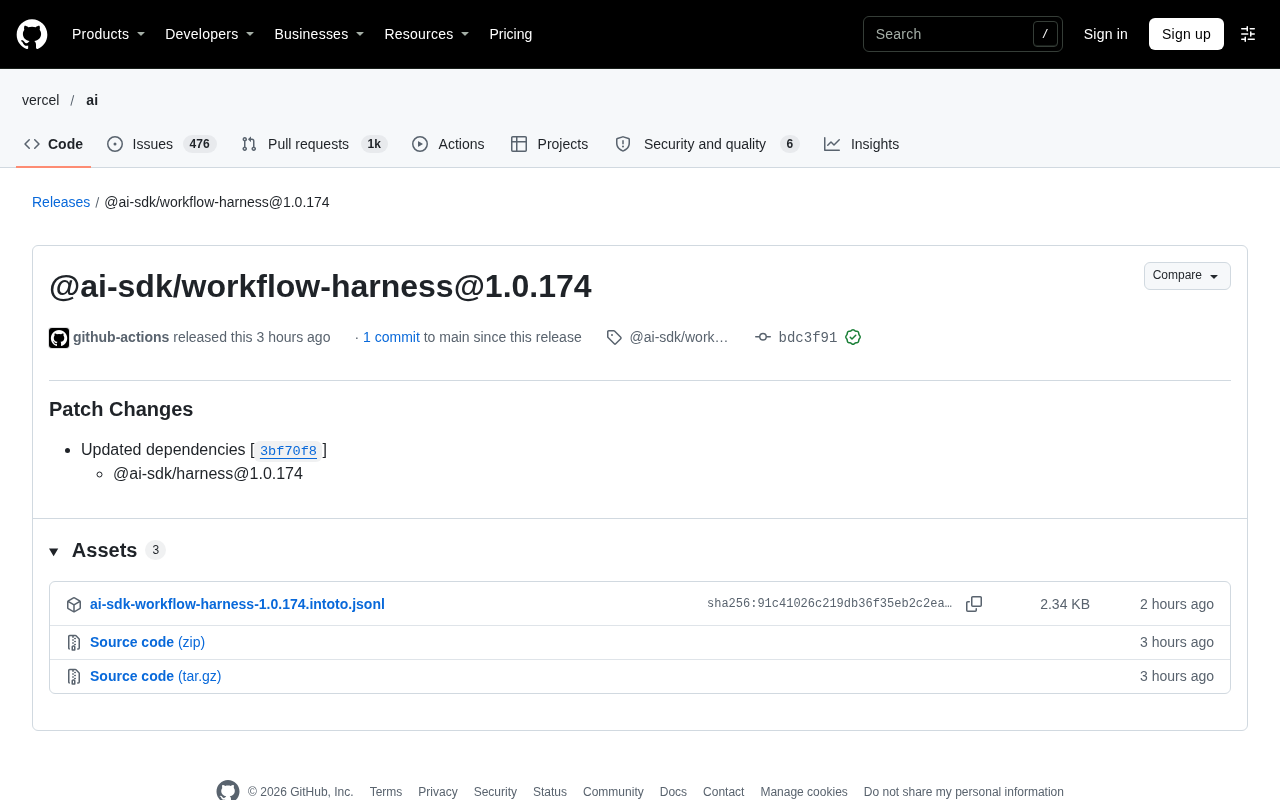
In Vercel's AI SDK ecosystem, @ai-sdk/workflow-harness released version 1.0.174, a patch update focused on dependency synchronization, with the core action being syncing the underlying @ai-sdk/harness to the same version number. The release was automatically completed by the github-actions bot with a verified signature, reflecting highly process-driven version management. The article notes that such "Updated dependencies" entries are worth interpreting in a rapidly evolving toolchain: version alignment reduces compatibility risks, and the determinism of automated releases is more valuable to production projects than any single patch's content. In terms of module division, workflow-harness handles workflow-scenario wrapping while harness is the underlying capability base; this layering lets the upper layer evolve independently. The author also acknowledges the material is only release-note level, and specific changes require checking the commit diff or the underlying package's notes.
A minor version update reveals AI SDK's modularization intent
Vercel's AI SDK ecosystem has seen another version iteration. @ai-sdk/workflow-harness has released version 1.0.174. Judging from the GitHub Releases page, this is not a major feature release but a patch update focused primarily on dependency synchronization.
According to the release notes, the core action of this update is "Updated dependencies," specifically pointing to @ai-sdk/harness@1.0.174. The release was automatically completed by the github-actions bot, and commit bdc3f91 carries a GitHub verified signature, indicating this is a standardized automated release process.
For readers unfamiliar with this toolchain, we first need to clarify the relationship between the workflow-harness and harness packages. Based on naming and dependency direction, the former appears to be a wrapper oriented toward workflow scenarios, while the latter is a more foundational capability base. The "Updated dependencies" pointing to the latter in this patch update means the change mainly syncs up fixes or adjustments from the underlying base.
Why dependency synchronization deserves attention
In most open-source projects' changelogs, "Updated dependencies" is often glossed over, and readers habitually ignore it. But in a rapidly evolving toolchain like AI SDK, dependency synchronization itself is a signal worth interpreting.
It indicates that @ai-sdk/harness changed at the 1.0.174 version node, and workflow-harness chose to follow upstream closely. This version alignment approach is common in monorepos or tightly coupled package groups; the benefit is reducing compatibility issues caused by version mismatches. When developers upgrade workflow-harness, they get a verified, matched version of the underlying dependency rather than having to piece it together themselves.
Another implication lies in the release cadence. Automated releases by github-actions with verified-signature commits indicate that version management for this package has become highly process-driven. For production projects that depend on it, this determinism is more valuable than the specific content of any single patch—you can expect version releases to be mechanical and traceable.
Semantic Versioning (SemVer) and patch updates
The three-part version number 1.0.174 follows the Semantic Versioning specification: a major version change (1) represents incompatible API modifications, a minor version change (0) represents backward-compatible feature additions, and a patch version change (174) represents backward-compatible bug fixes. Therefore, such a high patch number with major and minor versions unchanged for so long typically means the project is in a phase of high-frequency iteration but with a relatively stable API. Readers seeing 1.0.174 should understand it as "the 174th patch release," not some major milestone. Dependency-sync updates overwhelmingly fall at the patch level, which is exactly what SemVer prescribes—this also explains why it's not advisable to invest too much attention in such patches.
Monorepo and Fixed Versioning
The "version alignment" mentioned in the article is commonly backed by a fixed versioning release strategy under a monorepo. In this mode, a group of packages within the same repository share the same version number, and a single release bumps all packages in sync—even if a particular package has no code changes of its own. This contrasts with the "independent versioning" strategy supported by tools like Lerna and Changesets. The benefit of fixed versioning is that the compatible combination between any two packages is deterministic, and developers don't need to calculate version matrices themselves; the cost is generating a large number of "dependency-only" no-op releases. The fact that workflow-harness and harness share identical version numbers is a typical trace of this strategy, also suggesting that both likely reside in the same repository and are released by the same CI pipeline.
What patch updates mean for developers
From a practical standpoint, such patch updates typically don't introduce breaking changes. For projects already using @ai-sdk/workflow-harness, upgrade risk is low. The recommended approach is routine follow-up, especially if you also directly depend on @ai-sdk/harness—keeping the two versions aligned avoids potential version conflicts.
If you're evaluating whether to adopt this workflow tool into your tech stack, this update itself doesn't constitute a decision basis, but the module division approach it reflects is worth noting: separating workflow orchestration from the underlying execution base. This layering allows the upper layer to evolve independently and makes it convenient for developers to adopt on demand.
peerDependencies and dependency mismatch risks
Keeping workflow-harness and harness versions aligned matters because of npm's dependency resolution mechanism. If the upper-layer package declares the lower-layer package as a regular dependencies, npm may install two different versions of harness in the same project, leading to subtle issues like failed instanceof checks and split singleton state; if declared as peerDependencies, version mismatches directly produce install warnings or even errors. In either case, manually mixing versions carries higher risk than following the official matched versions. This is also the technical basis for the article's recommendation to "keep them aligned when directly depending on both": letting the package manager resolve a single version is far less troublesome than troubleshooting runtime exceptions after the fact.
Information limitations and follow-up observations
To be candid, this is only release-note-level material with limited information granularity. The specific code changes in the patch and what exactly the underlying harness package fixed are not elaborated in the original content. The event's specific time is shown on the page as "05 Nov," but the year is not indicated, so this article makes no additional inference about timeliness.
To understand substantive changes, it's recommended to directly examine the diff of commit bdc3f91 or follow the release notes of @ai-sdk/harness@1.0.174 itself. For developers following the AI SDK ecosystem, such minor version updates are suitable for inclusion in automated dependency monitoring processes rather than investing excessive attention.
Related articles
 Tech Frontiers
How Do You Stop AI Agent Emails From Sounding Like AI? One Developer's Solution
AI agent emails always sound like AI? A developer shares reright: a rewrite step that validates numbers, names, and links, preventing humanizers from tampering with key info. Test data and integration details inside.
 Tech Frontiers
Starlink Mobile: SpaceX's Carrier Ambitions and the 5G Deployment Challenge
SpaceX plans to make Starlink Mobile a mainstream carrier, deploying thousands of direct-to-cell satellites and building a terrestrial 5G network to challenge AT&T, Verizon, and T-Mobile. This article analyzes its dual-track strategy, 5G deployment challenges, and the competitive landscape.
 Tech Frontiers
OpenAI Raises Another $11 Billion, Valuation Hits $1.25 Trillion
OpenAI has raised an additional $11 billion in a new funding round at a valuation of $1.25 trillion. The deal is not yet closed and is expected to be completed in the coming weeks, further consolidating its leading position in AI.