@ai-sdk/workflow-harness 1.0.191 Released: What an Unremarkable Patch Update Reveals About the AI SDK Workflow Ecosystem
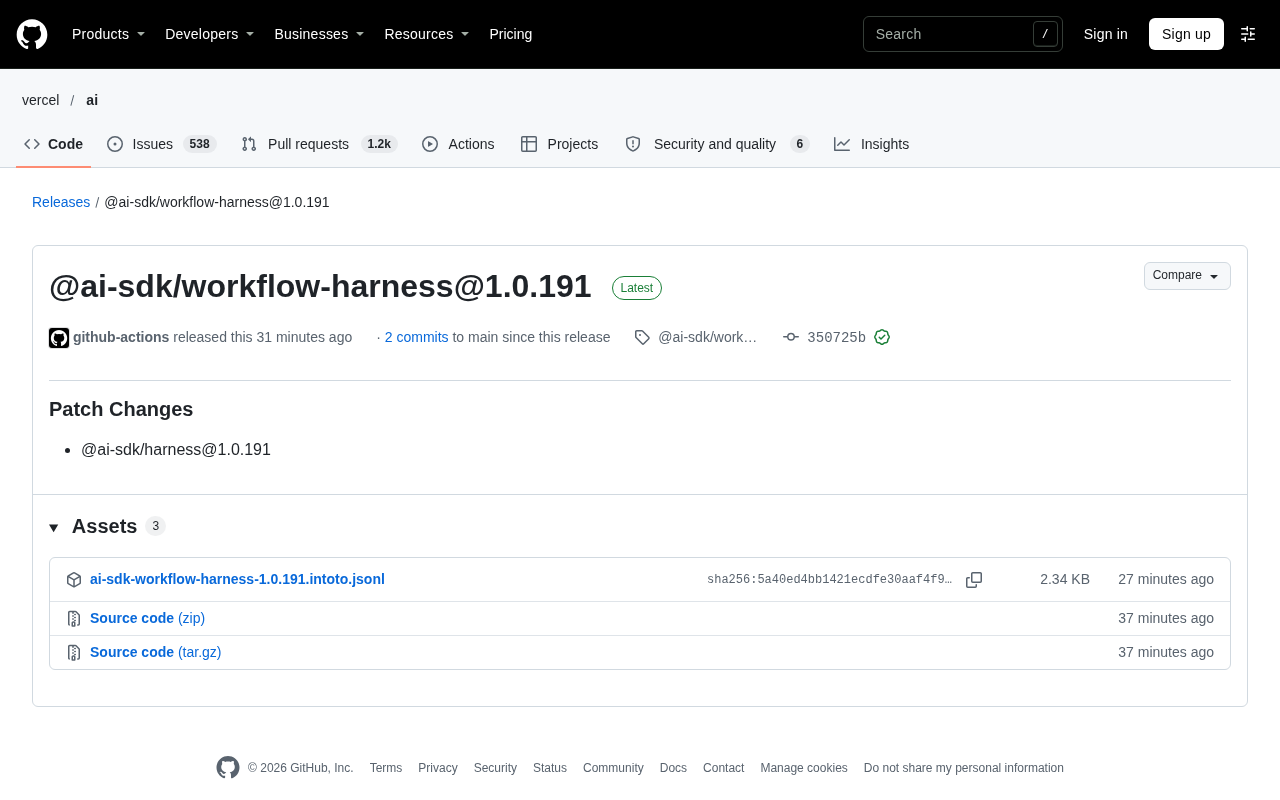
workflow-harness 1.0.191 minor update reflects the AI SDK ecosystem's automated, stable maintenance cadence.
The article interprets the Patch Changes update of @ai-sdk/workflow-harness@1.0.191 auto-released by github-actions, with 2 commits, 3 Assets, and GitHub verified signatures. It analyzes the layered roles and shared version coupling of workflow-harness and @ai-sdk/harness, arguing that high-frequency small releases show stable maintenance and engineering maturity, while warning that release notes omit specific fixes, so dependents should check diffs and upgrade both packages together.
A Quiet Patch Release
On the GitHub release page, the update notes for @ai-sdk/workflow-harness@1.0.191 are short enough to read in a single glance: auto-published by the github-actions bot on the 23rd, containing 2 commits, labeled as Patch Changes, with the core change pointing to @ai-sdk/harness@1.0.191. The commits carry GitHub verified signatures and include 3 Assets files.
On the surface, this is an utterly ordinary automated release note. But for developers who have long tracked the AI SDK ecosystem, this high-frequency, small-step patch cadence is itself a signal worth reading—it shows that workflow-harness has entered a relatively stable maintenance phase, with the team handling routine fixes through automated pipelines rather than frequent breaking refactors.
What Role Does workflow-harness Play in the AI SDK
Breaking Down Responsibilities from the Package Name
The AI SDK ecosystem consists of multiple collaborating packages, and the naming usually reflects responsibilities directly. @ai-sdk/harness can be understood as the underlying package that carries execution framework and scaffolding capabilities, while @ai-sdk/workflow-harness is the wrapper built on top of it for workflow scenarios. In other words, the former provides the mechanism for "how to run," while the latter defines the orchestration logic for "in what order to run."
This layered design is common in AI application development: model calls, tool calls, state transitions, and error retries need to be organized into reliable workflows, and workflow-harness is exactly the layer responsible for orchestration. This patch change is directly tied to @ai-sdk/harness@1.0.191, meaning fixes in the underlying framework propagate down to the workflow layer.
Semantic Versioning (SemVer) is an unavoidable backdrop when discussing version numbers here. SemVer specifies the format MAJOR.MINOR.PATCH: MAJOR indicates incompatible API changes, MINOR indicates backward-compatible feature additions, and PATCH indicates backward-compatible bug fixes. The 1.0.191 mentioned in the article means the package has not yet entered 2.x and is theoretically still in the "incremental evolution after 1.0" phase, where the accumulation of 191 PATCH releases also indirectly illustrates how high the maintenance frequency is. Notably, SemVer is a convention rather than a mandate; in real projects, PATCH releases may occasionally carry behavioral changes, which is why dependents cannot judge upgrade safety based on version numbers alone.
The Coupling Relationship Revealed by Synchronized Version Numbers
One detail: workflow-harness and harness share the same version number, 1.0.191. This kind of version alignment usually means the two packages are tightly bound in release cadence, and underlying changes are synchronously reflected in the upper-layer package. For dependents, this is both good—the version relationship is clear and mismatches are unlikely—and a reminder that upgrades should be considered as a whole rather than replacing a single package in isolation.
The Engineering Maturity Behind Automated Releases
github-actions and Verified Signatures
The publisher is the github-actions bot, and the commits carry GitHub verified signatures with GPG key ID B5690EEEBB952194. Together, these two points show that the project's release process has achieved a high degree of automation and traceability: changes are triggered by CI pipelines, commit sources can be verified, and omissions introduced by manual releases are reduced.
For open-source projects, automated releases are a side indicator of engineering maturity. When a package can reliably keep shipping patch releases, developers can have more confidence in putting it into production dependencies, because minor version updates usually mean backward-compatible fixes rather than interface-level changes.
GitHub verified signatures rely on Git's commit signing mechanism. Developers can sign their commits with GPG or SSH keys; after receiving a push, GitHub verifies the signature against the keys registered to the committer's account, and upon success displays a "Verified" badge next to the commit. The GPG key ID B5690EEEBB952194 appearing in the text is the short identifier of the key used for verification. The value of this mechanism lies in proving that "the commit genuinely comes from the claimed author and the content has not been tampered with," which is especially important for commits automatically produced by CI bots—it makes every link in the automated release chain auditable.
github-actions bot releases refer to automatically executing the release process through a GitHub Actions workflow. A typical approach is: after a PR is merged, CI is triggered; CI runs tests, builds, generates a changelog, executes npm publish, and creates a Release on GitHub. The "published by github-actions," "contains 2 commits," and "includes 3 Assets" shown on the release page in the text are exactly the standard output of such a pipeline. This model turns releases from manual operations into reproducible, code-driven processes, reducing the risk of missed or incorrect releases and making high-frequency patch-level releases sustainable from an engineering standpoint.
The Meaning and Boundaries of Patch Changes
Following semantic versioning conventions, Patch Changes indicate backward-compatible bug fixes. The original record does not disclose which specific issues were fixed or which functions or behaviors were affected, which is both a common shortcoming of this kind of automated release note and a reminder to dependents: before upgrading, it is best to confirm the actual scope of impact by consulting the commit history and changelog, rather than just looking at the version number.
The loading error messages appearing on the original page (such as "There was an error while loading") are rendering issues on the GitHub release page and unrelated to the package's functionality; they should not be misread as release anomalies.
What It Means for Developers
Upgrade Recommendations
For teams already using workflow-harness in their projects, 1.0.191 is a patch version that can be folded into the regular upgrade cadence. Because it is synchronized with @ai-sdk/harness, it is recommended to upgrade both together to avoid hidden compatibility issues caused by version mismatches.
For teams that have not yet adopted it, this kind of high-frequency patch release actually shows that the project is under active maintenance, which is a positive reference signal. However, selecting a workflow orchestration layer still requires judging against your own specific needs for observability, error handling, and extensibility—you cannot draw conclusions based on release frequency alone.
Information Transparency Remains a Weak Point
A common problem exposed by this release is that automatically generated release notes often only label the change type without explaining the change content. For dependents, this means extra effort is needed to read commits or source diffs. At the community level, pushing the release process to supplement automation with structured change descriptions is one direction for improving usability.
Conclusion
@ai-sdk/workflow-harness@1.0.191 is not a dramatic update, but through details such as automation, version alignment, and verified signatures, it outlines the current maintenance state of the AI SDK workflow ecosystem: stable, high-frequency, and engineering-driven. For developers, understanding the cadence behind this kind of minor version release is more valuable than chasing individual version numbers.
One-line Summary
workflow-harness 1.0.191 minor update reflects the automated and stable maintenance cadence of the AI SDK ecosystem
Paragraph Summary
The article interprets the Patch Changes update of @ai-sdk/workflow-harness@1.0.191 automatically released by github-actions, noting that it contains 2 commits, 3 Assets, and carries GitHub verified signatures. The author analyzes the layered responsibilities of workflow-harness and @ai-sdk/harness and their tight coupling through shared version numbers, arguing that high-frequency, small-step releases reflect that the project has entered a stable maintenance phase, while the automated pipeline and signature verification demonstrate engineering maturity. It also reminds readers that although Patch-level updates are usually backward-compatible, the release note does not disclose the specific fixes, so dependents need to check the diff themselves, and recommends upgrading both packages together to avoid version mismatches.
Related articles

Van Hollen on Holding Trump Accountable: Hearings and Building the Evidentiary Record
Senator Chris Van Hollen on holding the Trump administration accountable: focused hearings to expose corruption and wrongdoing, plus building an evidentiary record now to preserve space for future criminal charges.

Generating SVG and 3D Models with the Codex Plugin: A Hands-On Guide for Developers with Zero Art Background
Codex's SVG & 3D Design plugin lets developers with zero art background generate vector graphics and 3D models via code—editable, Blender-ready, with best practices built in.

Why Recursive Self-Improvement Holds Up: Responding to Six Major Objections One by One
Dwarkesh Patel responds point by point to six major objections about recursive self-improvement and superintelligence by 2030: whether verifiable proxy metrics exist, the human-link threshold for RSI, whether the math explosion can be analogized to AI research, the experimental compute bottleneck, reward hacking and the motivation for power-seeking, and whether METR acceleration rates can be extrapolated.