AI SDK Workflow Harness Patch Update: Parsing the Patch Changes

@ai-sdk/workflow-harness releases patch 1.0.166, only syncing versions and internal maintenance, with a compliant release process.
The article focuses on the release of @ai-sdk/workflow-harness@1.0.166, noting it is a Patch Changes release involving only version sync and internal maintenance, with no new features or breaking changes. The release was automatically completed by github-actions and passed GPG signature verification, reflecting a well-regulated automated release process. The author analyzes that such version-number-only patches commonly appear for upstream dependency alignment, CI rebuilds, or internal detail fixes, are expected to cause no behavioral changes for developers, but recommends keeping dependencies in sync and verifying in a small scope first under locking strategies. The article further positions workflow-harness as the AI SDK's application orchestration and execution layer component, believing its continuous maintenance reflects toolchain health and the project's long-term reliability.
The Signal Behind a Patch Version
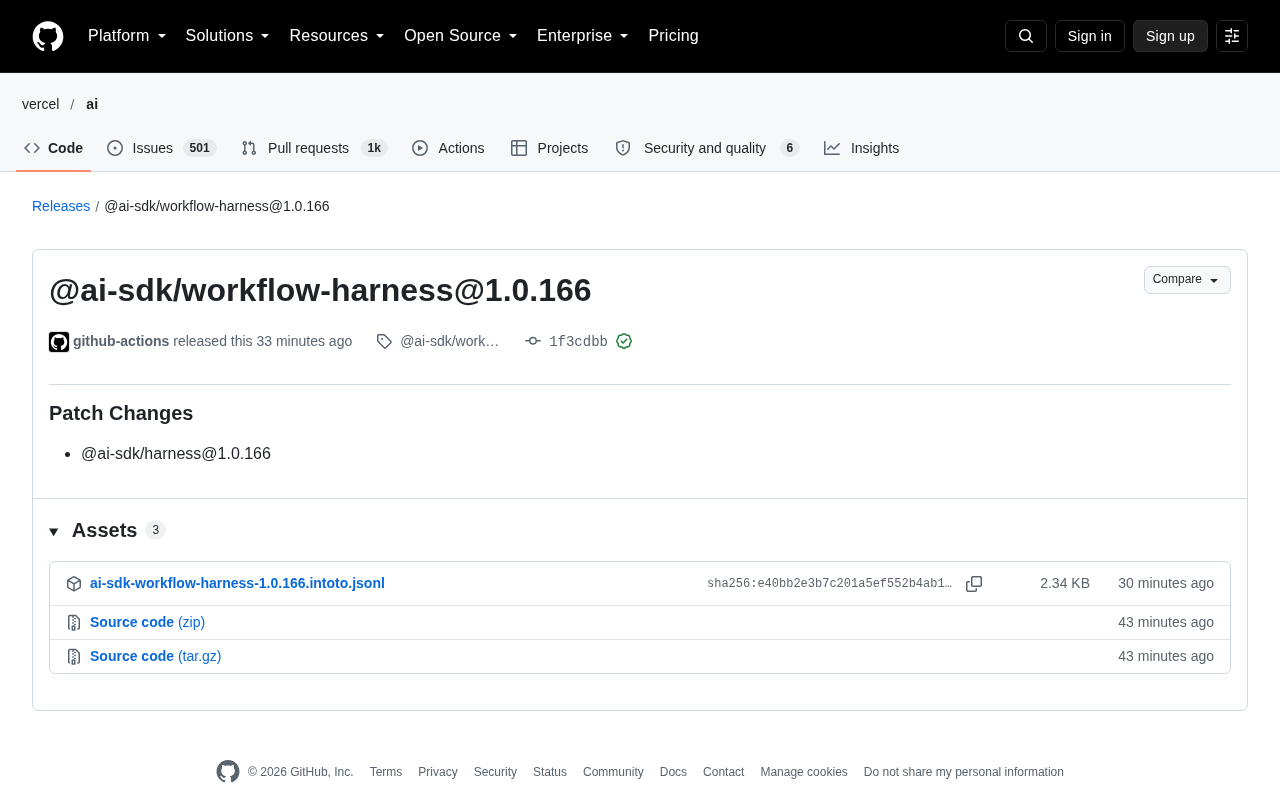
A seemingly inconspicuous patch version in the AI SDK ecosystem—@ai-sdk/workflow-harness@1.0.166—has been released on GitHub. Judging from the version number and changelog, this is a typical Patch Changes release, involving only synchronized version updates and internal maintenance, with no new features or breaking changes introduced.
It's worth noting that this kind of minor version iteration is quite common in fast-evolving developer toolkits like AI SDK. It rarely makes headlines, yet it's a necessary part of keeping the entire toolchain running stably.
Specifics of the Patch Changes
Version Consistency Maintenance
According to the release page, the core change in this update centers on version synchronization of @ai-sdk/harness@1.0.166. The release was automatically completed by github-actions, and the commit passed GPG signature verification (key ID: B5690EEEBB952194), indicating a well-regulated process and trustworthy provenance.
From an engineering perspective, such "version-number-only" patches typically appear in the following scenarios: upstream dependencies need version alignment, the CI pipeline triggers a rebuild, or internal details that don't affect the public API have been fixed.
GPG signature verification (GNU Privacy Guard signing) is a common provenance-checking mechanism in open-source release processes. Maintainers sign commits or tags with a private key, and anyone can use the corresponding public key to verify whether the signature is genuine and whether the content has been tampered with. GitHub displays a Verified badge next to the commit along with the key ID. For npm package releases, the signature itself cannot fully prevent supply chain attacks, but it can prove that the version genuinely came from the maintainer or trusted automation account holding the corresponding private key, making it an important basis for judging provenance credibility.
Practical Impact on Developers
For developers currently using @ai-sdk/workflow-harness, upgrading to 1.0.166 is expected to bring no behavioral changes. Still, keeping dependency versions in sync with official releases is a habit worth cultivating—especially in AI application projects with long dependency chains.
Tip: If your project has a dependency version locking strategy, it's advisable to verify in a small-scale environment first before upgrading across the board.
The AI SDK typically adopts a multi-package monorepo structure, where @ai-sdk/* packages share the same version sequence. When the core package or host SDK is upgraded, surrounding packages that depend on it often release in sync to maintain version number consistency and trigger new build artifacts. Therefore, a patch that appears to "only change the version number" may actually be the result of aligning the entire dependency chain. During installation, npm resolves and fetches the matching dependency combination, which also explains why such synchronized releases occur frequently.
Why This Kind of Release Deserves Attention
Maturity of the Release Process
The release page shows that this version was created by an automated process with a verified signature, which indirectly reflects the maturity of the project's maintenance. Against the backdrop of rapid AI toolchain iteration, a well-regulated release process says more about a project's long-term reliability than the version number itself.
The Role of Workflow Harness
workflow-harness is a component in the AI SDK that leans toward the application orchestration and execution layer. Its continuous patch maintenance means the official team is still actively addressing version compatibility issues with the host SDK. For teams building complex AI workflows, the stability of such foundational components directly affects the iteration pace of upper-layer products.
In AI application development, "workflow orchestration" refers to organizing steps such as model calls, tool calls, conditional branches, loops, retries, and state management into executable processes, while "execution-layer components" are responsible for driving these processes at runtime. The term harness originally refers to a testing or execution framework; here it can be understood as a middleware layer that encapsulates and adapts workflow execution. It connects upward to business orchestration logic and downward to the model SDK's interfaces, so interface changes in the host SDK typically require follow-up adaptation on the harness side—which is precisely why it needs continuous patching.
Summary
@ai-sdk/workflow-harness@1.0.166 is a standard patch release with limited information but a clear signal: the project is under continuous maintenance, and the release process is well-regulated. For ordinary users, upgrading as needed is sufficient; for teams watching AI SDK ecosystem trends, it can be viewed as a routine observation point for toolchain health.
One-line Summary
@ai-sdk/workflow-harness releases patch 1.0.166, solely for version sync and internal maintenance, with a well-regulated release process.
Paragraph Summary
The article focuses on the release of @ai-sdk/workflow-harness@1.0.166, noting that it is a Patch Changes release involving only version synchronization and internal maintenance, with no new features or breaking changes. The release was automatically completed by github-actions and passed GPG signature verification, reflecting a well-regulated automated release process. The author analyzes that such "version-number-only" patches commonly appear for upstream dependency alignment, CI rebuilds, or internal detail fixes, and are expected to cause no behavioral changes for developers, though it's recommended to keep dependencies in sync and verify in a small scope first under locking strategies. The article further positions workflow-harness as the application orchestration and execution layer component of the AI SDK, arguing that its continuous maintenance reflects toolchain health and the project's long-term reliability.
Related articles

Zero-Cost Local Jarvis: Open-Source Voice Cloning and Task Automation in Practice
AI Workshop shows how to build a zero-cost local Jarvis with Ollama and Voice Studio: local model switching, open-source voice cloning, file retrieval, and tool-calling tests, with setup steps and hardware trade-offs.

Mistral Large 4 Released: 1T-Parameter MoE Tops Western Open-Source Leaderboard
Mistral releases its flagship Mistral Large 4: a 1T-parameter MoE architecture activating only 49B parameters at inference, trained from scratch on 3,800 Grace Blackwell GPUs, topping the Western open-weight leaderboard with third-party endorsements in law, finance, and cybersecurity.

Mistral Large 4 Review: Can Europe's Strongest Open-Source Model Challenge the US and China?
Mistral Large 4 (L-Charm) review: trillion-parameter MoE, standout cybersecurity benchmarks but behind Kimi K3 in software engineering, 3,800 GPUs, a key step for European sovereign AI.