AI SDK Workflow Toolkit 1.0.193 Update Analysis
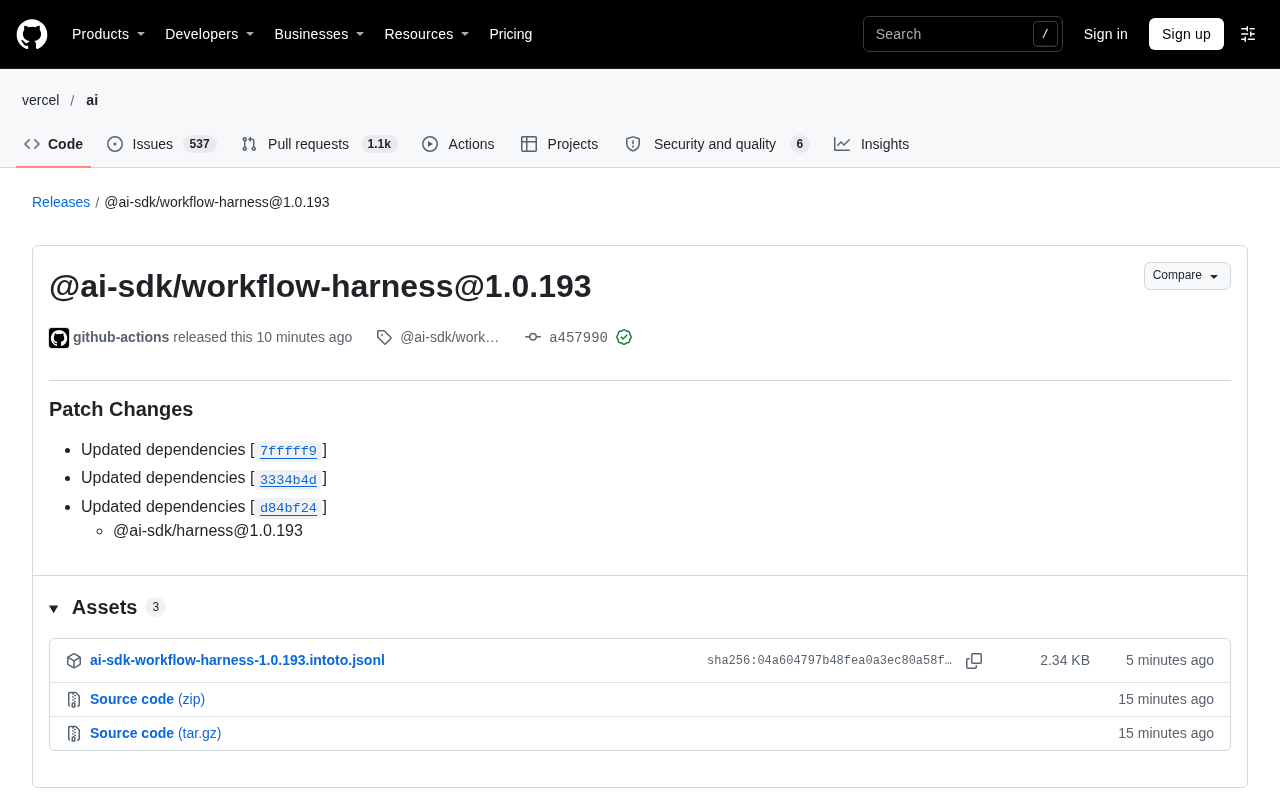
@ai-sdk/workflow-harness releases 1.0.193 patch, mainly syncing with underlying harness dependencies.
The @ai-sdk/workflow-harness package in the AI SDK ecosystem releases version 1.0.193, a patch update primarily focused on dependency synchronization. According to the GitHub release page, this change centers on three dependency update references (7fffff9, 3334b4d, d84bf24), all pointing to @ai-sdk/harness@1.0.193, indicating the workflow orchestration layer stays aligned with the underlying execution framework and iterates in the same batch. The article analyzes the value of this release strategy: in monorepo-managed SDK projects, underlying fixes quickly propagate to upper layers through dependency updates, reducing dependency conflict risk. For developers, patch updates theoretically don't involve breaking changes, but it's still recommended to verify the workflow execution chain after upgrading and check whether both package version numbers match for troubleshooting.
The @ai-sdk/workflow-harness package in the AI SDK ecosystem has released version 1.0.193. As a lightweight toolkit for AI workflow orchestration, this update is marked as a patch version, but it's still worth examining the dependency change logic behind it.
Core Content of the Version Update
According to the GitHub release page, version 1.0.193 is a typical patch update, with the main changes centered on synchronized dependency upgrades. The commit record lists three dependency update references (7fffff9, 3334b4d, d84bf24), all pointing to @ai-sdk/harness@1.0.193.
This means workflow-harness maintains version alignment with the underlying harness package, with both iterating synchronously in the same release batch. For developers building workflow applications on the AI SDK, this version linkage mechanism reduces the risk of dependency conflicts.
The version number continues to increment within the 1.0.x series, indicating the project is in a stable maintenance rhythm focused on fixes and minor improvements.
Patch versions follow the third-digit increment rule of Semantic Versioning (SemVer), used to identify backward-compatible bug fixes and internal improvements. Correspondingly, a minor version increment indicates new backward-compatible features, while a major version increment may contain breaking changes. The core basis for judging whether an update is safe is precisely this digit's change: moving from 1.0.192 to 1.0.193 means the API contract is unchanged and callers don't need to modify their business code. For projects relying on automatic upgrades (e.g., using the ^1.0.0 range specifier), patch versions are automatically pulled by package managers like npm, so the quality of patch updates directly affects production environment stability.
Seven-digit hexadecimal strings like 7fffff9 in the commit record are Git short commit hashes (commit SHA), used to uniquely identify a specific code change in the repository. They allow precise location of the specific changes, commit author, and time, and are also the foundation for automatic changelog generation and dependency tracing.
Significance of Dependency Synchronization
@ai-sdk/harness, as the underlying execution framework, handles the core scheduling of the workflow runtime; workflow-harness provides higher-level orchestration capabilities on top of it. Both packages share the same version number (both 1.0.193), indicating that upstream changes are promptly propagated to the workflow layer.
This release strategy is fairly common in monorepo-managed SDK projects: after the underlying package is fixed, the upper-layer package quickly follows up through dependency updates, ensuring that the combination users pull is verified. Although the patch version is small, it has a real impact on production environment stability.
A monorepo (single code repository) is an engineering practice of managing multiple interrelated packages in the same Git repository. Typical projects using this pattern include Babel, Vue, and various SDK toolchains. Its core advantage is that cross-package changes can be completed and tested uniformly in a single commit, avoiding version drift between multiple repositories. To ensure version consistency across packages, such repositories usually introduce version management tools like Changesets and Lerna, which automatically calculate new version numbers for affected packages and synchronously update dependency declarations at release time.
The layered design of the workflow orchestration layer and the underlying execution framework is also worth explaining: the underlying package handles runtime semantics such as node scheduling, state transitions, and error retries, while the upper-layer package provides declarative workflow definition, composition, and lifecycle management capabilities. This layering allows underlying fixes to propagate to all upper-layer applications at minimal cost, and also enables each layer to evolve independently.
Practical Impact on Developers
For projects that have already integrated @ai-sdk/workflow-harness, upgrading to 1.0.193 mainly involves dependency-level synchronization. Since it's a patch update, it theoretically doesn't involve breaking changes, but it's still recommended to check whether the workflow execution chain works properly after upgrading.
If you use a dependency management approach with locked versions, you can check whether the corresponding version of @ai-sdk/harness also needs to be updated together. The fact that both packages share the same version number can serve as a reference clue when troubleshooting issues.
Lock files (such as package-lock.json, pnpm-lock.yaml, yarn.lock) record the precise resolution results of the dependency tree, including the version number and integrity checksum of each package. When a project uses a lock file, dependencies won't change automatically due to upstream patch releases; an explicit upgrade command is required to update them. Therefore, for projects with locked versions, upgrading to 1.0.193 should use npm update @ai-sdk/workflow-harness or manually adjust the version number and reinstall, rather than merely modifying the range declaration in package.json.
Post-upgrade verification typically focuses on: whether workflows can start and complete normally, whether data transfer between nodes meets expectations, whether error retry and timeout behavior work properly, and whether logging and observability output are complete. Adding fixed smoke test cases to the CI pipeline can keep the risk of patch upgrades within an acceptable range.
Summary
Version 1.0.193 is a maintenance update primarily focused on dependency synchronization, with the core change being bringing underlying harness changes into workflow-harness. For developers following the AI workflow toolchain, maintaining version alignment is a fundamental practice for ensuring operational stability.
Related articles

Van Hollen on Holding Trump Accountable: Hearings and Building the Evidentiary Record
Senator Chris Van Hollen on holding the Trump administration accountable: focused hearings to expose corruption and wrongdoing, plus building an evidentiary record now to preserve space for future criminal charges.

Generating SVG and 3D Models with the Codex Plugin: A Hands-On Guide for Developers with Zero Art Background
Codex's SVG & 3D Design plugin lets developers with zero art background generate vector graphics and 3D models via code—editable, Blender-ready, with best practices built in.

Why Recursive Self-Improvement Holds Up: Responding to Six Major Objections One by One
Dwarkesh Patel responds point by point to six major objections about recursive self-improvement and superintelligence by 2030: whether verifiable proxy metrics exist, the human-link threshold for RSI, whether the math explosion can be analogized to AI research, the experimental compute bottleneck, reward hacking and the motivation for power-seeking, and whether METR acceleration rates can be extrapolated.