AI SDK xAI 3.0.147 Patch Released: Dependency Chain Synchronized

@ai-sdk/xai releases patch 3.0.147, only synchronizing upstream dependencies with no functional changes.
In the AI SDK ecosystem maintained by Vercel, @ai-sdk/xai has released patch version 3.0.147. This update introduces no new features; the only change is updating @ai-sdk/provider-utils to 4.0.63 and @ai-sdk/openai-compatible to 2.0.88, automatically submitted by the github-actions bot with a GPG signature. The article notes that provider-utils is a low-level utility package shared by multiple provider adapters, while openai-compatible carries the integration path for services like Grok that are compatible with the OpenAI API. Therefore, although dependency synchronization does not change the public API, it may still affect underlying behaviors such as request construction and streaming responses. According to semantic versioning conventions, patch upgrades are backward-compatible and low-risk, but version consistency of shared packages deserves attention, and projects with custom providers are advised to verify in a test environment first.
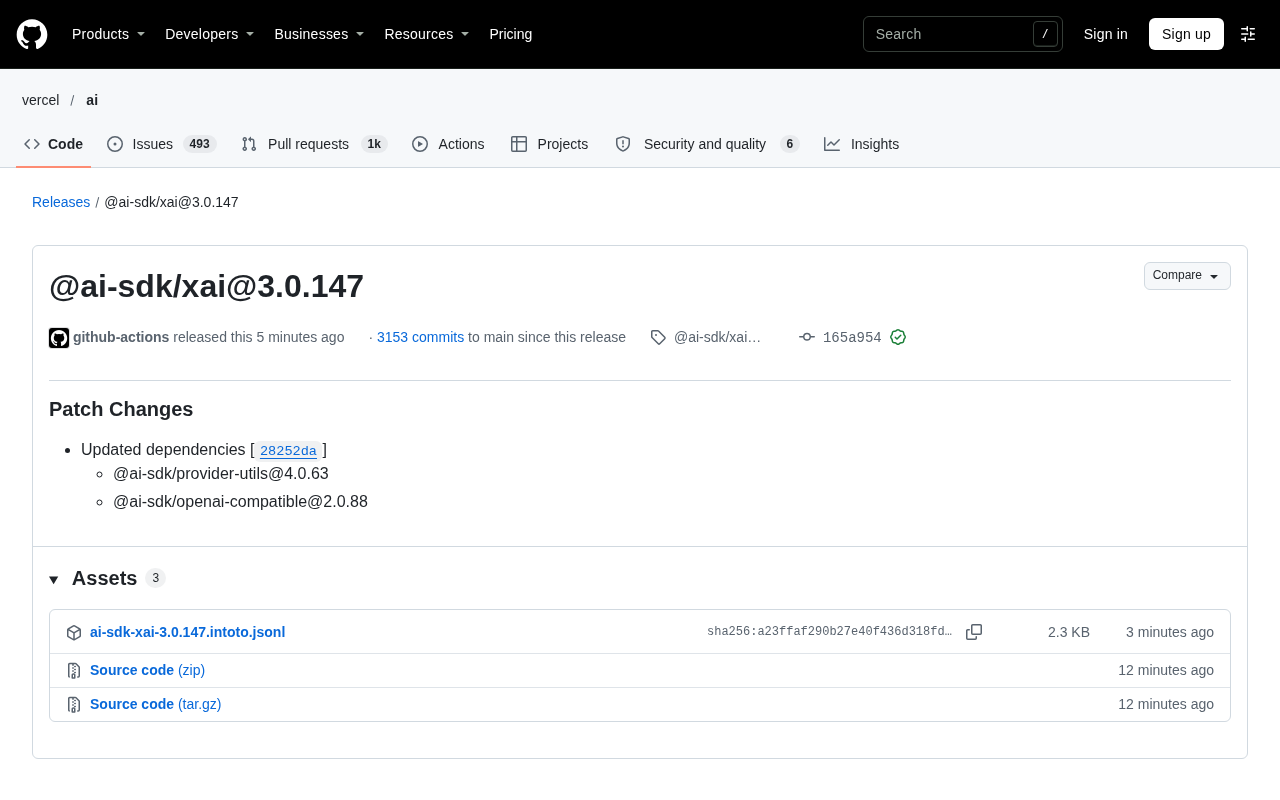
The AI SDK ecosystem maintained by Vercel has seen another minor iteration. @ai-sdk/xai has released version 3.0.147, a typical patch-level update that introduces no new features—its core action is synchronizing upstream dependencies.
Patch Contents: A Pure Dependency Alignment
According to the GitHub release record, version 3.0.147 contains only one change: updating the dependencies @ai-sdk/provider-utils to 4.0.63 and @ai-sdk/openai-compatible to 2.0.88. The change was automatically submitted by the github-actions bot, with commit hash 165a954 and a GitHub-verified signature.
As seen on the release page, this commit merged a cumulative 3,153 commits into the main branch. This number was not produced by this version alone but reflects the overall commit history of the repository—AI SDK, as a high-frequency open-source project, has a main branch that remains actively evolving over the long term.
Why Dependency Updates Matter
For ordinary developers, patch version number changes are often easy to overlook. But @ai-sdk/provider-utils is the shared package in AI SDK responsible for provider low-level utility functions, and it is jointly depended upon by multiple provider adapters.
@ai-sdk/openai-compatible is used to interface with compatible services that follow the OpenAI API specification. When xAI's Grok series models are integrated into AI SDK through the compatibility layer, they follow this dependency path. Therefore, although such dependency synchronization does not change the public API of the xAI provider, it may affect underlying details such as request construction and streaming response handling.
According to semantic versioning conventions, an increment in the patch number indicates backward-compatible fixes or internal adjustments. For production projects with locked versions, upgrading to 3.0.147 carries low risk; however, if the project contains custom provider implementations or directly calls low-level utility functions, it is still advisable to verify in a test environment first.
Semantic Versioning (SemVer) consists of three parts: major version, minor version, and patch number, in the form MAJOR.MINOR.PATCH. The specification states: an increment in the major version indicates incompatible API changes; an increment in the minor version indicates new functionality added in a backward-compatible manner; an increment in the patch number indicates only backward-compatible bug fixes or internal implementation adjustments. Therefore, when seeing @ai-sdk/xai go from 3.0.x to 3.0.147, one can expect by convention that the public API is unchanged and no calling code needs modification. However, semantic versioning is a social contract rather than a technical enforcement—maintainers may introduce behavioral changes in patch versions due to oversight or special considerations, especially when the dependency chain is deep, where behavioral adjustments in underlying shared packages may still indirectly affect upper layers. This is also why the article recommends verification in a test environment for projects with custom providers or direct calls to low-level utility functions.
Automation Characteristics of the Release Process
This release was completed by the github-actions bot, and the commit carries a GPG-verified signature (key ID B5690EEEBB952194). This pattern indicates that the AI SDK repository uses changesets or a similar automated release pipeline: after changesets are merged, the bot automatically calculates version numbers, updates dependency manifests, tags, and publishes.
The advantage of automated releases is a stable version cadence and consistent dependency references; the cost is that patch versions may be relatively frequent, and developers need a clear version management strategy to avoid unnecessary drift at the lockfile level.
Changesets is a version management and release tool for monorepos, often used in conjunction with GitHub Actions. Its workflow is: developers attach a changeset file in a PR declaring the packages affected by the change and the version increment type (patch/minor/major); after the change is merged into the main branch, the bot automatically aggregates all changesets, calculates new version numbers for each package, updates dependency manifests and CHANGELOGs, and creates a release PR or directly tags and publishes. This pattern is particularly suitable for repositories like AI SDK that contain multiple interdependent packages, because it ensures consistency of version references across packages in the same batch of changes, avoiding dependency mismatches that occur when manually changing versions. The github-actions bot commit and GPG signature mentioned in the article are exactly the traces of this pipeline executing automatically.
Practical Recommendations
For projects using @ai-sdk/xai, this update is a routine maintenance upgrade. If the project uses npm or pnpm and relies on a lockfile, a routine dependency update is sufficient; if in a version freeze period, it can safely be skipped, waiting for the next version with functional changes to upgrade uniformly.
What truly deserves attention is the version consistency of @ai-sdk/provider-utils and @ai-sdk/openai-compatible in the dependency tree—when multiple AI SDK providers coexist, mismatched versions of shared packages are a common source of problems.
Key Takeaways
This release does not carry much information, but it reflects the iteration rhythm of the AI SDK ecosystem: patch versions mainly focus on dependency synchronization, while functional evolution is concentrated in minor and major versions. Paying attention to dependency changes in release records is more practically meaningful than focusing on the version number itself.
Related articles

How to Build an Effective AI Code Review Agent: Prompt and Model Inversion in Practice
A practical breakdown of optimizing AI code review agents: from sandbox and PR webhooks to targeted prompts, historical PR calibration, model inversion, code knowledge bases, end-to-end QA, and cost tiering.

WorkBuddy in Action: How a Desktop Agent Automates Your Work
WorkBuddy is a desktop-level AI agent workbench that drives computers via command line, connects external tools, and automates file processing, data organization, and document generation. This article analyzes its working principles, complex task processing flow, and a practical path from getting started to taking orders.

Turning AI Intruders Against Themselves: A Hands-On Look at AgentCapture
AgentCapture is an AI countermeasure honeypot platform that integrates with existing networks and reverse proxies, using lossless deployment, AI agent identification, attacker profiling, and session replay to turn automated intruders against themselves.