AI SDK xAI 5.0.35 Update: Unified Model Catalog Management

xAI provider 5.0.35 patch consolidates multimodal capabilities into a shared model catalog, with no API changes.
The xAI provider module for AI SDK has released patch version 5.0.35, consolidating language, image, speech, transcription, and realtime capabilities into a shared model catalog while preserving existing request policies and generating capability tables from the same declarations. This is an engineering architecture adjustment with limited impact on developers who call the API directly; expected behavior is unchanged after upgrading. The real beneficiaries are projects using multiple xAI capabilities simultaneously and applications relying on capability tables for dynamic routing or UI display, since unified model metadata sources allow query and validation logic to be reused and reduce inconsistency between metadata and implementation. Released through an automated process as a continuing patch in the 5.0.x series, it indicates the module has entered a stable maintenance phase with changes focused on internal refactoring.
The xAI provider module for AI SDK has released patch version 5.0.35. The core change consolidates xAI's language, image, speech, transcription, and realtime capabilities into a single shared model catalog. This is primarily an engineering architecture adjustment with limited impact on developers who call the API directly, but it offers valuable reference for teams maintaining multimodal integrations.
What Changed: One Declaration Drives Multiple Capability Types
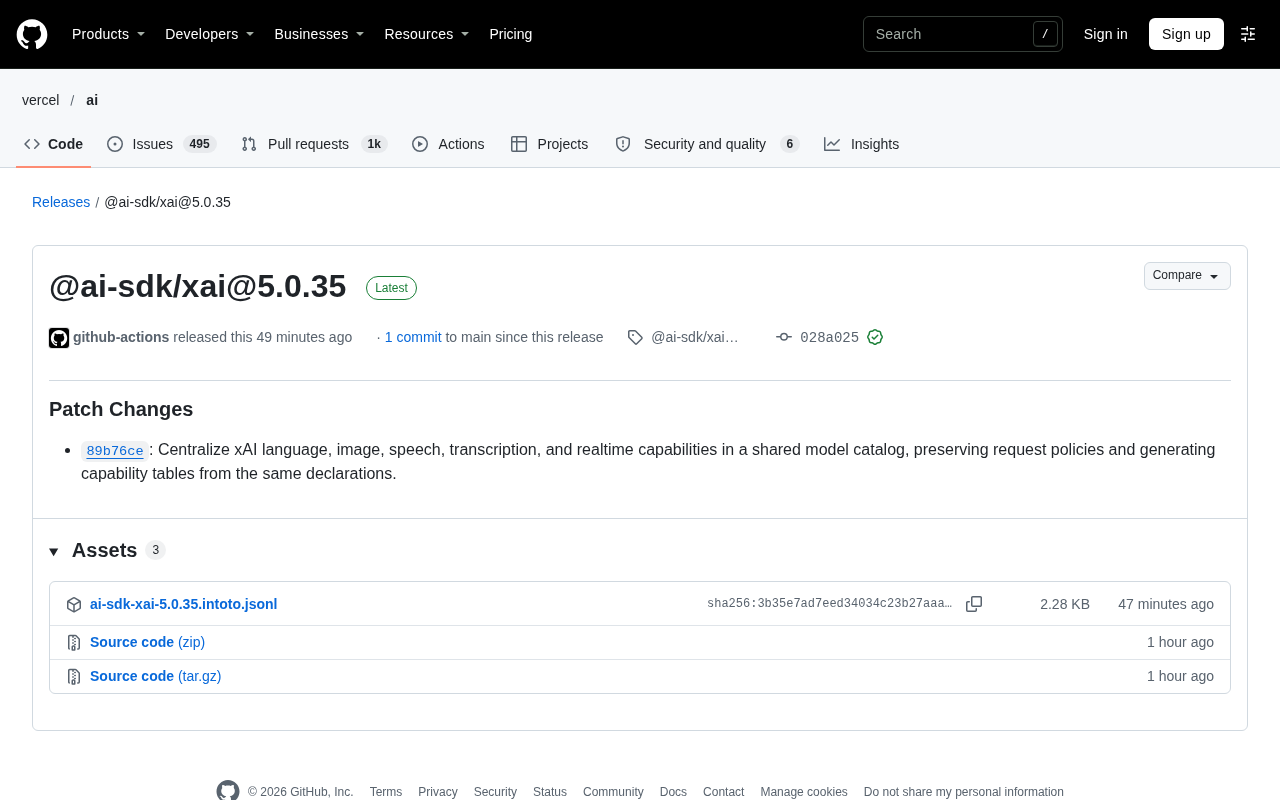
According to the release note, this patch was introduced by commit 89b76ce. The specific approach is to "Centralize xAI language, image, speech, transcription, and realtime capabilities in a shared model catalog," while "preserving request policies and generating capability tables from the same declarations."
Breaking this down reveals three layers of meaning. First, capability aggregation: model metadata previously scattered across different modules is now consolidated into a unified catalog structure. Second, request policies are preserved: the refactor does not change existing request behavior constraints, so callers need not adjust parameters. Third, capability tables are generated from the same declarations, reducing inconsistency between metadata and implementation.
This pattern is common in SDK maintenance: as providers support more modalities, maintaining duplicate model lists easily leads to discrepancies, and centralization reduces the surface area of changes when adding new models later.
Why Multimodal SDKs Need a Model Catalog
xAI's capability surface covers language, image, speech, transcription, and realtime interfaces, each with its own model identifiers, parameter constraints, and request policies. If each capability type maintains its own model list, adding or retiring a model requires synchronized changes in multiple places, easily creating mismatches where "a capability is supported but documentation is not updated."
A shared catalog turns model declarations into a single source of truth, with capability tables automatically generated from declarations—essentially replacing hand-written lists with structured data. This aligns with the evolution direction of other provider modules in the AI SDK ecosystem and represents infrastructure-level convergence rather than an end-user feature release.
One detail: the release note specifically emphasizes "preserving request policies," indicating that maintainers prioritized backward compatibility during the refactor to avoid introducing behavioral changes through centralization.
In SDK design, "Single Source of Truth" refers to defining a category of critical data (such as model identifiers and parameter constraints) in one place, with all consumers reading from the same location. For multimodal SDKs, model metadata serves both runtime (such as assembling requests and validating parameters) and documentation, type definitions, and capability table generation. Without a unified source, drift can occur between implementation and documentation, or across different modalities. A shared model catalog elevates model declarations to a single source of truth, deriving capability tables, request policies, and type information from it, so that adding or retiring a model requires changes in only one place. This pattern also facilitates automated generation of capability matrices, reducing the burden on maintainers to synchronize multiple lists.
Practical Impact on Developers
For developers calling xAI models through AI SDK, this version is a patch-level update with expected behavior unchanged after upgrading. The real beneficiaries are two scenarios: first, projects using multiple xAI capabilities simultaneously, where unified model metadata sources allow query and validation logic to be reused; second, applications relying on capability tables for dynamic routing or UI display, where declarations and implementation sharing the same source means more reliable information.
If your project maintains its own xAI model list, consider migrating to the catalog structure exposed by the SDK to reduce duplicate maintenance costs. However, since patch versions do not involve API surface changes, there is no need to schedule an emergency upgrade for this.
Observations on Release Cadence
This release was automatically completed by github-actions, with the commit carrying a GitHub verified signature—a typical automated release process. From the version number, 5.0.35 is a continuing patch in the 5.0.x series, indicating the module has entered a stable maintenance phase with changes focused on internal refactoring and detail corrections.
For teams watching the AI SDK ecosystem, the value of such commits lies in the signal they send: the xAI provider is completing unified management of multimodal capabilities, laying the groundwork for future model or capability additions. This version alone has no new features, but once the catalog structure is established, the cost of future expansion will drop significantly.
Upgrade Recommendations
A routine dependency update suffices, with no code changes needed. If your team is working on multi-provider abstraction, consider reviewing your own model metadata organization against this commit—the approach of a shared catalog plus declarative capability tables can be borrowed into internal wrappers.
Original link: @ai-sdk/xai@5.0.35 release.
Additional Background
xAI's realtime capability is typically provided through WebSocket or similar persistent connections, used for streaming conversations or low-latency voice interaction; transcription capability targets scenarios converting audio to text. These two capability types differ from language and image in that they impose additional constraints on connection lifecycle, chunked transmission, and error recovery. Incorporating realtime and transcription into a shared model catalog means these special constraints also need to be expressed in unified declarations—for example, describing connection timeouts or reconnection behavior through request policy fields. This explains why the release note emphasizes "preserving request policies": centralization cannot sacrifice the existing behavioral contracts of each capability type, or it would introduce hard-to-detect regressions.
One-line Summary
xAI provider 5.0.35 patch consolidates multimodal capabilities into a shared model catalog, with no API changes.
Paragraph Summary
The xAI provider module for AI SDK has released patch version 5.0.35. The core change consolidates language, image, speech, transcription, and realtime capabilities into a single shared model catalog, while preserving existing request policies and generating capability tables from the same declarations. This is an engineering architecture adjustment with limited impact on developers who call the API directly; expected behavior is unchanged after upgrading. The real beneficiaries are projects using multiple xAI capabilities simultaneously and applications relying on capability tables for dynamic routing or UI display, since unified model metadata sources allow query and validation logic to be reused and reduce inconsistency between metadata and implementation. The version was released through an automated process as a continuing patch in the 5.0.x series, indicating the module has entered a stable maintenance phase with changes focused on internal refactoring.
Related articles
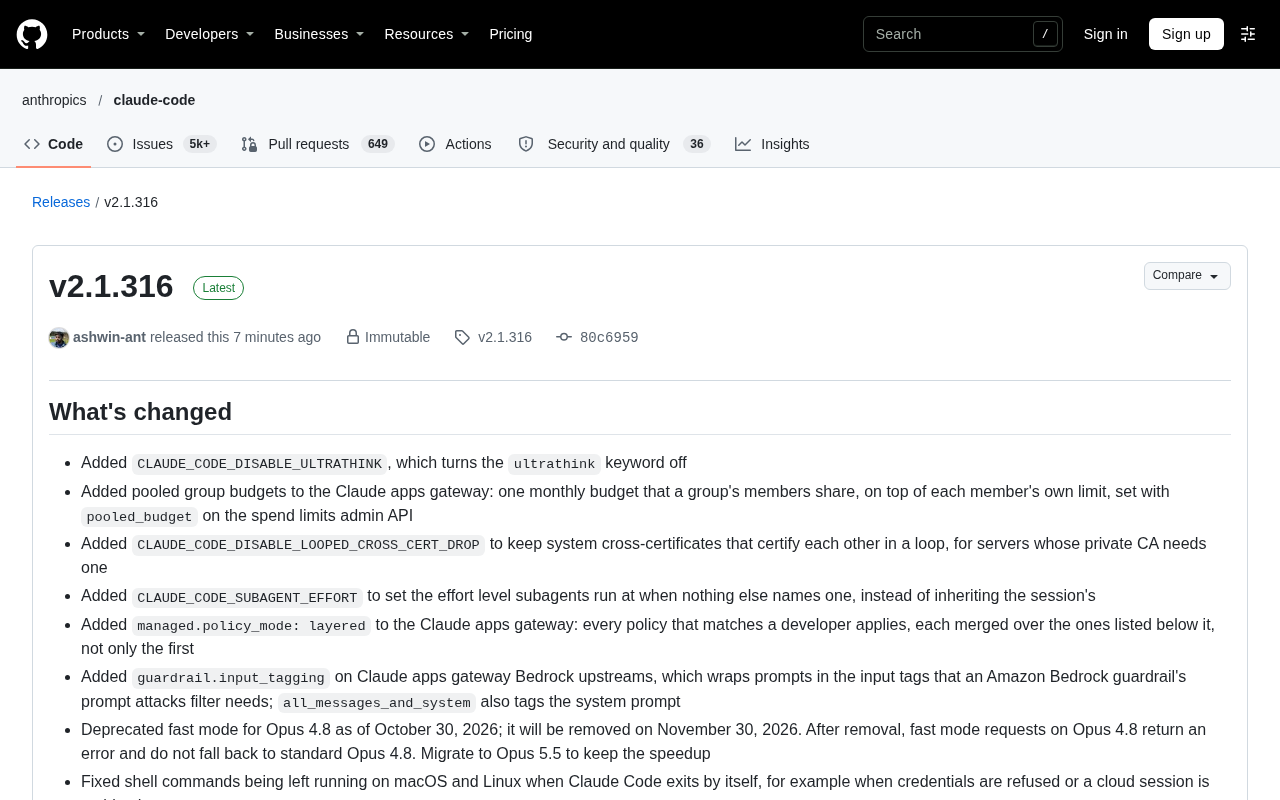
Claude Code v2.1.316 Update Analysis: Enterprise Gateway and Multiple Stability Fixes
Claude Code v2.1.316 released: new enterprise gateway pooled group budgets, layered policy mode, subagent effort control, dozens of Shell, network, and session recovery fixes, and Opus 4.8 fast mode deprecated.

17th-Century British Floods and Doomsday Panic: A New Perspective on Weather History
Based on a Hacker News discussion of '17th-Century British Floods and Foreboding,' this piece explores how extreme weather was given divine and political significance, and what weather history teaches us about contemporary climate communication.

Salesforce Acquires Rune for $375M: AI Logistics Tech Bolsters Defense Business
Salesforce reportedly acquires defense tech startup Rune for $375M. Rune's AI logistics tech will strengthen Salesforce's Missionforce defense platform, continuing its M&A spree.