@ai-sdk/zai 3.0.41 Patch Release: Synchronized Dependency Upgrades

@ai-sdk/zai releases patch 3.0.41, only synchronizing two underlying dependencies with no breaking changes.
The Zhipu model adapter package @ai-sdk/zai in the Vercel AI SDK ecosystem has released version 3.0.41, a patch-level update containing a single commit. The core change upgrades @ai-sdk/provider-utils to 5.0.69 and @ai-sdk/openai-compatible to 3.0.79, with no new features or external interface changes. Such dependency synchronization often implies upstream edge-case fixes passed indirectly through the adapter layer. Developers should watch for transitive dependency version alignment to avoid type mismatches. The package has entered a stable, high-frequency small-step maintenance phase, with real feature evolution occurring mainly in upstream foundational components.
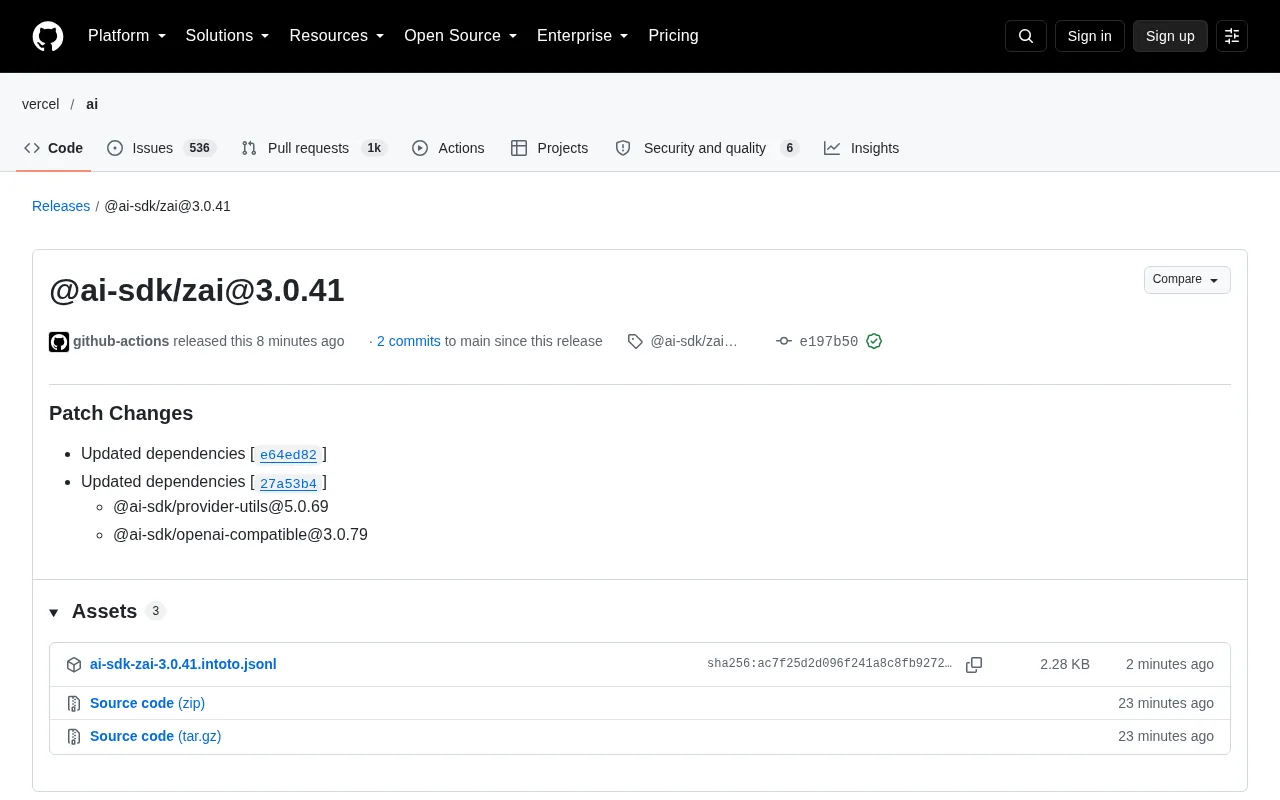
The AI SDK ecosystem under Vercel has received a minor update. @ai-sdk/zai has released version 3.0.41, a patch-level release whose core change is the synchronized upgrade of two underlying dependency packages. For developers using Zhipu AI (Z.ai) model capabilities, this update brings no breaking API-level changes, but it's worth noting the shifts in the dependency chain.
Patch Contents: Only One Thing Changed
According to the release notes on GitHub, version 3.0.41 contains only a single commit (e197b50) and falls under standard Patch Changes. The update is highly focused:
@ai-sdk/provider-utilsupgraded to 5.0.69@ai-sdk/openai-compatibleupgraded to 3.0.79
These two packages are infrastructure components within the AI SDK ecosystem. provider-utils provides shared utility functions and type definitions used across model providers, while openai-compatible handles integration with model services that conform to the OpenAI API specification. @ai-sdk/zai, as the adapter layer for Zhipu models, is built on top of these two layers.
In other words, this release adds no new features, modifies no external interfaces—it simply raises the foundation by one level.
Semantic Versioning (SemVer) is a versioning convention widely followed in the npm ecosystem, formatted as major.minor.patch (e.g., 3.0.41). A major version change indicates incompatible API changes, a minor version indicates backward-compatible feature additions, and a patch number indicates backward-compatible bug fixes. The article refers to 3.0.41 as "Patch Changes," meaning it is judged to contain no breaking changes under this specification. npm's ^ and ~ range symbols are also based on this: ^3.0.41 allows upgrades to higher versions within 3.x, while ~3.0.41 only allows patch upgrades within 3.0.x.
Transitive dependencies refer to packages that a project does not directly declare but that are depended upon by its direct dependencies. The dependency of @ai-sdk/zai on provider-utils and openai-compatible mentioned in the article falls into this category. When multiple packages depend on different versions of the same package, npm may nest-install multiple copies, while pnpm will issue peer dependency warnings. When versions are inconsistent, even if the code logic is identical, TypeScript may report type mismatch errors due to two separate type declarations—so checking the dependency tree after upgrading is necessary.
Why Patch Updates Are Still Worth Noticing
Many developers habitually ignore patch versions, assuming "no new features means no need to care." But in the SDK ecosystem, dependency synchronization often implies fixes.
The version numbers of provider-utils and openai-compatible each advanced by a small step, which typically means upstream has fixed some edge cases—perhaps parsing details of streaming responses, normalization of error types, or minor adjustments to type definitions. @ai-sdk/zai passes these underlying improvements indirectly to users through synchronized dependencies, without needing to change a single line of its own code.
From an engineering perspective, this "dependency-following" strategy reduces the maintenance cost of the adapter layer and keeps the behavior of various provider packages consistent. For users, the most direct benefit after upgrading is that behavioral differences with other AI SDK providers become smaller.
Vercel AI SDK is an open-source toolkit for uniformly calling multiple large models in JavaScript/TypeScript. Its core package is ai, used alongside provider-specific adapter packages (such as @ai-sdk/openai, @ai-sdk/anthropic, @ai-sdk/zai). Its design goal is to accomplish text generation, streaming output, tool calling, and structured output with a single API—switching models only requires replacing the provider instance.
OpenAI-compatible interfaces refer to the practice of many model service providers mimicking OpenAI's /v1/chat/completions and other endpoint formats. @ai-sdk/openai-compatible is precisely the general-purpose adapter layer for such services—Zhipu, DeepSeekAd, Moonshot, and others can all connect through it. This also explains why the article emphasizes that all provider packages share the same underlying layer: their request construction and response parsing logic is highly reused, and upstream fixes benefit all OpenAI-protocol-compatible service providers simultaneously.
Practical Impact on Users
If your project directly depends on @ai-sdk/zai, upgrading to 3.0.41 works the same as usual—change the version number and reinstall. As a patch version, it involves no breaking changes according to semantic versioning conventions.
What to watch for is version alignment of transitive dependencies. If your project simultaneously pins older versions of @ai-sdk/provider-utils or @ai-sdk/openai-compatible, the package manager may produce duplicate installations or version conflict warnings. It's recommended to run a dependency tree check after upgrading to confirm there are no type mismatches caused by multiple versions coexisting.
For teams calling multiple models through the AI SDK's unified interface, keeping dependency versions of various provider packages close together reduces the debugging cost of "the same code behaving differently across different models." This patch release provides just such an opportunity for alignment.
Signals Behind the Release Cadence
@ai-sdk/zai iterates in high-frequency, small steps, and a version number like 3.0.41 indicates it has entered a stable maintenance phase. The adapter layer's logic itself isn't complex—the main work centers on following changes in upstream infrastructure. For the ecosystem, this cadence means that Zhipu model integration remains actively maintained, but there won't be major adapter-layer overhauls in the short term.
The truly exciting feature evolution will most likely emerge in the two upstream packages, provider-utils and openai-compatible, and then be absorbed in batch by the various provider packages. Developers following the AI SDK should direct more of their attention to these two foundational components.
Related articles

Last Week Tonight Exposé: The Dangerous Ties Between Politicians and White Supremacy
Last Week Tonight investigates Georgia Senate candidate Mike Collins and Florida candidate Marshall Rawson, exposing their multiple ties to white supremacists and the Republican Party's silent response.
AI Buzz Weekly: GPT-6.5 Leak, New Claude Model, and MiniMax's Cost-Effectiveness
This week's AI buzz roundup: suspected GPT-6.5 leak, Microsoft configs showing GPT-6.1 Tera, Anthropic's new model that can identify entire classes of bugs, disappointing early Gemini 4 Carbon results, and MiniMax M3.1 Flash beating Claude Opus 5 and GPT-5.6 Sol in benchmarks at extremely low cost.

AI Briefing: Gemini 4 Carbon Released, Ant Open-Sources Ling-3.1
AI Briefing: Google releases Gemini 4 Carbon qubit model, claiming to surpass Opus 5.5 with half-price tokens; Ant open-sources Ling-3.1-1019 for real-task Personal Agents; domestic AI drug discovery succeeds in 18 of 19 projects, hitting all 6 GPCR targets; zero-revenue company valued at $20B raises another $1B; Sichuan convenience store robot sales fail.