AI SDK zai Patch Update: Dependency Upgrades and Compatibility Changes

@ai-sdk/zai releases patch 2.0.16, upgrading only two underlying dependencies; follow up and verify streaming output.
The @ai-sdk/zai package in the AI SDK ecosystem has released patch version 2.0.16. It contains no new features or API changes; the only change is upgrading @ai-sdk/provider-utils to 4.0.63 and @ai-sdk/openai-compatible to 2.0.88. These packages handle common provider logic and the OpenAI-compatible adapter layer, so the upgrade essentially syncs upstream bug fixes and edge-case handling. The release was automated via github-actions, with 3,153 commits accumulated on the main branch since the last release, reflecting high-frequency iteration. Most users face low risk and should follow up; projects that pin dependencies or use overrides/resolutions need to adjust accordingly. After upgrading, verify streaming output completeness and error response handling.
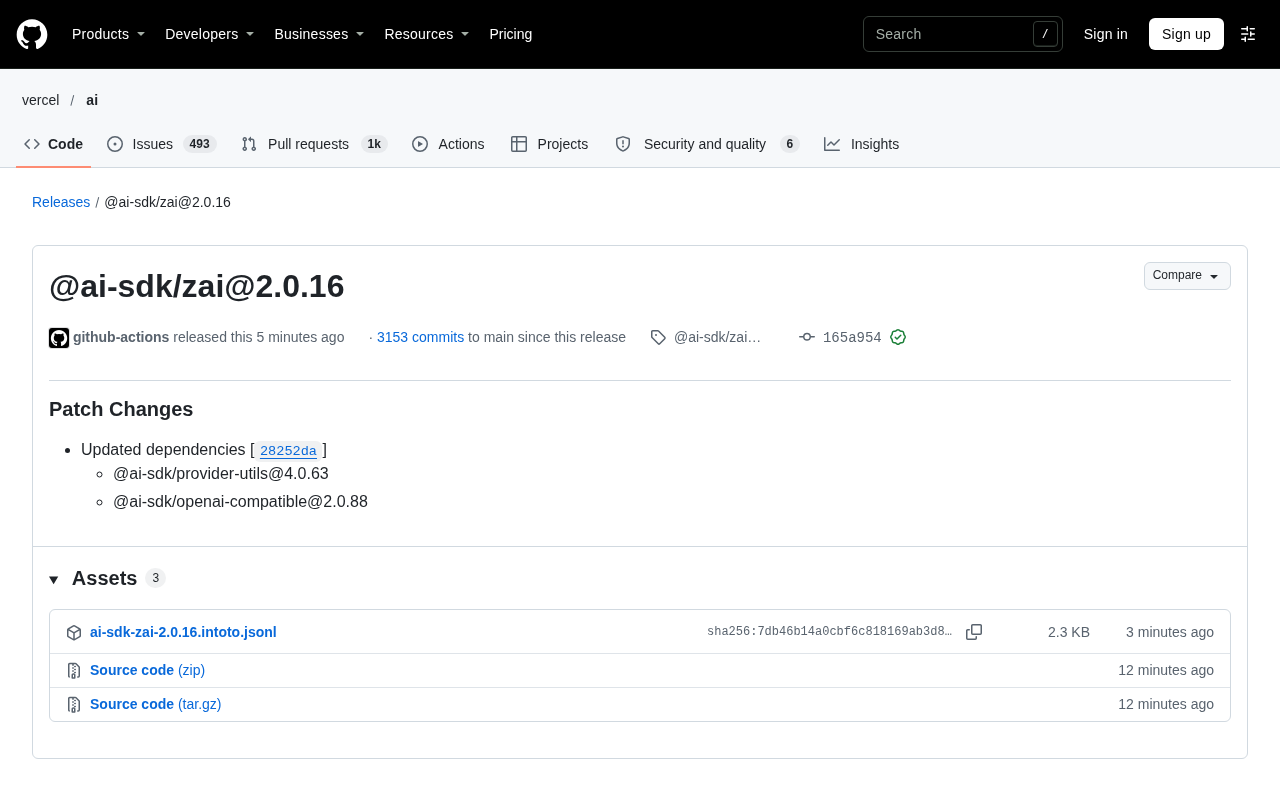
The @ai-sdk/zai package in the AI SDK ecosystem has released version 2.0.16. This is a patch-level update, with the core change centered on upgrading underlying dependencies rather than adding new features or changing APIs. For developers integrating the Z.ai provider, updates like this often affect compatibility and stability, so it's worth a quick look.
What the patch update contains
According to the changelog on the GitHub release page, version 2.0.16 contains only one Patch Change: it updates two dependency packages, @ai-sdk/provider-utils@4.0.63 and @ai-sdk/openai-compatible@2.0.88.
The release was completed automatically by github-actions, the commit was signed and verified by GitHub, and the main branch has accumulated 3,153 commits since the last release. This shows that the AI SDK project as a whole is in a state of high-frequency iteration, and the provider sub-packages release in sync with the rhythm of the core toolchain.
What the dependency upgrade means
provider-utils is the utility library in the AI SDK responsible for common provider logic, and openai-compatible provides an adapter layer compatible with the OpenAI API specification. The Z.ai SDK package depends on both, which means that its behavior for request construction, streaming response parsing, error handling, and so on is built on shared infrastructure.
Patches that update dependencies are usually meant to sync upstream bug fixes or edge-case handling. The release notes do not list which specific issues were fixed; developers can check the changelogs of provider-utils@4.0.63 and openai-compatible@2.0.88 respectively to confirm whether they affect their own use cases.
The layered architecture of the AI SDK: The Vercel AI SDK adopts a "core + provider adapter layer" design. At the bottom is @ai-sdk/provider (which defines abstract interfaces such as LanguageModel and EmbeddingModel). The middle layer, @ai-sdk/provider-utils, encapsulates utility functions shared by all providers—including request parameter serialization, SSE stream parsing, response schema validation, retries, and error mapping. On top are the vendor-specific adapter packages. @ai-sdk/openai-compatible is a special kind of adapter: many vendors (such as Z.ai, DeepSeekAd, and Groq) expose OpenAI-style /chat/completions endpoints, so you only need to extend this package and override a few fields to complete the integration without implementing the protocol from scratch. Understanding this dependency relationship makes it clear why a patch release of the zai package often simply "conveys" fixes from the upstream utility library rather than changing its own logic.
Should you upgrade
For the vast majority of users, patch-level dependency updates carry low risk, and it is advisable to keep up with them. This is especially true when the upstream utility library has fixed issues related to the functionality you use, in which case upgrading brings direct benefits.
However, if your project strictly pins dependency versions, or if you are troubleshooting anomalies related to Z.ai integration, it is worth comparing the specific diffs of the two dependency packages before upgrading. The release page does not list breaking changes, and according to semantic versioning conventions, patch-level updates should not introduce incompatible API adjustments.
Semantic versioning and lockfile interaction: SemVer specifies that in major.minor.patch, the patch position only contains backward-compatible bug fixes, so 2.0.16 should not change the public API relative to 2.0.x. But the actual resolution result is affected by the lockfile: if package.json specifies ^2.0.15, npm/pnpm will only pull 2.0.16 upon reinstallation; if a package-lock.json / pnpm-lock.yaml already exists, it stays unchanged, and you need to explicitly run npm update @ai-sdk/zai or delete the lockfile and reinstall. In addition, if @ai-sdk/provider-utils is pinned via overrides (npm) or resolutions (yarn) / pnpm.overrides, the newly required 4.0.63 may be forcibly downgraded, causing multiple provider-utils instances to appear in the same project—this not only wastes space but may also cause hard-to-troubleshoot runtime errors due to inconsistent instanceof checks or Symbol identities.
Observations on release cadence
The cumulative 3,153 commits reflect the activity level of the AI SDK project. Provider packages frequently follow core dependencies with patch releases. The benefit of this model is that upstream fixes can quickly propagate downstream; the cost is that users need to pay more active attention to version changes. For teams building production applications on the AI SDK, establishing automated dependency update and regression testing processes will be more reliable than manually tracking every patch.
Practical advice
When upgrading, first check whether the resolved versions of the two updated dependencies in package.json are consistent, to avoid version splits caused by the lockfile. If you use pnpm or npm's overrides/resolutions mechanism to pin the version of provider-utils, you need to adjust it accordingly; otherwise, 2.0.16 may not pull the new dependencies as expected. For verification, you can focus on the completeness of streaming output and the handling path for error responses, since these two areas depend most on changes to the underlying tools.
Overall, this is a routine maintenance release with no signals requiring special caution, but it reflects the ongoing evolution of the AI SDK ecosystem.
One-line Summary
@ai-sdk/zai releases patch 2.0.16, upgrading only two underlying dependencies; it is advisable to follow up and verify streaming output.
Paragraph Summary
The @ai-sdk/zai package in the AI SDK ecosystem has released patch version 2.0.16. This update contains no new features or API changes; the only change is upgrading @ai-sdk/provider-utils to 4.0.63 and @ai-sdk/openai-compatible to 2.0.88. These two packages handle common provider logic and the OpenAI-compatible adapter layer, respectively, so the upgrade essentially syncs upstream bug fixes and edge-case handling. The release was completed automatically by github-actions, and the main branch has accumulated 3,153 commits since the last release, reflecting high-frequency iteration. For most users, patch-level dependency updates carry low risk and are worth following; however, projects that pin dependencies or use overrides/resolutions need to adjust accordingly, otherwise the new dependencies may not be pulled as expected. After upgrading, focus verification on streaming output completeness and error response handling paths.
Related articles

Claude Code v2.1.314 Update Analysis: Tighter Permissions and Stability Fixes
Claude Code v2.1.314 adds permissions.blockWritesOutsideWorkingDirectories to block writes outside the working directory, IdP group routing and Bedrock guardrail tracing for enterprise gateways, and fixes for claude -p silent failures, Bedrock multi-image sessions, vim mode, and VS Code issues.

v0.5.23 Release: The Engineering Signals Behind a Minor Version Update
Interpreting the v0.5.23 release: analyzing the iteration rhythm, maintenance model, and upgrade risks of a 0.x-stage project through its semantic version number, Bump commit message, and release page asset loading anomaly.

Rejecting Hallucinated Citations: A More Honest Research Agent Practice
Reddit developer shares ResearchAgent: a research agent that only cites real retrieved sources, with calibrated confidence scores and severity-ranked limitations, using an explicit plan→search/verify→synthesize pipeline, running locally with Ollama+DuckDuckGo.