Claude Code v2.1.314 Update Analysis: Tighter Permissions and Stability Fixes

Claude Code v2.1.314 tightens write boundaries, completes enterprise gateway features, and fixes a batch of stability and interaction issues.
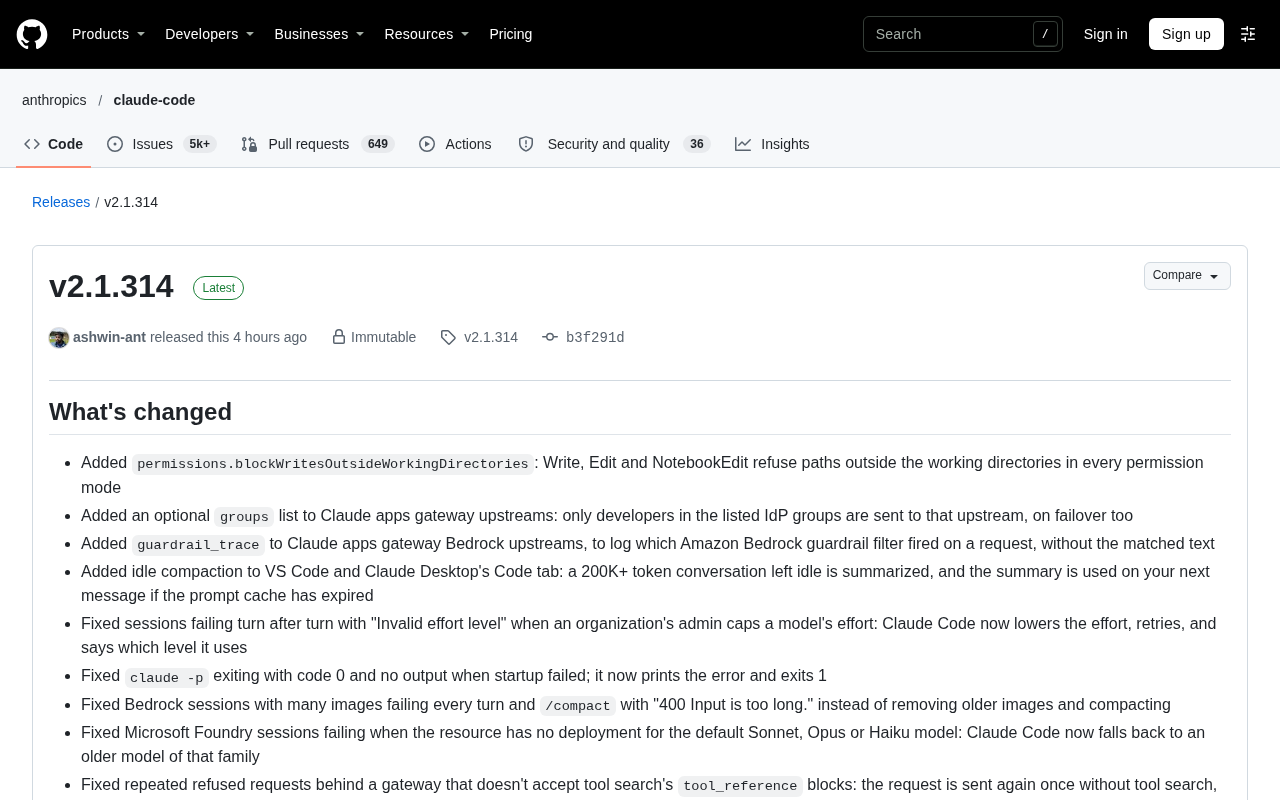
Claude Code v2.1.314 is an iteration focused on security hardening and experience polish. The core change is the new permissions.blockWritesOutsideWorkingDirectories, making out-of-directory writes a hard boundary effective in any permission mode for organization-level control. On the enterprise gateway side, upstream supports routing by IdP groups, and Bedrock adds guardrail_trace to record which guardrail was triggered without writing matched text to disk. Stability fixes address claude -p silent success, Bedrock multi-image sessions and /compact input-too-long errors, and TLS cross-signed root certificates affecting CI and availability. IDE and terminal fixes correct multiple VS Code interaction defects, non-Latin keyboard shortcuts, and vim mode line-overrun and markdown table streaming rendering issues. Context management adds idle compaction and optimizes long-session memory and trash directory growth.
Claude Code has released v2.1.314, a typical "security hardening + experience polish" iteration. The changelog spans dozens of entries, covering the permission model, enterprise gateway, IDE integration, terminal interaction, and cloud sessions. This article picks out the parts that genuinely affect daily use and examines the product thinking behind this update.
Permission model tightened again: file write boundaries made explicit
The most noteworthy new configuration in this update is permissions.blockWritesOutsideWorkingDirectories. When enabled, the three file-writing tools—Write, Edit, and NotebookEdit—will reject paths outside the working directory in any permission mode.
The significance of this design is that it turns "implicit trust" into an "explicit boundary." Previously, different permission modes handled writes outside the directory inconsistently, making it hard for administrators to lock down an entire organization's behavior with a single rule. Now, as long as this switch is on, out-of-bounds writes are hard-blocked without relying on per-instance approval. For teams deploying Claude Code in managed environments, this is a more direct control than post-hoc auditing.
Several permission-related fixes accompany it: settings files excluded by --setting-sources no longer secretly supply auto-mode rules and saved permission grants; and file tools now ask before editing the local copy of organization server-managed settings, consistent with how they handle user settings files.
On "permission modes": Claude Code uses a multi-layered permission model to constrain tool calls. Common modes include the default per-instance prompting, acceptEdits (auto-accept file edits), and the fully permissive bypassPermissions. Handling of the "outside the working directory" boundary has historically been inconsistent across modes—for example, auto-accept mode might let out-of-directory paths through directly, while the default mode tends to confirm each time. The design philosophy behind blockWritesOutsideWorkingDirectories is to elevate this boundary from "each mode for itself" to a global hard constraint orthogonal to the mode: regardless of the current permission mode, as long as the switch is on, out-of-bounds writes are rejected. This also explains why it is especially valuable for enterprise managed environments—administrators can write it into organization-level managed settings without caring which mode a developer has switched to locally.
Enterprise gateway capabilities completed: IdP groups and guardrail tracing
For the Claude apps gateway, two new options aimed at enterprise operations have been added.
First, upstream now supports an optional groups list, so that only developers belonging to specified IdP groups are routed to that upstream—and the same applies during failover. This means the gateway's routing policy can directly reuse the identity provider's group structure, eliminating the need to maintain a separate mapping table.
Second, Bedrock upstream gains guardrail_trace, which records which Amazon Bedrock guardrail filter was triggered on a request, but not the matched text itself. This trade-off is pragmatic: operations needs to know which rule blocked the request, while compliance does not want sensitive content written to disk as a result.
On IdP groups and Amazon Bedrock guardrails: IdP (Identity Provider) refers to enterprise unified identity systems such as Okta, Azure AD, or Google Workspace, where users are typically organized into "groups" for centralized authorization. As the enterprise-side traffic entry point, the Claude apps gateway previously often required maintaining a separate user-to-upstream mapping to route by team or department to different upstreams (such as different cloud providers or model endpoints under different accounts). Directly reusing the IdP's groups declarations aligns routing policy with the existing identity governance system, so no secondary synchronization is needed when personnel change.
Bedrock Guardrail is a policy layer provided by Amazon Bedrock that filters and blocks requests and responses by content category, sensitive terms, privacy information, and other dimensions. guardrail_trace records the metadata of "which filter was triggered" rather than the matched original text—the former suffices to support troubleshooting and compliance auditing, while the latter could write sensitive content to logs. This trade-off is a common consideration in enterprise deployments.
Stability fixes: from startup failures to image compression
Several of these fixes directly affect availability.
Previously, claude -p would exit with code 0 and no output when startup failed; it now prints an error and exits with code 1. For teams embedding Claude Code in CI pipelines, this change eliminates the illusion of "silent success."
The issue where Bedrock sessions failed every turn when there were many images has been fixed, and /compact no longer reports "400 Input is too long" but instead removes earlier images before compressing the context. When a Microsoft Foundry resource lacks a default Sonnet, Opus, or Haiku model deployment, Claude Code now falls back to an older model in the same family rather than failing outright.
A TLS connection issue was also fixed: when the system certificate store contains a new root certificate cross-signed with a predecessor, it previously reported UNABLE_TO_GET_ISSUER_CERT; now it can connect normally. When an MCP server's stored login expires but the server itself supports login-free use, it no longer incorrectly shows "authentication required" but continues working in a logged-out state.
IDE and terminal interaction: details determine feel
The VS Code extension fixes a batch of interaction issues: missing loading animation and stop button when hooks run on queued messages, silent failure when saving session groups, Cmd+F / Ctrl+F failing to open the find widget in the plan preview tab, and the Ctrl+D voice dictation shortcut failing under non-Latin keyboard layouts such as Russian, Greek, and Hebrew. The last one is a real experience improvement for non-native English speakers.
On the terminal side, several vim mode behaviors have been corrected: dw, dW, yw, and yW no longer continue operating past the end of the line; w and W stop at empty lines; and aw and iw no longer swallow the trailing newline. The issue where markdown tables repeatedly jittered in a half-rendered state during streaming output and long tables degraded into raw pipe characters has also been fixed.
Context management: idle compaction and memory optimization
The Code tabs in VS Code and Claude Desktop now add idle compaction: conversations exceeding 200K tokens are automatically summarized after being idle, and if the prompt cache has expired, the next message uses this summary. This mechanism previously existed in other entry points and is now brought to the desktop.
Memory usage for long sessions has also improved. In headless mode and SDK turns running large numbers of subagents, the parent session no longer retains each subagent's tool results until the end of the turn. Meanwhile, --resume has been optimized for speed and memory usage on damaged transcript files, and /context responds faster in sessions containing tens of thousands of MCP tools.
An easily overlooked fix is the unbounded growth of ~/.claude/skills/.trash and ~/.claude/plugins/.trash: both now retain about 1,024 entries each, unaffected by cleanupPeriodDays. Previously, each skill deletion caused the file watcher to run a round of checks, and load would accumulate over long-term use.
On the interplay between prompt caching and idle compaction: Prompt caching is a mechanism provided by cloud model vendors that caches the unchanging prefix of a conversation; subsequent requests that hit the cache can greatly reduce latency and cost, but cache entries have an expiration. So-called "idle compaction" means that after a conversation has been idle for a while and the token count exceeds a threshold, the system automatically summarizes the history into a shorter context; if the original prompt cache has expired by then, the next message continues directly based on the summary, avoiding replaying the entire long history. This is why this update specifically notes that idle compaction also takes effect after one-hour prompt caching is enabled on Bedrock, Vertex, Foundry, and LLM gateways—under different backends and different cache durations, the compaction trigger timing needs to be adjusted accordingly.
A few behavior changes to note
FORCE_HYPERLINK=false (as well as no and off) previously had inverted semantics; it now correctly disables hyperlinks. When auto mode is rejected by the safety classifier without a clear verdict, it no longer incorrectly reports as "blocked" and lists it in /permissions. If model switching under remote control takes more than 8 seconds, it previously returned "still waiting" instead of the final result; it now returns normally.
For subscribers, idle compaction now also runs with telemetry disabled, and also takes effect after one-hour prompt caching is enabled on Bedrock, Vertex, Foundry, and LLM gateways.
Summary
v2.1.314 introduces no new core features; its value centers on three areas: making the permission boundary a configurable hard constraint with blockWritesOutsideWorkingDirectories; completing the enterprise gateway's IdP group routing and Bedrock guardrail tracing; and a batch of fixes affecting CI reliability and day-to-day feel. For individual users, the most noticeable changes come from the vim mode corrections and table rendering; for team administrators, the write-boundary switch and gateway group policy are worth evaluating first.
Related articles

Will GitHub Die? Open Source Maintainer Burnout and the Collaboration Crisis in the AI Era
Lex Fridman podcast discussion on open source maintainer burnout and GitHub's predicament: massive pull requests overwhelm core maintainers, and AI worsens code bloat. Using math journal peer review and Poincaré conjecture verification as analogies, the article analyzes why verification in knowledge production must be deliberately slow, and how open source communities can avoid the failure mode of maintainers exiting.

Stop Building Cookie-Cutter AI Websites: 3 Tools That Transform Your Coding Agent
Three tools that boost AI coding agents: FFmpeg skill for local video editing in Claude Code and Cursor, Hallmark's 50 design themes to fix cookie-cutter AI sites, and Jailbreaks' 25+ model prompts.

How America's Gerontocracy Squeezes the Younger Generation
Americans over 55 hold nearly three-quarters of national wealth, alongside an 80-year-old president and elderly congressional leaders. The Atlantic's Idrees Kahloon explains how gerontocracy drives up housing costs, squeezes opportunities for the young, and explores zoning reform and child poverty reduction as practical fixes.