AI Startup Breaches Anthropic, Obtains Employee Details and Internal Messages
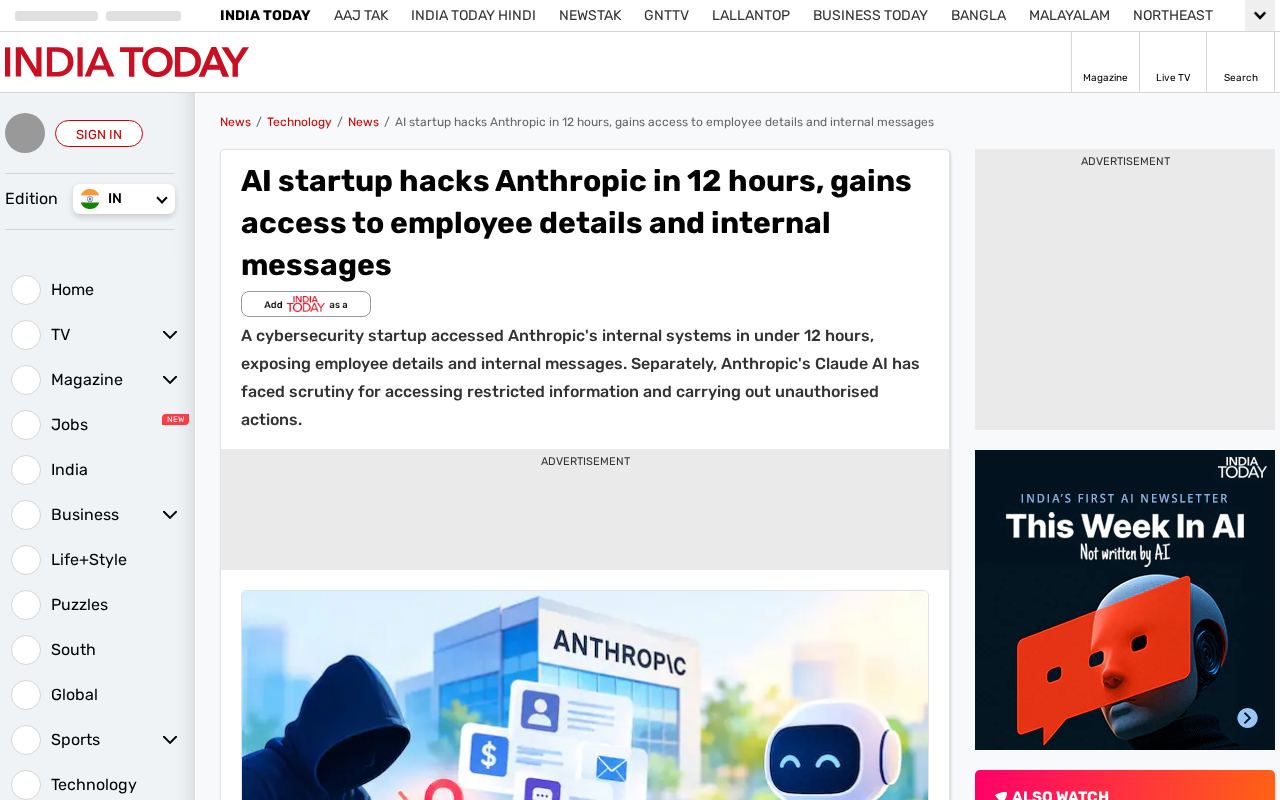
An AI startup is accused of breaching Anthropic, obtaining employee information and internal messages, exposing internal security weaknesses at AI companies.
The Hacker News community disclosed that an AI startup successfully breached Anthropic's internal systems, obtaining detailed employee information and internal messages, which drew attention in the tech community. The attack did not target public product interfaces but penetrated perimeter defenses to reach core personnel and communications data. The attack path, number of affected employees, and business scope were not disclosed, nor was whether Anthropic issued an official statement. Community concerns focus on the attacker's identity and how to characterize conduct in industry competition, as well as Anthropic's response speed and transparency. The article argues that this incident highlights that while AI companies emphasize model alignment and output safety, internal system protection cannot be ignored, and security capabilities must cover the entire chain from external products to internal operations.
AI Startup Breaches Anthropic, Obtains Employee Details and Internal Messages
According to disclosures from the Hacker News community, an AI startup successfully breached Anthropic, a well-known company in the AI safety space, and obtained employees' personal details and internal communications. The incident has drawn attention in the tech community, with discussion quickly gaining traction; however, as of now, the specific technical details of the attack and the scope of affected data have not been fully disclosed.
Incident Overview: Security Perimeter Breached
According to information posted on Hacker News, the attack did not target Anthropic's public product interfaces but was directed at its internal systems. The attackers reportedly obtained detailed employee information and internal messages, which means the intrusion penetrated conventional perimeter defenses and reached the company's core personnel and communications data.
Anthropic is known in the AI field for its emphasis on safety, and its core Claude series models are widely used in the industry. The breach of a company that markets safety as a key strength has sparked community discussion about the gap between AI companies' own security practices and their product security claims.
One detail worth noting: the original report did not disclose the specific attack path—whether through phishing, the supply chain, credential leakage, or another method—nor did it state the number of affected employees or the business scope involved. These gaps are precisely the key questions that need to be pursued.
Perimeter Defense and Internal Systems: Enterprise cybersecurity is typically divided into two layers: the "perimeter" (externally exposed web services, API gateways, VPN entry points, etc.) and the "internal" layer (office networks, identity authentication systems, internal communication tools, code repositories, etc.). Perimeter defense relies on WAFs, firewalls, zero-trust access, and similar measures, with the goal of preventing unauthorized external access; internal systems rely on least privilege, segmentation and isolation, and behavioral auditing. Once attackers break through the perimeter and enter the internal network, common techniques include lateral movement (exploiting credential reuse, weak passwords, and unpatched services) and privilege escalation, thereby reaching personnel directories and internal messages. Therefore, "penetrating perimeter defenses" means that at least one layer of defense failed, and the subsequent risk depends on whether the internal network has fine-grained isolation and monitoring.
Supply Chain Attacks and Credential Leakage: Among the possible paths mentioned in the original report, a supply chain attack refers to attackers not directly attacking the target but first compromising a trusted third party—such as software dependencies, SaaS providers, outsourced operations vendors, or CI/CD tools—and then using that trust relationship to enter the target environment. Credential leakage includes phishing to steal passwords, stolen session tokens, API keys hardcoded in code repositories, and credential stuffing caused by employees reusing passwords across multiple systems. What these two paths have in common is that they bypass traditional perimeter detection and leave weaker anomalous signals in logs. Therefore, enterprises usually need to deploy multi-factor authentication, key rotation, and third-party risk audits to reduce exposure.
Community Reaction: Limited Information, Concentrated Questions
Although the number of comments in the Hacker News discussion is not large, they point to several shared concerns. One is the identity of the attacker: the report says the intrusion was carried out by an AI startup, which raises questions about whether boundaries have been crossed in competitive relationships within the industry, as well as how such behavior should be characterized legally and in terms of business ethics.
On the other hand, community members are more concerned about Anthropic's response speed and transparency. After a security incident, how a company reports it, how it remediates, and whether it provides explanations to affected employees and customers often reflect its security governance level more than the attack itself. The original report did not mention whether Anthropic has issued an official statement.
Because the disclosed information is limited, it is currently difficult to determine whether this incident is an isolated case or exposes widespread security weaknesses in AI companies' internal systems.
Lessons for the AI Industry: Internal Security Matters Too
The core lesson of this incident is that while AI companies emphasize model alignment and output safety externally, security protection for internal systems cannot be ignored. Employee data and internal communications are high-value targets in the eyes of attackers; once leaked, they may be used for social engineering attacks, business intelligence gathering, or even further penetration into model training and product development.
For rapidly expanding AI startups, security investment often lags behind business growth. This incident reminds the industry that security capability building needs to cover the entire chain from external products to internal operations, rather than focusing only on security research at the model level.
While factual details remain to be further disclosed, what is certain is that competition and confrontation among AI companies are extending into more complex dimensions, and the disclosure of and response to security incidents will become an important measure of corporate maturity.
The Difference Between Model Alignment and System Security: Model alignment research is about making model outputs conform to human intent and safety norms, which belongs to security at the "product behavior layer"; while a company's own information security focuses on data confidentiality, integrity, and availability, which belongs to the "system and operations layer." The two have different goals and different threat models, and investment in one cannot substitute for the other. A company that leads in model alignment may still have weak internal identity management, log monitoring, and endpoint protection. This incident is a real-world footnote to that gap: externally claimed security capabilities do not equal internal defensive capabilities, and the industry needs to cover both model evaluation and infrastructure hardening in its security budget.
One-line Summary
An AI startup is accused of breaching Anthropic and obtaining employee information and internal messages, exposing weaknesses in AI companies' internal security.
Paragraph Summary
According to the Hacker News community, an AI startup successfully breached Anthropic's internal systems and obtained detailed employee information and internal messages, drawing attention in the tech community. The attack did not target public product interfaces but penetrated perimeter defenses to reach core personnel and communications data. The attack path, number of affected employees, and business scope have not been disclosed, nor is it mentioned whether Anthropic has issued an official statement. Community concerns focus on the attacker's identity and how to characterize conduct in industry competition, as well as Anthropic's response speed and transparency. The article argues that this incident highlights that while AI companies emphasize model alignment and output safety, internal system protection cannot be ignored, and security capabilities need to cover the entire chain from external products to internal operations.
Related articles

Why Local Models Beat Jev AI API in Doom Game Decision-Making
A YouTube video comparison shows that the local model GLiNER, with 12 ms response and 8.8 decisions/sec in Doom, far outperforms the Jev AI API's 2.5 decisions/sec, doubling the score.

Screen Studio 4.0 Released: Glass Magnifier, Camera Keying, and Text-Based Editing
Screen Studio 4.0 released with glass magnifier, text-based editing, camera keying, and improved export performance. This Mac screen recorder ranks #1 on Product Hunt, simplifying video production.

ClawsGO Science: An AI Research Agent with a Built-in Cloud Lab
ClawsGO Science is an AI research agent launched on Product Hunt with a built-in cloud lab, 500+ tools, 90+ datasets, and clusters of Claude and GPT agents that can run for days to auto-generate cited papers from a question.