ClawsGO Science: An AI Research Agent with a Built-in Cloud Lab

ClawsGO Science aims to turn scientific questions directly into cited papers using a cloud lab and long-horizon multi-agent scheduling.
ClawsGO Science ranks second on Product Hunt and focuses on end-to-end automated research: users input a scientific question, the system completes experiments and writing in its own cloud lab, and outputs a paper with citations. Its selling points include an integrated environment with 500+ tools and 90+ datasets, and a long-horizon scheduling framework that can run clusters of Claude and GPT agents continuously for days. The article affirms the value of stringing "question—experiment—writing" into a complete chain, while noting that automated papers still lack third-party validation on reproducibility, soundness of experimental design, and citation accuracy. There remains a gap between conceptual excitement and research usability, and success depends on whether the output can withstand peer review.
Research automation is moving from "assistive tools" toward "end-to-end executors." ClawsGO Science, the second-ranked new product on Product Hunt, makes an ambitious claim: take a question all the way to a citable paper.
What it actually does
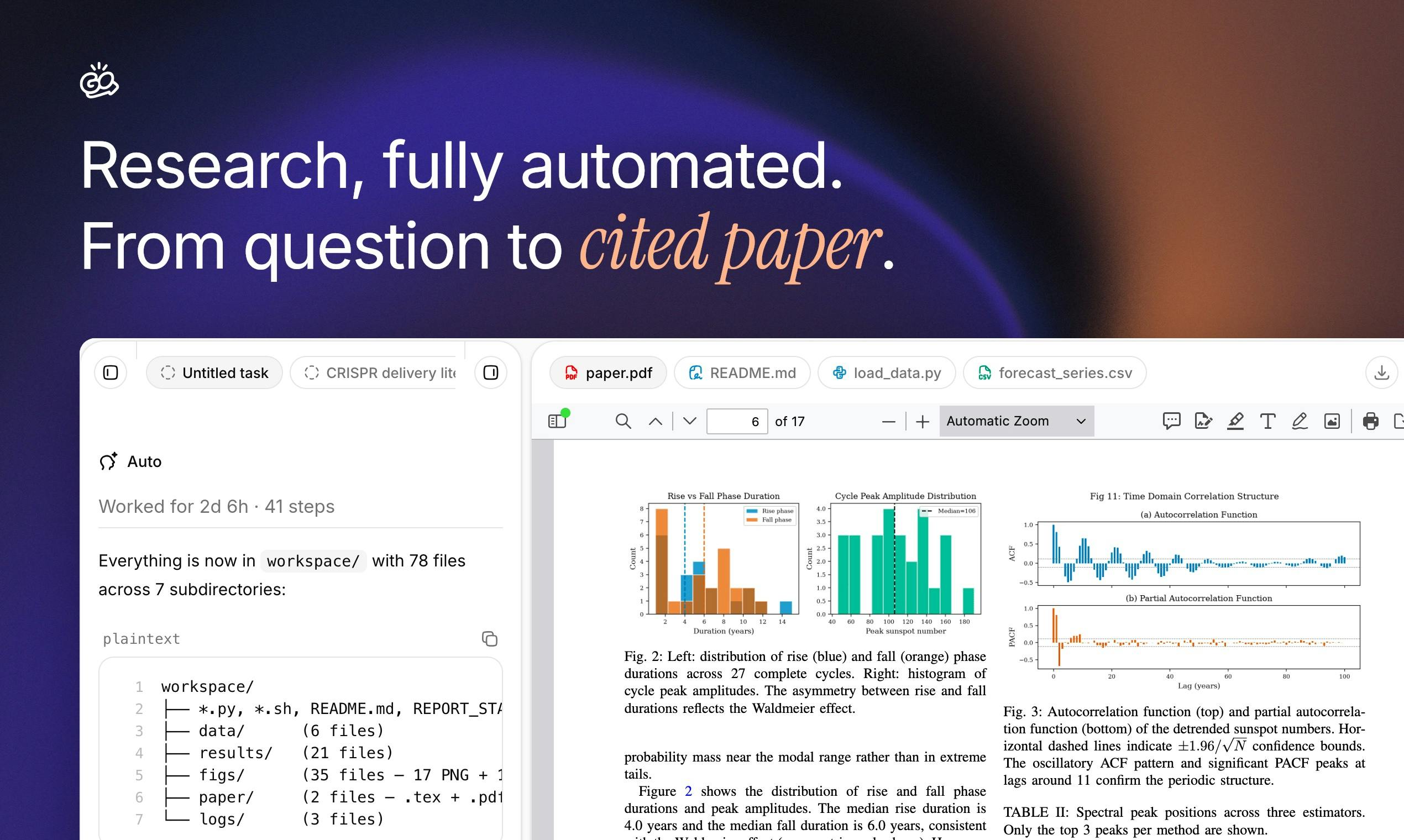
ClawsGO Science describes itself plainly — "Research, fully automated." A user inputs a scientific question, the system runs the research process inside its own cloud lab, and it ultimately outputs a paper with citations.
The key to this pipeline isn't automation of any single step, but stringing "question—experiment—writing" into one complete chain. Most traditional AI research assistants stop at literature search or code generation; ClawsGO attempts to cover the entire research pipeline.
The cloud lab: 500+ tools and 90+ datasets
According to the product page, ClawsGO's cloud lab comes with over 500 tools and more than 90 datasets built in. This means the agent can call on compute resources, data processing capabilities, and analysis tools within the same environment, without relying on external assembly.
Centrally hosting tools and data theoretically solves two problems: first, the instability caused by agents frequently switching between external services during long tasks; second, the permission and format friction between data and compute. For experimental research that requires repeated iteration, the value of this integrated environment is even more obvious.
Cloud lab here does not mean remotely operating real wet-lab equipment, but rather a collection of software-based research environments hosted in the cloud, including computational notebooks, data pipelines, analysis libraries, and model services. Its difference from "assembly-style" approaches lies in unified identity authentication, unified data formats, and unified scheduling interfaces. The risk of such environments is vendor lock-in: once a research workflow is deeply bound to a platform's toolchain and datasets, migration costs become high — and science precisely emphasizes portability and verifiability. Moreover, the sheer number of tools does not equal capability coverage; among 500+ tools, only a minority may actually be called frequently, so evaluation should focus on the quality of orchestration between tools rather than absolute counts.
The long-horizon harness: letting agents "run for days"
Another notable design in ClawsGO is its long-horizon harness. The company claims it can schedule clusters of Claude and GPT agents to run continuously for several days.
This touches on the core bottleneck of current AI agents. Most agents perform acceptably on short tasks, but once the task span stretches to hours or even days, context drift, goal forgetting, and error accumulation set in. Using clusters to distribute long tasks is one direction the industry is exploring, and ClawsGO making it a selling point suggests it has some engineering depth in multi-agent collaborative scheduling.
Long-horizon harness refers to a scheduling shell designed for ultra-long tasks (harness originally means horse tack; in software it refers to the execution framework that wraps and drives a component). It typically includes a task decomposer, persistent state storage, checkpoint and rollback mechanisms, and memory compression modules across sessions. Compared with ordinary agent frameworks, the core difficulty of a long-horizon harness lies in: how to compress days of execution history into a limited, replayable context; how to retry locally rather than restart globally when a subtask fails; and how to establish a unified progress ledger among multiple agents. Common industry practices include using external vector stores to save intermediate conclusions, using structured plan files to replace long conversation memory, and setting up periodic "health check" sub-agents to correct goal drift. ClawsGO's claim of running continuously for days means it must provide engineering solutions in at least some of these areas.
The leap from tool to "paradigm"
ClawsGO uses phrasing like "The next paradigm for science" in its promotional copy. Such claims should be viewed with caution.
On one hand, end-to-end automated research could indeed change how researchers work — handing repetitive experiments and first-draft writing to agents while people focus on problem definition and judging results. On the other hand, automatically generated papers still need rigorous verification for reproducibility, soundness of experimental design, and citation accuracy. In the currently public information, I have not seen third-party evaluations or case details regarding output quality.
On Product Hunt, the product received 132 votes and 18 comments, ranking second for the day, indicating considerable community interest in its concept. But there is still a considerable distance between conceptual excitement and actual research usability that the product itself must prove.
Reproducibility is the first hard threshold for judging automated research output. It requires that every experimental record in a paper can be rerun by a third party under the same conditions and yield consistent results. For AI-generated papers, this means the system must fully record tool versions, dataset snapshots, hyperparameters, random seeds, and execution traces. Most end-to-end research agents currently output only the final text, with the intermediate process compressed into conversation history that is hard to audit. Another related concept is soundness of experimental design — automated systems easily produce control experiments that "run but have no scientific meaning," such as missing necessary negative controls or insufficient sample size. Citation accuracy involves the citation hallucination problem: models may generate plausible-looking but nonexistent references, which is a fatal error in academic contexts. These three constitute the basic checklist by which external reviewers assess automated papers.
Who should pay attention
For research teams that need rapid exploratory analysis, tools like ClawsGO can serve as a pre-filter — first run a round of hypotheses through an automated pipeline, then let humans judge which directions are worth pursuing. For engineering teams, its multi-agent long-horizon scheduling approach also offers reference value.
What really determines the success of such products is not the number of tools or the scale of datasets, but whether the output papers can withstand peer review. On this point, ClawsGO still needs to answer with real cases.
One-line Summary
ClawsGO Science aims to turn scientific questions directly into cited papers using a cloud lab and long-horizon multi-agent scheduling.
Paragraph Summary
ClawsGO Science ranks second on Product Hunt and focuses on end-to-end automated research: users input a scientific question, the system completes experiments and writing in its own cloud lab, and outputs a paper with citations. Its selling points include an integrated environment with 500+ tools and 90+ datasets, and a long-horizon scheduling framework that can run clusters of Claude and GPT agents continuously for days. The article affirms the value of stringing "question—experiment—writing" into a complete chain, while noting that automated papers still lack third-party validation on reproducibility, soundness of experimental design, and citation accuracy. There remains a gap between conceptual excitement and research usability, and success depends on whether the output can withstand peer review.
Related articles

Anthropic's IPO Crisis: Why $16.8B in Revenue Can't Buy a High Valuation
Anthropic posted $16.8B in Q3 revenue with 85% gross margin yet faces a cut to its IPO valuation. A deep dive into halved growth, the token price war, circular financing, and the clash between safety ideals and capital reality.

Anthropic Races Toward the Largest IPO in History: Can a $100 Billion Raise Ignite the AI Investment Boom?
Anthropic may file its prospectus as early as October 23, aiming to raise up to $100 billion at a valuation of up to $2 trillion, potentially the largest IPO ever. Q3 revenue hit $16.8 billion, up nearly 50% quarter over quarter, with adjusted profitability, but slowing growth has led some investors to cut valuation to $1.5 trillion. The IPO is a key test of whether the AI investment boom can continue.

Bessemer Partner on Anthropic IPO: The Public's First Direct Investment in AI Software
Bessemer partner Byron Theta on the Anthropic IPO: why it's called the moment everyone's been waiting for, the $650M four-round investment, the LP liquidity bind, and expectations of a 2027 IPO wave—plus open-source model pricing pressure, existential risk disclosures, and what the founders' 50.1% voting structure means for ordinary investors.