AI4Plasma: Five Surrogate Models Compete on Data Efficiency, FNO Wins

Systematic comparison of five surrogate architectures for CCP field prediction shows FNO is optimal in most scenarios.
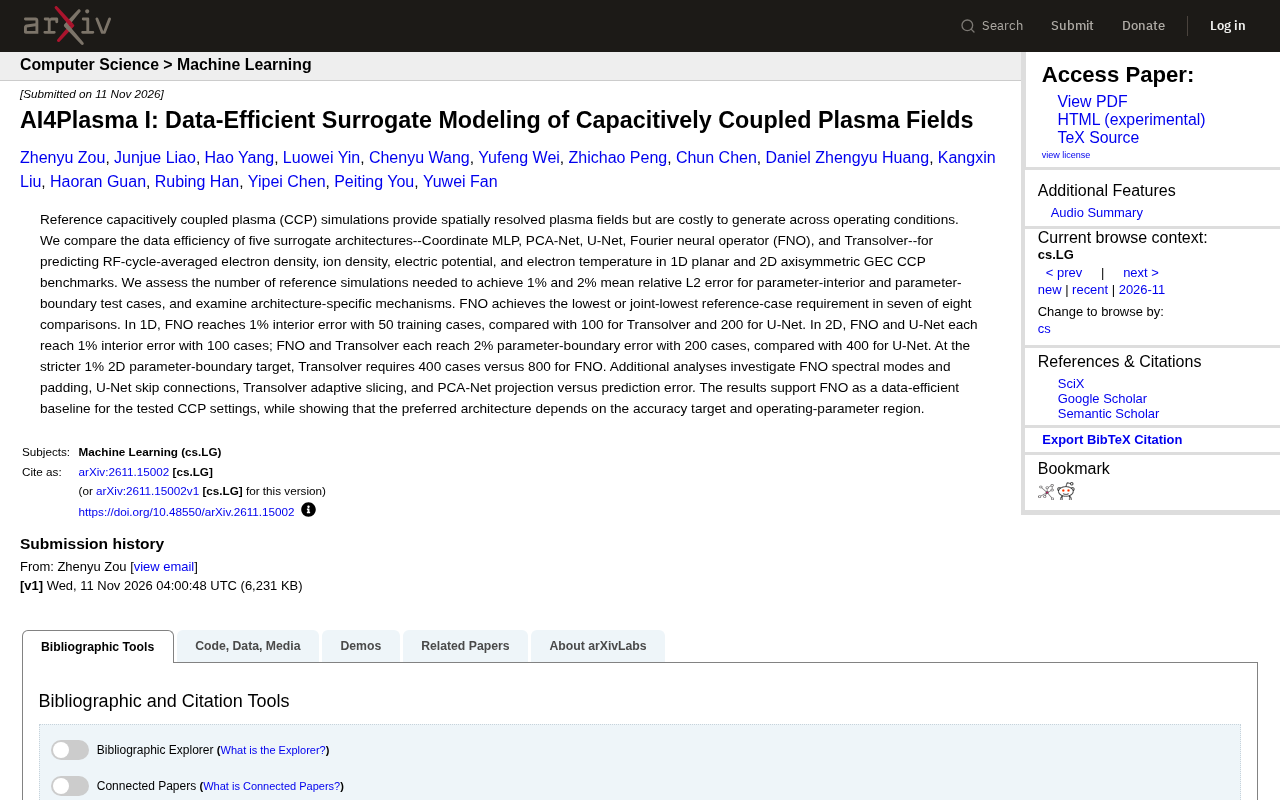
AI4Plasma I systematically compared five surrogate architectures—Coordinate MLP, PCA-Net, U-Net, FNO, and Transolver—for plasma field prediction on 1D planar and 2D axisymmetric GEC CCP benchmarks. The core metric was the number of reference simulations needed to achieve 1% and 2% mean relative L2 error, distinguishing in-parameter from parameter-boundary test cases. FNO achieved the lowest or tied-lowest sample requirement in seven of eight comparisons: in 1D only 50 cases were needed for 1% in-parameter error, four times more efficient than U-Net. However, for the 2D 1% parameter-boundary target, Transolver outperformed FNO (400 vs. 800 cases). The study further analyzed mechanisms such as spectral modes and skip connections, concluding that the optimal architecture depends on accuracy targets and parameter regions, providing actionable guidance for engineering selection.
Why Do We Need Surrogate Models?
Capacitively coupled plasma (CCP) simulations can provide spatially resolved plasma field data, but generating this data across different operating conditions is costly. Each reference simulation requires solving complex physical equations, which is time-consuming and computationally intensive. The goal of surrogate models is to train neural networks with a small amount of simulation data to rapidly predict plasma field distributions, thereby accelerating process design and optimization.
However, the data efficiency of different surrogate architectures varies significantly—some require hundreds of training samples to reach target accuracy, while others need only a few dozen. Research in AI4Plasma I systematically compared the data efficiency of five mainstream architectures on the CCP field prediction task, providing a basis for architecture selection in practical applications.
Capacitively coupled plasma (CCP) is a type of plasma source widely used in semiconductor manufacturing: within a vacuum chamber, RF voltage is applied between parallel plate electrodes, forming sheaths near the electrodes and exciting ionization to produce high-density plasma. The core difficulty of CCP simulation lies in the coupling between electron and ion transport in non-uniform electric fields and collisional reactions, requiring solutions to drift-diffusion equations or Boltzmann equations, as well as time-averaging over the RF cycle. Spatially, multiple scales must be resolved—the sheath, bulk plasma region, and electrode boundaries—so a single simulation often takes hours to days. This "high-fidelity but high-cost" characteristic is precisely the fundamental reason why surrogate models are needed to learn field distribution mappings from a small number of simulation samples.
Comparison Framework of Five Architectures
The study compared five surrogate architectures on 1D planar and 2D axisymmetric GEC CCP benchmarks: Coordinate MLP, PCA-Net, U-Net, Fourier Neural Operator (FNO), and Transolver. Prediction targets included RF cycle-averaged electron density, ion density, electric potential, and electron temperature.
The core evaluation metric was "the number of reference simulations required to achieve 1% and 2% mean relative L2 error," distinguishing between in-parameter test cases and parameter-boundary test cases. "In-parameter" refers to operating conditions falling within the training parameter range, while "boundary" refers to conditions approaching or exceeding the training range—the latter places higher demands on the surrogate model's generalization capability.
This design reveals a key dimension of architecture selection: different target accuracies and different parameter regions may lead to completely different optimal architectures.
Fourier Neural Operator (FNO) is based on learning function-to-function mappings in the frequency domain: it projects input fields onto low-frequency modes via the fast Fourier transform, performs linear transformations in a truncated spectral space, then inverse-transforms back to physical space, in parallel with a pointwise MLP branch. This structure naturally adapts to grid resolution changes and has strong expressive capacity for globally smooth structures. Transolver, on the other hand, employs an adaptive slicing mechanism that dynamically partitions input point clouds or meshes into slices based on physical similarity, performing attention aggregation within each slice to capture both local and global features without relying on fixed grid topology. These two represent the technical routes of "frequency-domain global modeling" and "adaptive local aggregation," respectively—which is the root of their performance differences in in-parameter versus boundary scenarios.
FNO Achieves Optimal Data Efficiency in Most Scenarios
Across eight comparison groups, FNO achieved the lowest or tied-lowest reference case requirement in seven. Specifically:
- 1D scenarios: FNO required only 50 training cases to achieve 1% in-parameter error, compared to 100 for Transolver and 200 for U-Net. FNO's data efficiency was four times that of U-Net.
- 2D scenarios: Both FNO and U-Net achieved 1% in-parameter error with 100 cases. For the 2% parameter-boundary error target, FNO and Transolver each required 200 cases, while U-Net needed 400.
- The stricter 2D 1% parameter-boundary target: Transolver required 400 cases while FNO needed 800—here Transolver was actually superior.
This result demonstrates that FNO is a reasonable data-efficient baseline for CCP scenarios, but the "optimal architecture" is not absolute—it depends on the accuracy target and parameter region.
Architecture Mechanism Analysis: Why Is FNO More Data-Efficient?
The study also provided in-depth analysis of each architecture's working mechanisms, including FNO's spectral modes and padding strategies, U-Net's skip connections, Transolver's adaptive slicing, and the relationship between projection error and prediction error in PCA-Net.
The value of these analyses lies in going beyond "which model is better" rankings to reveal the sources of data efficiency differences. FNO's spectral representation is naturally suited to capturing the global structure of plasma fields, while U-Net's skip connections are better at local details—this explains why performance varies across different accuracy targets and parameter regions.
For engineering practice, this means architecture selection should not blindly chase the top of leaderboards, but should be combined with the specific task's accuracy requirements and parameter coverage. If operating conditions are stable and target accuracy is moderate, FNO is the most data-efficient choice; if very high accuracy is needed at parameter boundaries, Transolver may be more suitable.
Mean relative L2 error is the core metric for measuring surrogate accuracy in this study: for each test sample, the squared differences between predicted and reference fields are computed pointwise, averaged, and square-rooted, then divided by the RMS value of the reference field, and finally averaged over all test samples. It is normalized relative to the root-mean-square error, allowing comparison across different physical quantities (electron density, electric potential, electron temperature). In-parameter test cases refer to operating conditions within the training parameter range, testing interpolation capability; parameter-boundary test cases refer to conditions approaching or exceeding the training range, testing extrapolation capability. The error curves of the same architecture often diverge between these two types of cases, so the number of samples required to reach target accuracy must be reported separately—otherwise differences in generalization capability would be obscured.
Implications for Plasma Simulation Practice
The direct value of this work lies in providing an actionable selection guide for surrogate modeling of CCP simulations. The number of reference simulations directly corresponds to computational cost—reducing from 200 cases to 50 cases means a fourfold computational saving. For plasma process development requiring repeated iteration, this improvement in data efficiency can significantly shorten design cycles.
The study also shows that the data efficiency of surrogate models is not a fixed attribute but a dynamic result jointly determined by accuracy targets, parameter regions, and physical field dimensions. Future work can build on this to explore more complex CCP configurations and joint prediction of more physical quantities.
For more details, refer to the original paper "AI4Plasma I: Data-Efficient Surrogate Modeling of Capacitively Coupled Plasma Fields."
Related articles

Programmers in the AI Era: How Deep Should You Learn Legacy Tech?
How should programmers transform under AI's impact? How deep should legacy tech be learned? Drawing on a Bilibili creator's share, this breaks down the levels of embracing AI, the shift from process-driven to project-driven learning, and how lower technical barriers affect junior and mid-level roles.

OpenAI Releases GPT-6.2 Dual Models Astra and Sol, API Price Cut by 20%
OpenAI releases GPT-6.2 Astra and Sol, with Astra's API price cut 20% to $8/$40 per million tokens and ranking second on the Artificial Analysis Intelligence Index. This article analyzes the dual-model strategy, price-cut impact, and developer selection advice.

Perplexity Computer Launches Multiagent: 16 AI Agents Cross-Validate Each Other
Perplexity launches Multiagent mode for Computer: a lead agent orchestrates up to 16 sub-agents on Claude, GPT, and Gemini, sharing findings and cross-validating work with effort above Ultra.