Aionterra: A Continuous World Learning Experiment with Multiple Bodies Sharing One Policy

Aionterra experiment lets multiple digital bodies share one learning policy and openly discusses evaluation challenges.
Aionterra is a simulated world developed by YD Emergence Lab, whose inhabitants are digital organisms with humanoid bodies. Its core design is shared policy with independent bodies: multiple bodies each perceive the environment and act, but their experiences feed into the same learning policy. This architecture naturally involves experience aggregation and representation generalization, and is closer to a picture of a group adapting to its environment than single-agent reinforcement learning. The team explicitly defines environmental and physical rules and emphasizes that behavior should develop through experience rather than being pre-scripted. What draws the most attention is the project's honest attitude toward evaluation: changes in internal learning counters cannot prove behavioral improvement—controlled comparisons and observable consequences are needed. The project is still in development, with methodology publicly available and feedback being solicited.
When Multiple "Bodies" Share One Brain: Aionterra's Embodied Learning Experiment
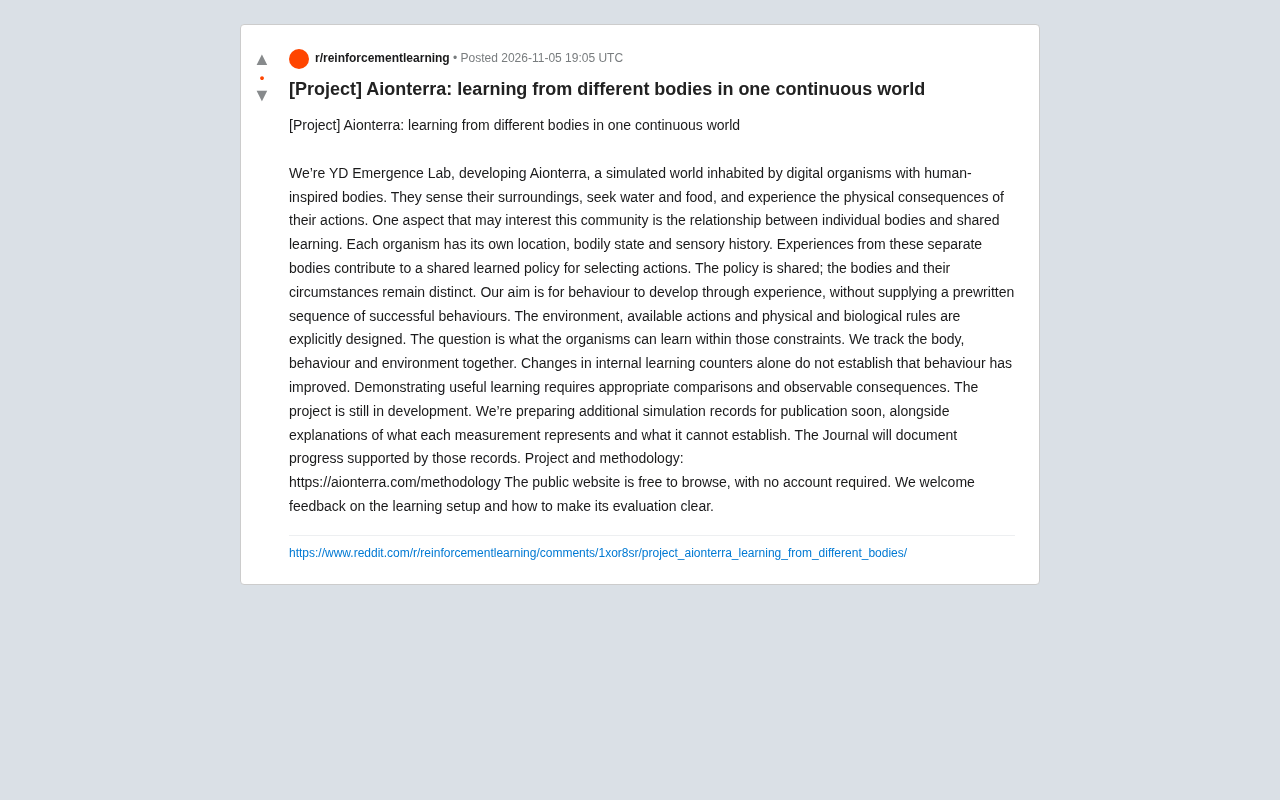
A project post from YD Emergence Lab recently appeared on the Reddit community, introducing the simulated world Aionterra they are developing. The inhabitants of this world are digital organisms with humanoid bodies: they perceive their surroundings, seek out water and food, and bear the physical consequences of their own actions. For readers interested in embodied intelligence and multi-agent learning, what is truly worth noting is how it handles the relationship between "individual bodies" and "shared learning."
Core Design: Shared Policy, Independent Bodies
The mechanism of Aionterra can be summed up in one sentence: the policy is shared, while bodies and circumstances are each independent.
Each organism has its own position, body state, and perceptual history. These experiences, distributed across different bodies, jointly feed into a shared learning policy used to select actions. In other words, multiple bodies act under the same policy, but their sensory inputs and physical circumstances are not identical. This setup contrasts with common single-agent reinforcement learning—where typically only one body collects experience—whereas here the sources of experience are naturally distributed.
The team explicitly states that their goal is for behavior to develop through experience rather than being pre-written as a script of successful behaviors. The environment, available actions, and physical and biological rules are all explicitly designed; the truly open question is: under these constraints, what can the organisms actually learn?
Shared policy is an architecture common in multi-agent or multi-body systems: all agents call the same parameterized policy network (e.g., a neural network) to select actions, but each has its own independent observations and state. Compared with "one independent policy per agent," a shared policy can significantly increase the amount of training data and forces the policy to learn behavioral representations that are invariant to individual differences, thereby improving generalization. This design is often called parameter sharing in reinforcement learning, with typical applications including multi-agent cooperation (such as OpenAI's hide-and-seek experiment) and distributed robot control. Its core challenge lies in how to balance the contributions of different individuals' experiences and avoid the policy being biased by certain dominant distributions.
Why "Shared Policy" Is Worth Noting
The shared policy design introduces an interesting tension. If all bodies share one policy, how is the learning signal distributed among the experiences of different bodies? Are the experiences of a body near a water source and a body in a food-scarce region equally contributing to the same policy?
This architecture naturally involves the problems of experience aggregation and representation generalization. The state of a single body is local and transient, while the shared policy must distill reusable behavioral patterns from it. For those studying multi-agent systems and embodied cognition, this is closer to the real-world picture of a group adapting to its environment than simply "training an agent to walk."
Another noteworthy point is that the team has explicitly defined the environmental rules and biological rules. This means the experiment is highly interpretable: behavioral changes can be traced back to specific environmental constraints rather than black-box emergence.
Experience aggregation refers to combining experience data from multiple sources (such as different bodies, different times, and different environments) to update the same model. Under a shared policy architecture, the aggregation method directly affects learning efficiency and stability: simple averaging may drown out rare but important experiences, while weighted aggregation (e.g., weighting by advantage function or uncertainty) can better utilize heterogeneous data. The related concept of representation generalization focuses on the policy's ability to distill transferable behavioral patterns from local, transient experiences. These two concepts are core issues in multi-agent learning and embodied intelligence, determining whether the system can benefit from distributed experience rather than suffer from mutual interference.
The Evaluation Challenge: Learning Counters Are Not Equal to Behavioral Progress
The most honest aspect of this project may be its attitude toward the evaluation problem.
The team states plainly in the post: changes in internal learning counters alone do not prove that behavior has actually improved. To demonstrate useful learning, appropriate controlled comparisons and observable consequences are needed. In other words, they acknowledge that "appearing to learn" and "actually getting stronger" are two different things, and they proactively put this distinction on the table.
They also mention that more simulation records are being prepared for release, and that they will simultaneously explain what each measurement represents and what it cannot prove. This awareness of the boundaries of measurement is uncommon in research-oriented projects, and it is also an important signal for readers who wish to reproduce or evaluate this work.
Learning counters typically refer to internal metrics recorded during training, such as the number of policy updates, the decrease in the loss function, or the size of the experience replay buffer. These metrics reflect changes in the algorithm's internal state, not the agent's actual performance in the environment. In reinforcement learning, a common pitfall is "reward hacking" or "metric inflation": the model may optimize proxy metrics without truly improving task performance. Therefore, rigorous evaluation requires setting up control groups (such as random policies or fixed scripted policies) and measuring observable behavioral consequences (such as task completion rate or survival time). The team's emphasis on this point reflects a respect for empirical research standards.
Project Status and How to Get Involved
Aionterra is still in the development stage. The team has placed methodological details at aionterra.com/methodology, and the public website can be browsed for free without registering an account. They are also soliciting feedback on the learning setup and on how to make the evaluation clearer.
For readers who want to follow this kind of continuous world embodied learning experiment, this project provides an observation window: it does not promise results, but instead discloses design choices, evaluation criteria, and limitations together. As for what these digital organisms will ultimately learn, we will have to wait for subsequent simulation records to answer.
One-line Summary
Aionterra experiment lets multiple digital bodies share one learning policy and openly discusses evaluation challenges.
Paragraph Summary
Aionterra is a simulated world developed by YD Emergence Lab, whose inhabitants are digital organisms with humanoid bodies. Its core design is shared policy with independent bodies: multiple bodies each perceive the environment and act, but their experiences feed into the same learning policy. This architecture naturally involves experience aggregation and representation generalization, and is closer to a picture of a group adapting to its environment than single-agent reinforcement learning. The team explicitly defines environmental and physical rules and emphasizes that behavior should develop through experience rather than being pre-scripted. What draws the most attention is the project's honest attitude toward evaluation: changes in internal learning counters cannot prove behavioral improvement—controlled comparisons and observable consequences are needed. The project is still in development, with methodology publicly available and feedback being solicited.
Related articles
 Tech Frontiers
Sherlock: An Open-Source Tool for Tracking Usernames Across Social Networks
Sherlock is an open-source Python tool that tracks social accounts across networks by username. This article covers its core features, why developers love it, typical use cases, and privacy compliance considerations.
 Tech Frontiers
GitHub Daily·Nov 07: Agent-Ready and Context Compression
GitHub Trending Nov 07: meta's agent-ready design system astryx, billion-context's 5x context compression, sherlock nearing 100k stars, plus local-first localthings and bare-metal GPU orchestration nvke.
 Tech Frontiers
Buoyant Open-Sources Kinference: An Inference Control Plane for vLLM on K8s
Buoyant open-sources Kinference, an inference control plane for vLLM on Kubernetes, with declarative routing, KV-cache-aware load balancing, and per-tenant metrics—claiming 95% lower median TTFT in official benchmarks.