Amazon Applied Science Intern Interview: How PhDs Can Tackle Both ML and DSA Challenges

One-week sprint guide for Amazon Applied Science Intern interview: focus on ML breadth, high-frequency DSA problems, and behavioral interviews, while weighing the opportunity costs of canceling versus preparing.
An EU PhD student received an Amazon Applied Science Intern interview invitation, facing two rounds covering ML breadth and DSA coding. With no technical interview experience, the candidate is anxious and even considering canceling. The article analyzes that the role typically assesses machine learning fundamentals, statistics and probability, Python coding, and behavioral interviews (Leadership Principles), noting that while canceling may relieve pressure, opportunities are scarce and real interview experience is valuable. Short-term sprint preparation should focus on high-frequency topics: core ML concepts and personal project explanations, commonly tested Amazon algorithm problems (arrays, strings, hash tables, two pointers, binary trees, BFS/DFS), and STAR-method stories for Leadership Principles. Long-term, coding ability is a fundamental skill for applied scientists, and AI-assisted programming cannot replace mastery of algorithm details and debugging skills. Community experience shows that the coding round for applied science internships is less difficult than for SDE roles, and one week of targeted preparation can still lead to passing. Candidates are advised to adjust their mindset and treat the interview as a learning opportunity.
A Hard-Won Interview Opportunity, But a Big Challenge
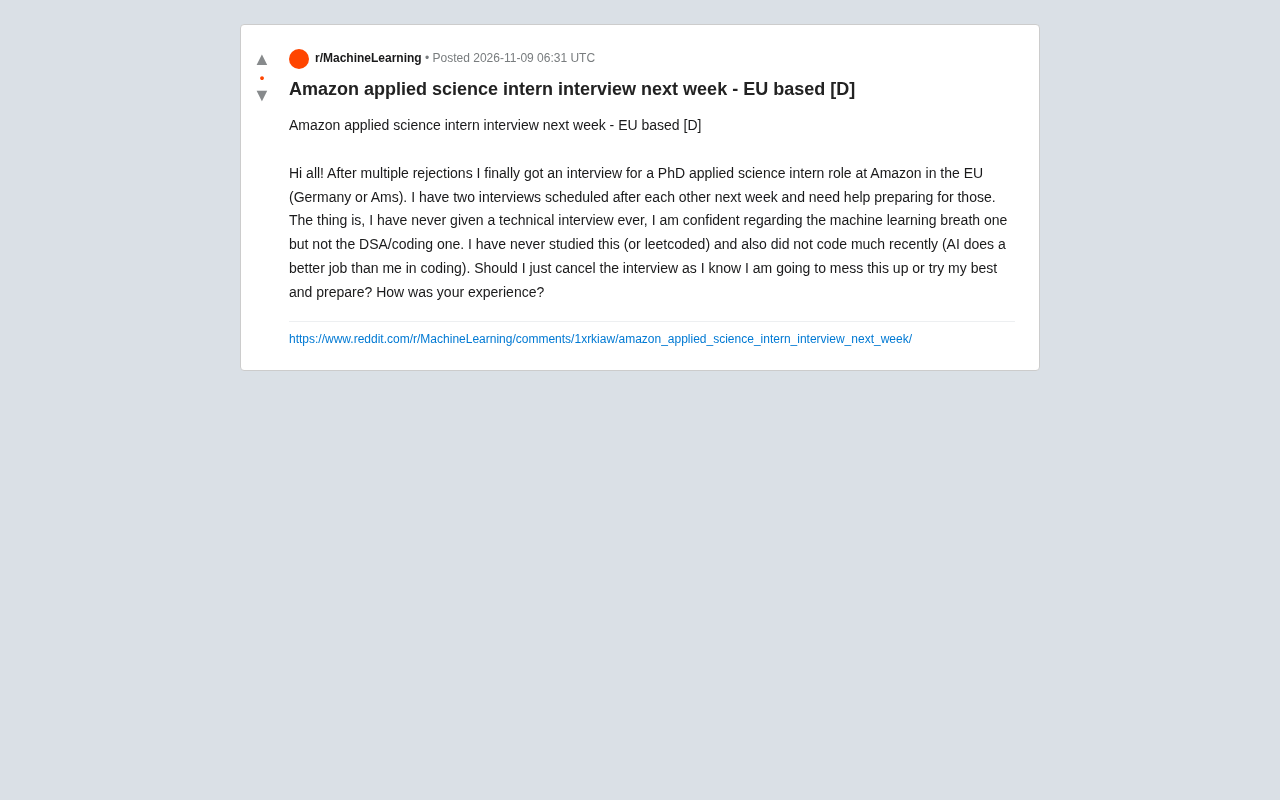
A PhD student in the EU recently received an interview invitation for an Amazon Applied Science Intern position, possibly in Germany or Amsterdam. After multiple rejections, this opportunity feels especially precious. However, the joy was quickly overshadowed by anxiety—the interview consists of two rounds held back-to-back, one covering machine learning breadth and the other a DSA/coding test. The candidate admits they have never attended a technical interview, feel somewhat confident about the ML portion, but have almost zero foundation in DSA and coding: "I've never studied this stuff, never grinded LeetCode, and haven't written much code recently (AI writes code better than I do)." They even considered canceling the interview outright to avoid messing it up.
What Does the Applied Science Intern Interview Cover?
Amazon's Applied Science Intern positions typically target master's or PhD students, with work focused on combining research and application—such as building machine learning models, designing experiments, and analyzing data. Interviews generally assess several dimensions: machine learning fundamentals, statistics and probability, coding ability (usually Python), and behavioral interviews (Amazon's Leadership Principles). For PhD candidates, interviewers may also focus on research depth and approach to solving practical problems.
The "ML breadth" the candidate mentioned likely covers core concepts such as supervised learning, deep learning, evaluation metrics, overfitting, and regularization; while "DSA/coding" may include common problem types like arrays, strings, hash tables, trees, sorting, and dynamic programming. Although coding requirements for applied science roles are usually lower than for pure software engineers (SDEs), basic data structures and algorithm skills are still necessary, since daily work involves writing code to implement models and process data.
Amazon Leadership Principles are 16 behavioral guidelines used internally at Amazon for hiring, performance evaluation, and daily decision-making, including Customer Obsession, Ownership, Invent and Simplify, Are Right, A Lot, Hire and Develop the Best, Insist on the Highest Standards, Think Big, Bias for Action, Frugality, Earn Trust, Dive Deep, Have Backbone; Disagree and Commit, Deliver Results, and more. In behavioral interviews, interviewers ask questions based on these principles, requiring candidates to demonstrate relevant traits with specific examples (usually following the STAR method: Situation, Task, Action, Result). When preparing, have at least one real story for each principle, highlighting your personal contribution and quantified results.
Should You Cancel? First Assess Sunk Costs and Opportunity Costs
Facing an interview you're underprepared for, canceling can feel like a relief. But think carefully: interview opportunities themselves are scarce resources, especially for candidates who have experienced multiple rejections. Even if you perform poorly this time, interview feedback (if available) can help you understand the gaps; more importantly, real interview experience cannot be replaced by any mock session. Amazon interviews typically have a cooldown period (e.g., 6 months), but if you feel your preparation time is completely insufficient, you can also choose to postpone or cancel. However, this candidate has already scheduled the interview, and canceling could affect future applications.
A compromise approach: prepare with full effort, but adjust your mindset—treat this interview as an intensive learning opportunity. Even if you fail, you'll clarify the areas you need to improve next.
Short-Term Sprint Strategy: Focus on High-Frequency Topics
With only one week until the interview, comprehensively learning DSA is unrealistic, but you can adopt a "precision strike" strategy:
- ML portion: Review the principles, pros and cons, and applicable scenarios of common algorithms, such as linear regression, logistic regression, decision trees, random forests, gradient boosting, and neural network fundamentals. Prepare 1-2 projects from your own research, and be able to clearly explain the problem definition, methodology, experimental results, and contributions.
- Coding portion: Prioritize mastering Amazon's high-frequency problems (search online for "Amazon OA" or "Amazon interview questions"), focusing on arrays, strings, hash tables, two pointers, sliding window, binary tree traversal, BFS/DFS, etc. Write code by hand in Python, and familiarize yourself with basic syntax and common libraries (such as collections, heapq). Solve 3-5 problems daily, emphasizing understanding over quantity.
- Behavioral interview: Prepare 3-5 stories corresponding to Amazon's Leadership Principles (such as Customer Obsession, Ownership, Invent and Simplify), organized using the STAR method.
Amazon Online Assessment (OA) and High-Frequency Problem Types: Amazon's technical interview question bank is relatively fixed. The "Amazon OA" circulating in the community typically includes two types of questions: first, work simulation, which assesses decision-making style and Leadership Principles; second, coding problems, with common types including array and string manipulation (such as Two Sum, Longest Substring Without Repeating Characters), hash table applications (such as Group Anagrams), two pointers and sliding window (such as Container With Most Water, Minimum Window Substring), binary tree traversal (preorder/inorder/postorder, level order), graph BFS/DFS (such as Number of Islands, Clone Graph), and simple dynamic programming (such as Climbing Stairs, Maximum Subarray). Coding rounds for applied science roles often focus more on data processing—for example, using Python to aggregate, sort, and filter lists or dictionaries—rather than complex algorithm derivation. It's recommended to filter high-frequency problems by the "Amazon" tag on LeetCode, complete 3-5 problems daily under time constraints, and focus on understanding solution templates rather than rote memorization.
Long-Term Perspective: Coding Ability Is a Fundamental Skill for Applied Scientists
The candidate mentioned that "AI writes code better than I do," which reflects a common mindset today. But the work of an applied scientist is not just calling libraries or writing prompts—it requires understanding algorithm details, debugging models, and implementing methods from papers. Coding ability is the tool for communicating ideas and validating hypotheses. Even as AI-assisted programming becomes increasingly powerful, a solid coding foundation still enables you to solve problems more efficiently and locate bugs faster. For PhD students who want to pursue industry research positions in the future, it's advisable to incorporate coding practice into daily routines—for example, setting aside fixed time each week for problem-solving or contributing to open-source projects.
The Boundaries of AI-Assisted Programming: Current large language models (such as GitHub Copilot and ChatGPT) can generate code snippets from natural language descriptions and even complete medium-difficulty algorithm problems, but they still have obvious limitations: misunderstandings of complex business logic, missed edge cases, and generated code that may lack maintainability or security. Applied scientists need to read and modify AI-generated code in daily work, debug numerical issues in model training (such as vanishing gradients or loss non-convergence), and implement custom layers or loss functions from papers—tasks that require a solid grasp of programming language features, data structure complexity, and algorithm correctness. Therefore, AI is a tool for improving efficiency, not a reason to replace coding ability; candidates should treat AI as a "co-pilot," using it to accelerate development on the basis of understanding code, rather than skipping foundational training.
Multi-Source Perspectives: Interview Preparation Resources and Community Experience
On Reddit's r/cscareerquestions and r/MachineLearning, discussions similar to "Amazon applied science interview" are not uncommon. Many who have been through it suggest: focus on reviewing ML fundamentals (such as bias-variance tradeoff, regularization, evaluation metrics) and Python coding, while also familiarizing yourself with Amazon's 16 Leadership Principles. Some users also mention that the coding round for applied science internships is usually less difficult than for SDE roles but involves data processing and simple algorithms. Additionally, some blogs and YouTube channels (such as "Data Science Interview Prep") provide mock interviews and problem type summaries.
Overall, the community consensus is: although a one-week sprint is tight, it's still possible to pass with targeted practice. The key lies in strategic trade-offs—investing limited time in the highest-frequency topics.
Conclusion: Turn Anxiety into Action
Back to the original question: cancel or prepare? The answer depends on your priorities. If this opportunity matters to you, make good use of this week—create a plan, execute it, and do mock interviews. Even if the result isn't ideal, you'll be closer to your goal than you are now. Technical interviews are a trainable skill, not a test of innate talent. Good luck!
Related articles

Claude Fable 5.2 Hands-On: Top Intelligence but Absurdly Expensive
Anthropic releases Claude Fable 5.2 and Mythos 5.2, topping the Artificial Analysis intelligence leaderboard with big gains in scientific reasoning, strong game and hardware design, but max mode costs ~$26.54 per task. Hands-on game, circuit board design, and pricing advice.

1,000 AI Agents Formalize Fermat's Last Theorem in 30 Hours, Anthropic Releases New Claude Models
Anthropic releases Claude Fable 5.2 and Mythos 5.2: 1,000 agents formalize Fermat's Last Theorem in 30 hours, coding costs halved, plus hardware design and physics.

Claude Fable 5.2 Released: A Thousand AI Agents Build a Bootable OS in 8 Days
Anthropic releases Claude Fable 5.2 and Mythos 5.2—same model, two safety tiers. Demo shows 1,000 AI agents build a bootable OS in 8 days, formalize Fermat proof in 30 hours, score 64.6 beating Gemini 4 Carbon, price cut 20%.