Amazon Echo Show 16 Hands-On: Gorgeous Big Screen, Off-Putting Price

Amazon launches the 16-inch Echo Show 16 — stunning screen but a high $499.99 starting price.
Amazon has launched its largest smart display yet, the Echo Show 16, starting at $499.99 (wall-mount included), $569.99 for the Nanomatte anti-glare version, with a $100 pre-order discount and shipping later this year. The 16-inch screen is the standout, boosting calendar, video, and smart home display efficiency and repositioning the device as a standalone home information terminal. But its high-end pricing nears tablet territory, making it a considered purchase best suited to users deeply invested in the Alexa ecosystem.
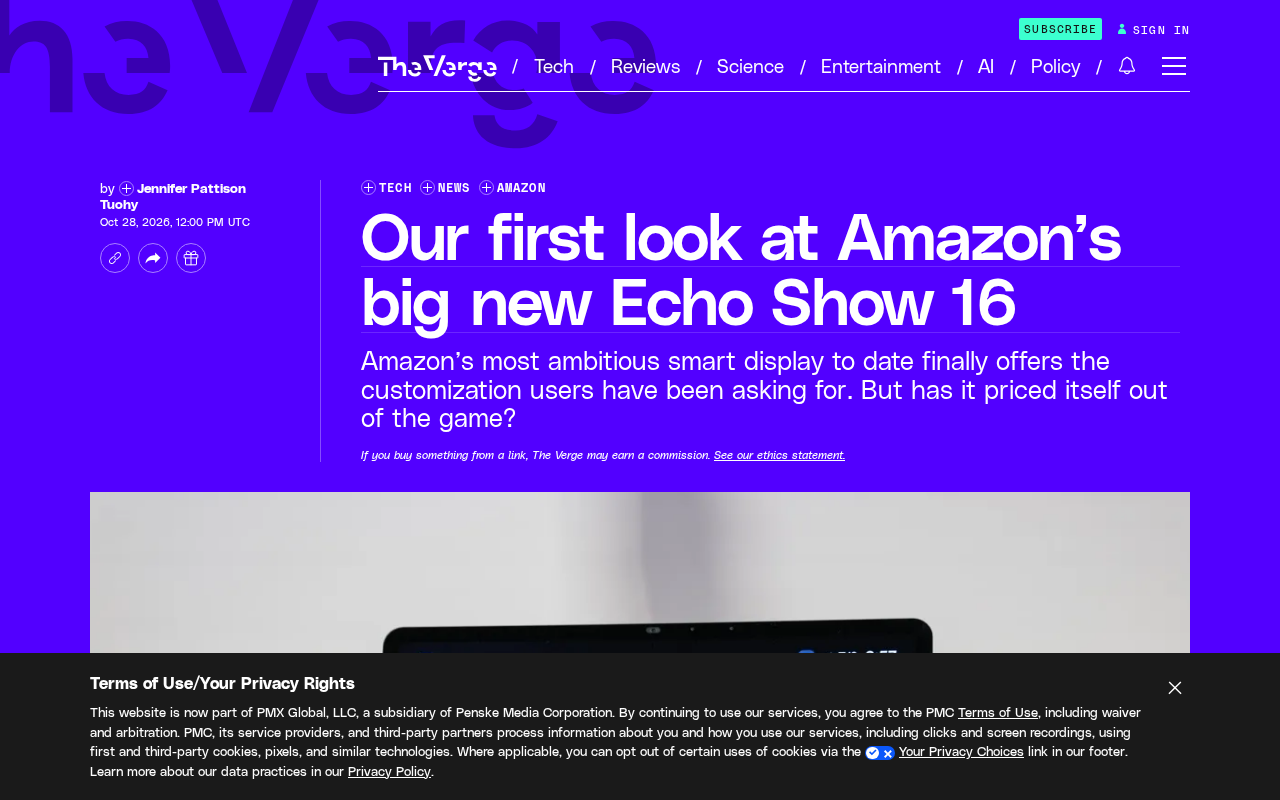
Amazon today launched its next-generation smart display, the Echo Show 16 — the largest and most premium-positioned product in the lineup to date. We got hands-on time with the device right away, and the conclusion is straightforward: the screen quality is stunning, but the price will make you gasp just as sharply.
Pricing Strategy: Premium Positioning, High Barrier to Entry
The Echo Show 16 starts at $499.99, a price that already includes a wall-mount bracket. If you opt for the Nanomatte display version, the price rises to $569.99. Before the official launch, Amazon is offering a $100 pre-order discount, with the device expected to ship later this year.
This pricing places it clearly in the high-end tier of the smart display category. Amazon evidently hopes that a larger screen and better display quality will push the Echo Show from being a small kitchen-counter tool to a core household display device. The question is whether consumers are willing to pay nearly tablet — or even entry-level laptop — prices for a smart display.
The smart display category
A smart display is a product form sitting between a smart speaker and a tablet: it centers on a voice assistant as the primary interaction entry point, while also featuring an always-on touchscreen for showing weather, calendars, video, photos, and smart home control panels. This category was pioneered by Amazon's Echo Show series in 2017, followed by Google Nest Hub, Meta Portal, and others. For a long time, mainstream products clustered in the 7 to 10-inch, $100 to $250 range, positioned as auxiliary devices for the kitchen counter or nightstand. By pushing the size to 16 inches and the price to the $500 tier, the Echo Show 16 is essentially attempting to redefine the category as a "shared household large-screen terminal," competing with tablets and even entry-level laptops for a fixed spot in the living room.
Display Quality: The Visual Impact of a Big Screen
From actual viewing experience, the Echo Show 16's screen is its biggest selling point. A 16-inch display area is quite rare among smart displays, and paired with the Nanomatte anti-glare option, it should offer better readability in environments with complex lighting such as living rooms or kitchens.
The direct benefit of a large screen is improved information display efficiency. Whether checking calendars, playing videos, or serving as a smart home control hub, the larger canvas makes side-by-side multitasking display possible. This is also the core logic behind Amazon extending its product line to larger sizes — smart displays are transitioning from "visual accessories for voice assistants" into standalone home information terminals.
What is Nanomatte
Nanomatte is an anti-glare screen treatment Amazon introduced on this generation of products, using nanoscale microstructures on the glass surface to scatter ambient light rather than simply applying a matte film. Its significance lies in the fact that smart displays typically need to stay on for long periods, and when placed in a living room or kitchen they inevitably face strong light sources like windows and chandeliers. Standard glossy screens show obvious reflections in such environments, causing the image to look washed out and reducing readability. Nanomatte can suppress specular reflection while maintaining relatively high contrast and color saturation, at the cost of a $70 price increase and a slight loss of image sharpness due to the matte texture. For users who primarily play video, the glossy version may be more pleasing to the eye; for users who mainly display information like calendars, recipes, and home control panels, Nanomatte offers greater practical value.
Is It Worth Buying: The Trade-Off Between Experience and Price
From a hardware perspective alone, the Echo Show 16's screen quality and size genuinely live up to the "flagship" label. But the $499.99 starting price, plus the higher premium for the Nanomatte version, makes it hard to justify as an impulse purchase.
This product is better suited to users who have already deeply tied their smart home ecosystem to the Alexa platform and genuinely need a large always-on display device. For ordinary households, the price barrier means purchasing decisions will be more cautious. Amazon's pre-order discount also somewhat reflects the manufacturer's probing of market acceptance for a high-price strategy.
The operating costs of always-on display devices
Keeping a 16-inch screen powered on and always-on in the living room involves two hidden costs beyond the purchase price that are easily overlooked. First, power consumption: a large high-brightness panel running continuously adds up over a year — not a huge electricity bill, but a noticeable increase compared to a small speaker. Second, screen lifespan and burn-in risk: static elements displayed continuously (clock, calendar, home control panels) in fixed positions over long periods may leave ghosting, which manufacturers typically mitigate through software mechanisms like pixel shifting and brightness decay. This is also why always-on devices tend to automatically dim or switch to ambient imagery when no one is around. For users planning to use the Echo Show 16 as a 24-hour information hub, these factors should factor into the purchase decision rather than looking only at the launch price.
Initial Impressions
The Echo Show 16 is a product with a clear direction: use a big screen and a good screen to differentiate from competitors, and use high pricing to filter for target users. The experience is compelling enough, but whether the price is reasonable ultimately depends on how much the market accepts the "premium smart display" category. We'll bring a more complete review after the official launch.
One-line Summary
Amazon launches the 16-inch Echo Show 16 — stunning screen but a high $499.99 starting price.
Paragraph Summary
Amazon has introduced its largest smart display to date, the Echo Show 16, starting at $499.99 (including wall-mount bracket), with a Nanomatte anti-glare version at $569.99 and a $100 pre-order discount, expected to ship later this year. Hands-on experience shows the 16-inch large screen is its biggest selling point, significantly improving information display efficiency for calendars, video, and smart home control, shifting the product from a visual accessory for voice assistants to a standalone home information terminal. However, the pricing sits clearly in the high-end tier of the smart display category, approaching tablet and even entry-level laptop prices, making it hard to justify as an impulse purchase. The product is better suited to users already deeply invested in the Alexa ecosystem who genuinely need a large always-on display device, and whether the high-price strategy will be accepted by the market remains to be seen.
Related articles

LLM Application Development: A High-Paying Career Guide for Ordinary People
LLM application development offers fresh graduates up to 35K/month, with SP offers reaching 600K. This article explains the core skills, how to break in, and how ordinary people can seize AI opportunities through learning by doing.

Say Goodbye to AI Influencer Faces: A Complete Guide to Creating Visual Assets for AI Comic Dramas from Scratch
Bilibili creator shares a full workflow for zero-basics AI comic drama visual assets: use Doubao Work skills with script-first, visual references, and real-person texture to escape AI influencer faces, then lock character and scene consistency with asset sheet layouts, weapon detail images, scene nine-grids, and cinematic color palettes.

The AI Production Pipeline Behind Great Videos: From Research to Agent Validation
AI video production isn't just a model race. This article breaks down a transferable four-step pipeline: researching professional workflows, organizing a skill checklist, configuring agents, and experimental validation—and explains how general-purpose LLMs like DeepSeek can replace paid tools to run the entire process.