Andrew Ng Teams Up with Anthropic to Launch Free MCP Course: A Complete Guide from Fundamentals to Deployment
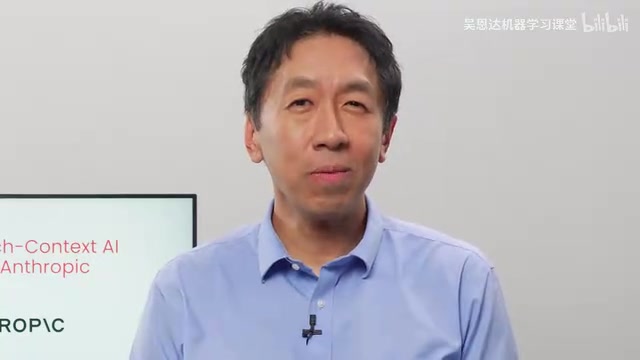
Andrew Ng and Anthropic's MCP introductory course systematically explains the architecture, origins, and engineering practices of this open protocol.
The article introduces the MCP introductory course launched by Andrew Ng in collaboration with Anthropic. MCP is an open protocol released by Anthropic in November 2024 to standardize how LLM applications access tools, data resources, and prompt templates, based on a client-server architecture and model-agnostic. The course is taught by Elie Schoppik, Anthropic's Head of Technical Education, and reveals that MCP originated from an internal project to extend Claude Desktop. The article also explains the real pain points MCP solves: developers no longer need to write custom tools for each external system, and tool providers can develop once to serve a large number of AI applications. The course follows the MCP transformation of a chatbot as its main thread, covering architecture understanding, server construction, third-party integration, and remote deployment, emphasizing the interoperability benefits of build once, reuse everywhere.
Why MCP Is Worth Your Time
The MCP (Model Context Protocol) introductory course, launched by Andrew Ng in collaboration with Anthropic, is one of the most bookmark-worthy MCP learning resources currently available in the Chinese community. The course opens with Andrew Ng and is taught by Elie Schoppik, Anthropic's Head of Technical Education, systematically covering MCP's core concepts and engineering practices.
MCP is an open protocol for standardizing how LLM applications obtain external context (tools, data resources, and prompt templates). It is based on a client-server architecture: the MCP client is embedded within the LLM application, while the MCP server exposes tools, data resources, and prompt templates to the outside, with the two communicating through the protocol. According to Andrew Ng in the course, since Anthropic released MCP in November 2024, the entire ecosystem has grown very rapidly.
This background matters: MCP is not an academic specification designed in a vacuum, but a practical protocol that grew out of Anthropic's internal engineering needs.
From Internal Project to Open Protocol
In the course, Elie Schoppik reveals the origins of MCP: it was initially part of an internal Anthropic project, where the team wanted to extend Claude Desktop's capabilities so it could access the local file system and other external systems. During this process, they realized that this protocol would be equally applicable to many AI applications with similar needs, so they decided to publish the specification and open the development process to the open-source community.
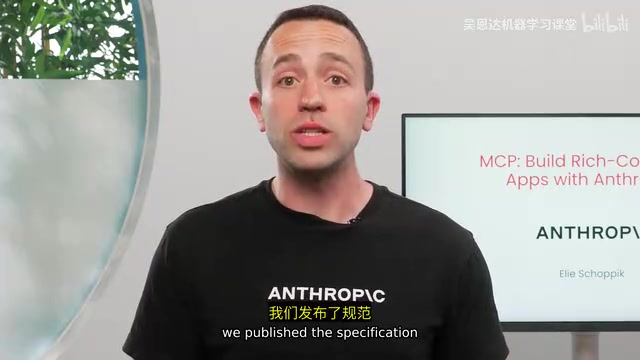
This decision directly drove the expansion of the MCP ecosystem. The course mentions that the ecosystem already includes a large number of MCP services developed jointly by the open-source community and the Anthropic MCP team. MCP is designed to be model-agnostic and can be easily integrated into a variety of applications—meaning it is not tied to Claude, nor to any specific model vendor.
"Context" in MCP refers to all external information and capabilities that an LLM can access when generating answers or executing tasks, including callable functions (tools), retrievable data resources, and preset prompt templates. Traditionally, these contexts were integrated by each application in a proprietary way, lacking a unified standard, which led to the same tool needing to be re-adapted for different AI applications. MCP's core contribution lies in abstracting this capability into a protocol layer, decoupling the "context provider" and "context consumer" sides, thereby enabling plug-and-play functionality like a USB interface. Understanding this level of abstraction helps grasp why MCP is positioned as infrastructure rather than a specific framework.
"Model-agnostic" is a key attribute of MCP's design, meaning the protocol itself does not depend on any specific model vendor's API, SDK, or proprietary extensions. Any LLM application that implements MCP client logic can connect to the same set of MCP servers; conversely, MCP servers do not need to care whether the caller is using Claude, GPT, or an open-source model. This neutrality reduces the risk of ecosystem lock-in, allows tool providers to develop once and reuse across multiple platforms, and preserves flexibility for developers in model selection. However, model-agnosticism refers only to the protocol layer; the actual invocation results of specific tools still depend on the capabilities and reasoning quality of the underlying model.
The Real Pain Points MCP Solves
In the course, Andrew Ng uses a concrete scenario to illustrate the value of MCP: suppose you are building a research assistant Agent that needs to operate GitHub repositories, read Google Drive documents, generate summaries, and store them in a local system.
Traditionally, developers write custom tool definitions and invocation logic for each external system themselves. After integrating MCP, the Agent only needs to connect to the MCP services corresponding to GitHub, Google Drive, and the file system, with the server providing tool/API invocation definitions and handling execution. Developers are freed from repetitive integration work and can focus their energy on the Agent's own logic.
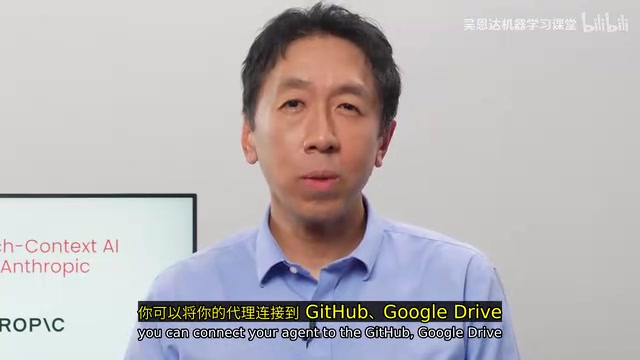
This division of labor also benefits tool providers. The course points out that for teams building tools or providing data, MCP makes it easier to open up their capabilities to a large number of developers without having to adapt separately for each AI application. In Andrew Ng's words, this is "a technology worth learning."
In the context of MCP, a "tool definition" typically includes a name, functionality description, and input parameter schema, based on which the model decides whether to invoke and how to pass parameters. Under the traditional approach, every AI application has to hand-write such definitions for external systems like GitHub and Google Drive, and implement authentication, request sending, and result parsing itself, with the workload growing linearly with the number of integrations. MCP servers encapsulate tool definitions and execution logic on the server side, so clients only need to discover and invoke them, greatly reducing repetitive code and allowing updates to tool behavior to be centralized on the server side rather than modified one by one on the caller side.
Course Content and Learning Path
The course adopts a "concepts + hands-on" structure, with Elie Schoppik explaining MCP protocol details step by step. The main thread is the MCP transformation of a chatbot application:
- Understand the architecture: Dive into the communication mechanisms of the MCP client-server architecture
- Transform the application: Convert a chatbot application to be MCP-compatible
- Build a server: Build and test an MCP server from scratch, providing tools, prompt templates, and resources
- Connect to the ecosystem: Connect the chatbot to trusted third-party MCP servers to extend its capabilities
- Reuse and interoperability: Reuse the MCP server you built and connect to other MCP applications such as Claude Desktop
- Remote deployment: Learn how to deploy MCP servers to remote environments
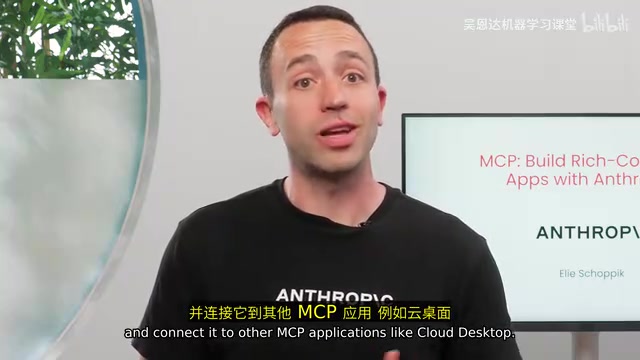
The cleverness of this path lies in "build once, reuse everywhere": the MCP server produced in step 3 simultaneously serves your own chatbot and Claude Desktop in step 5, intuitively demonstrating the interoperability benefits brought by protocol standardization. For learners, this also means that course assignments can accumulate into reusable engineering assets.
A Few Observations
From the course's positioning, this is an introductory course for developers, focusing on "getting it running" rather than a line-by-line interpretation of the protocol specification. Elie Schoppik, as Anthropic's Head of Technical Education, ensures consistency with the official implementation; Andrew Ng's involvement brings broader audience reach. The course also acknowledges contributions from Hara Salami of DeepLearning.AI.
For Chinese developers, the bilingual subtitled version on Bilibili lowers the language barrier. If you are building AI applications that need to connect to external tools and data, or want to provide MCP service interfaces for your own products, this course offers an extremely low-cost starting point. Subsequent videos will explain "why connecting applications to resources has been so difficult in the past" and how MCP addresses this, and are worth watching in order.
Related articles

Why Local Models Beat Jev AI API in Doom Game Decision-Making
A YouTube video comparison shows that the local model GLiNER, with 12 ms response and 8.8 decisions/sec in Doom, far outperforms the Jev AI API's 2.5 decisions/sec, doubling the score.

Screen Studio 4.0 Released: Glass Magnifier, Camera Keying, and Text-Based Editing
Screen Studio 4.0 released with glass magnifier, text-based editing, camera keying, and improved export performance. This Mac screen recorder ranks #1 on Product Hunt, simplifying video production.

ClawsGO Science: An AI Research Agent with a Built-in Cloud Lab
ClawsGO Science is an AI research agent launched on Product Hunt with a built-in cloud lab, 500+ tools, 90+ datasets, and clusters of Claude and GPT agents that can run for days to auto-generate cited papers from a question.