Anthropic Bets $3.4 Billion on Natural Gas Power as AI's Compute Race Moves to the Energy Battlefield
Anthropic's $3.4B bet on self-built natural gas power signals AI's bottleneck shifting from chips to energy.
Anthropic's $3.4 billion deal with a natural gas power project sparked discussion on Hacker News. The article argues that while it appears to be about securing power for data centers, it actually signals AI's key bottleneck shifting from chips to energy. As model sizes grow and inference demand climbs, data center power demand far outpaces grid expansion, making Anthropic's direct investment in generation a rare heavy-asset decision. Natural gas is the realistic choice due to short build times and stable output, though it creates tension with clean energy commitments. The article analyzes three impacts: reshaped compute cost structures, energy as a new competitive moat, and scrutiny of environmental commitments—noting AI companies are moving from buying chips to buying power, with balance sheets increasingly resembling infrastructure operators.
The Compute-Energy Anxiety Behind a Single Deal
Anthropic's $3.4 billion deal with a natural gas power project has sparked discussion on Hacker News. On the surface, it's an AI company locking in electricity supply for its data centers; beneath that, it marks a shift in AI's key bottleneck from chips to energy.
Over the past two years, industry attention has focused on GPU supply, model parameters, and training costs. But as model sizes keep expanding and inference request volumes climb, data center power demand is starting to grow at a pace far outstripping the grid's ability to add capacity. By choosing to invest directly in natural gas generation, Anthropic is essentially admitting that waiting for the grid and for clean energy buildouts no longer keeps pace with model iteration cycles.
The exact structure of the deal has not been fully disclosed, but the $3.4 billion scale speaks for itself—this is not an ordinary power purchase agreement, but capital investment approaching infrastructure level. For a model company, directing funds to the generation side is a rather rare heavy-asset decision.
Why Natural Gas, Not Renewables
Based on public information, the deal centers on natural gas generation. This creates a certain tension with the clean energy commitments AI companies habitually emphasize publicly.
The real constraint lies in supply stability and construction timelines. Wind and solar are limited by intermittency, requiring supporting storage to meet data centers' 24/7 high-load demand; nuclear takes long to build and involves complex approval; natural gas generation, by contrast, can be built quickly and delivers stable output—making it one of the few options today that can rapidly match the pace of compute expansion.
This also explains why the deal amount is so high: rapid deployment of generation capacity commands a premium. For Anthropic, certainty of power supply takes priority over short-term carbon controversy.
The difference between power purchase agreements (PPAs) and self-built generation: A PPA is a long-term power purchase contract between a data center operator and a generator, setting electricity price and volume, but the generation assets remain owned and operated by a third party; Anthropic's deal is closer to direct investment or self-built generation assets, meaning it bears responsibility for construction, operations and maintenance, and fuel supply. The former is an asset-light financial lock-in, the latter a heavy-asset infrastructure investment. The $3.4 billion scale is closer to the latter, which is why the article calls it "capital investment approaching infrastructure level"—it changes not just the electricity price, but the company's balance sheet structure.
Data center load characteristics and "24/7 high load": AI data centers' power consumption curves are entirely different from ordinary commercial buildings. Training tasks often run at full load for weeks, while inference requests fluctuate with user volume but have an extremely high baseline, overall presenting high and steady load characteristics. Wind and solar output fluctuates with weather and day-night cycles; to match this steady high load, large-scale storage or reliance on grid peak-shaving is required, significantly raising cost and uncertainty. Natural gas generator units can start and stop quickly and output on demand, naturally fitting this load curve—the core reason they are hard to replace in the short term.
Three Impacts on the AI Industry
First, the compute cost structure will be reshaped. When model companies start bearing generation-side investment, the way AI services' marginal costs are calculated will change. Electricity shifts from an externally purchased item to a strategic resource that must be locked in advance, further raising the capital threshold for top players.
Second, energy becomes a new competitive moat. Chips can be bought, talent can be poached, but the speed of deploying power infrastructure depends on site selection, approvals, and local grid conditions. Whoever locks in long-term power supply earlier gains the initiative over the pace of training and inference.
Third, environmental commitments face re-examination. Natural gas generation means direct carbon emissions. How AI companies balance growth narratives with climate commitments in public disclosures will become a question investors and regulators keep pressing.
Marginal cost and capital threshold: AI service costs are traditionally divided into one-time training investment and inference marginal costs, the latter mainly comprising GPU depreciation and electricity. When electricity shifts from market-price purchase to a strategic resource locked in years in advance, marginal cost predictability improves, but upfront capital expenditure is significantly front-loaded. For top companies this is a manageable financial arrangement; for smaller companies it means competing against rivals with locked-in power without stable supply guarantees—further pushing up industry concentration.
Industry Trend: From Buying Chips to Buying Power
Anthropic's deal is not an isolated case but part of a trend. As the power of individual data centers keeps climbing, AI companies intervening in the energy supply chain is becoming the norm.
From the Hacker News discussion, community attention focuses on two directions: first, the conflict between the natural gas path and climate goals; second, whether this heavy-asset model will become a barrier to entry for smaller AI companies. The answer to the first depends on how fast storage and nuclear mature; the second is almost certain—energy lock-in capability will further intensify industry concentration.
For Anthropic, the $3.4 billion buys not just electricity but a time window for model iteration. As the compute race enters the energy dimension, AI companies' balance sheets will increasingly resemble those of infrastructure operators.
Related articles

Did the US Midterms Vote No to AI Data Centers? A Map Reveals the Truth
After the US midterms, media claimed voters rejected AI data centers, but a map shows restrictive votes are concentrated in a few Ohio townships, affecting less than 1% of US towns—the national anti-AI wave is exaggerated.
ApexW Optimizer Benchmark: Matches 8-bit AdamW in Unsloth with Lower Memory Usage
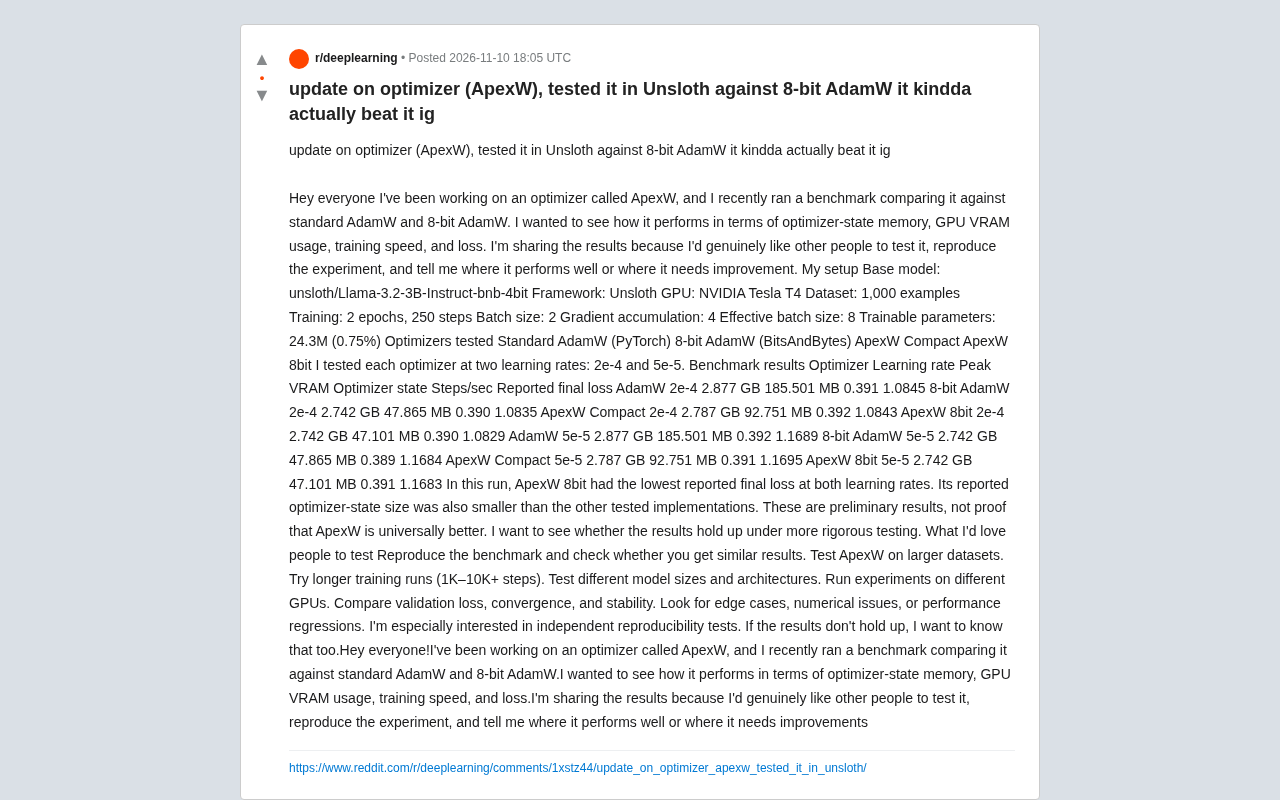
Developer shares benchmark of ApexW optimizer in Unsloth: ApexW 8bit has lower optimizer state memory (47.101 MB) and slightly better final loss than 8-bit AdamW, but similar speed. Needs independent reproduction.

US Computer Science Enrollment Drops 12.4% — Is CS Still Worth Studying?
CS enrollment fell 12.4% while health majors grew 6.2%. A CS master's grad explains why the degree's real value isn't coding but systems thinking.