Anthropic Buys $3.4B in Natural Gas Turbines as AI Energy Anxiety Spreads

Anthropic spends $3.4B on gas turbines, joining AI's energy procurement wave while planting heavy-asset mismatch risks.
Anthropic's $3.4B purchase of natural gas turbines marks AI companies' shift from power renters to direct allocators of generation assets. The article analyzes the practical logic: data centers build far faster than nuclear or large renewables, and gas turbines deploy quickly with strong dispatchability. But the core contradiction: gas turbines are long-cycle heavy assets—if AI efficiency improves faster than expected or grids catch up, these fossil assets could become a burden. The deal also exposes industry-wide energy anxiety and new risk structures.
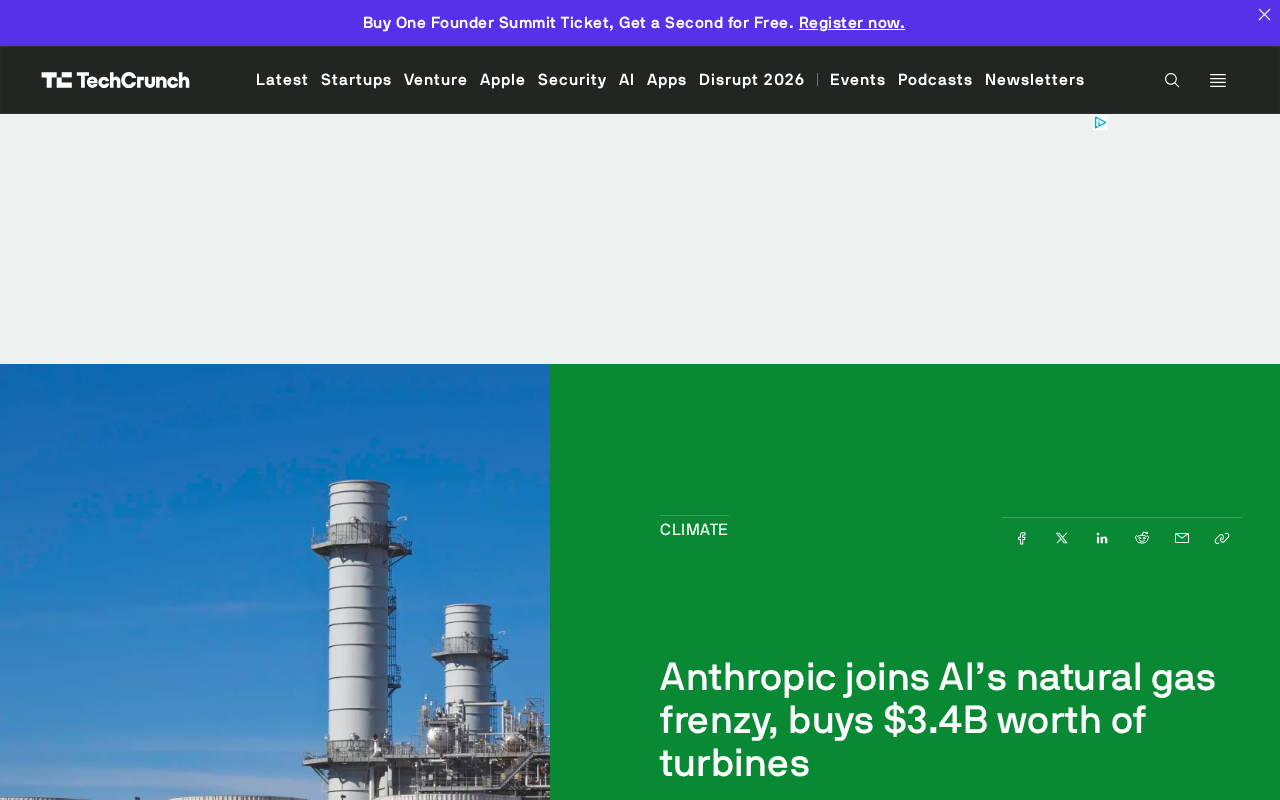
AI companies' hunger for power is reshaping the energy procurement landscape. The latest entrant to this race is Anthropic—according to media reports, the company behind Claude has purchased $3.4 billion worth of natural gas turbines, a scale large enough to turn heads.
A Deal That Could Lead to Buyer's Remorse?
The core tension in this purchase is clear: AI infrastructure's power demand is growing extremely fast, but natural gas turbines are long-cycle assets—from order to delivery, installation, and grid connection often takes years. The original article states outright that this deal "could give Anthropic buyer's remorse."
In other words, if AI training energy efficiency improves faster than expected, or if grid expansion and clean energy supply catch up, this batch of fossil fuel assets locked in for years could become a burden. Once such heavy-asset decisions are made, there's very limited room to adjust.
Why AI Companies Are Betting on Natural Gas
The Time Window Won't Wait
Data center construction cycles are far shorter than new nuclear or large-scale renewable projects. Natural gas turbines are relatively mature and deploy faster, making them one of the few power supply options that can "rapidly scale up" right now. For labs racing to train next-generation models, the time cost of waiting in grid queues is unbearable.
The Rigid Demand for Stable Power Supply
Training workloads have a load profile completely different from ordinary commercial electricity use, with extremely high requirements for supply stability and capacity margin. Natural gas power generation offers strong dispatchability that can match this fluctuating demand—which is why it keeps being chosen in this round of AI infrastructure buildout.
A gas turbine is a power device that uses high-temperature, high-pressure gas generated by natural gas combustion to drive a turbine to rotate, which in turn drives a generator to produce electricity. Unit capacity can range from several megawatts to hundreds of megawatts, and in combined cycle configurations, power generation efficiency can exceed 60%. Its core advantages are short construction cycles, flexible start-stop capability, and strong dispatchability: a simple cycle unit typically takes only 1-3 years from order to commissioning, far faster than nuclear power (often 7-15 years) or large hydropower. But gas turbines are also typical long-cycle heavy assets—order scheduling, grid connection permits, and pipeline infrastructure all need to be locked in advance, and equipment lifespan reaches 20-30 years, creating ongoing fuel costs and carbon emission lock-in once operational. Precisely because of this, they are both the realistic solution for AI data centers "scrambling for power" and a source of long-term path dependence.
The key difference between AI training loads and ordinary commercial electricity use lies in power fluctuation amplitude and sensitivity to power quality. Large-scale GPU clusters simultaneously raise the power consumption of thousands of cards during training, with loads that can jump dramatically within seconds, creating "impact loads" on the grid. At the same time, even minor voltage and frequency deviations can cause training interruption and checkpoint loss, resulting in costly compute waste. The dispatchability of natural gas generation is reflected in this: gas turbines can ramp to full load within minutes, and combined with fast-response peak-shaving capability, they can smooth out such fluctuations. By contrast, wind and solar power have unstable output affected by weather, requiring supporting energy storage to meet equivalent requirements—and current storage costs and scale are still hard-pressed to support ultra-large-scale data centers. This is also the technical reason why natural gas keeps being chosen in the AI infrastructure wave.
The Industry Dilemma This Deal Exposes
Anthropic's move is not an isolated case but a microcosm of the entire AI industry's "energy anxiety." The growth in power consumption brought by model scaling is pushing AI companies into the role of energy suppliers—they are no longer just software companies renting compute and electricity, but are beginning to directly intervene in the allocation of power generation assets.
This role shift brings a new risk structure. Energy asset price volatility, regulatory policy changes, and carbon emission constraints will all be transmitted to the company's financial level through this $3.4 billion investment. For a company whose brand is labeled with AI safety and responsible development, heavy betting on fossil fuels also creates narrative tension.
Several Questions Worth Watching
- How the delivery and commissioning timeline for these turbines is arranged will directly determine the actual return cycle of the investment
- Whether Anthropic will purchase carbon offsets or invest in clean energy to balance carbon emission controversies
- Whether other AI labs will follow with similar-scale direct energy procurement, forming an industry-wide trend
Currently, public information is limited—specific deal terms, turbine models, and deployment locations have not been disclosed. But one thing is certain: the battlefield of AI competition has extended from chips to power generation equipment.
One-line Summary
Anthropic spends $3.4 billion on natural gas turbines, joining the AI industry's energy procurement wave while planting the seeds of heavy-asset mismatch risk.
Paragraph Summary
The news that Anthropic purchased $3.4 billion worth of natural gas turbines marks AI companies' transition from power renters to participants directly allocating power generation assets. The article analyzes the practical logic behind this deal: data center construction cycles are far shorter than nuclear and large-scale renewable projects, while gas turbines deploy quickly and offer strong dispatchability, matching AI training's rigid demand for stable power supply and capacity margin. But the article also points out the core contradiction—gas turbines are long-cycle heavy assets, and if AI energy efficiency improves faster than expected or grid expansion catches up, this batch of fossil fuel assets could become a burden, giving Anthropic "buyer's remorse." The deal also exposes industry-wide energy anxiety and a new risk structure: energy price volatility, regulatory changes, and carbon emission constraints will directly transmit to company finances and create tension with AI safety brand narratives.
Related articles

5.3-Inch Phone Crowdfunding: Small-Screen Revival or a $599 Compromise?
Enough Phone crowdfunds on Kickstarter with a 5.3-inch screen, 8GB RAM, and 50MP sensor at $599. The Vergecast asks: can small phones find a middle ground?

Asahi Linux Ditches MIT for GPL: A Farce Aimed at Omarchy?
Asahi Linux switched its code license from MIT to GPL V2, accusing Omarchy of stealing code and commercializing it. Analysis suggests the move is poorly justified and violates the MIT license, exposing political divisions and AI controversies in the open source community.
Understanding NVIDIA Dynamo Frontend in 5 Minutes: An OpenAI-Compatible Entry Point for Inference Architecture
What is the NVIDIA Dynamo frontend? Based on the official 5-minute series, this article explains how it uses an OpenAI-compatible API as a stable boundary to enable backend engine replacement, routing, and KV cache reuse in a decoupled architecture.