Asahi Linux Ditches MIT for GPL: A Farce Aimed at Omarchy?
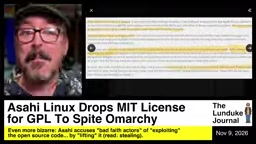
Asahi Linux switches from MIT to GPL V2, accused of impure motives and violating the MIT license.
Asahi Linux changed its codebase license from MIT to GPL V2, claiming it was to counter the "greed" of AI labs and code theft by bad actors. But analysis suggests this is actually retaliation against the free open source project Omarchy, with weak justification: MIT already allows others to freely use code, and the claims of "commercialization" and "theft" are hard to sustain. More seriously, Asahi removed many MIT license notices during the migration, and the project did not require contributors to sign a CLA, potentially violating the MIT license and infringing on the copyright of hundreds of contributors. The incident reflects deep divisions in the open source community over AI use and political stances, and warns that emotion-driven license changes will harm the open source spirit itself.
Asahi Linux, the project dedicated to making Linux run smoothly on Apple Silicon Macs, recently made a puzzling decision: switching its codebase license from the permissive MIT license to the stricter GPL V2. On the surface, this is meant to counter "bad actors" and AI code theft, but behind this license change lies the increasingly sharp political divisions within the open source community—and it may even have landed Asahi itself in the awkward position of violating the MIT license.
According to an analysis by a YouTube creator who has long followed the Linux ecosystem, this may be one of the strangest and even dumbest relicensing cases in recent years. Asahi's motivation seems to stem not from technical considerations, but from a desire to "get back at" another open source project—Omarchy.
Asahi's Accusation: From "Friendly" to "Declaration of War"
In its official statement, Asahi Linux first recalled the project's original intent: to promote the development of the free software ecosystem on the Apple Silicon platform and to encourage friends from other free operating systems like BSD to participate, they adopted the permissive MIT license wherever possible.
But the statement then pivots, saying "Unfortunately, this is no longer viable. The bad faith of the 90s and 2000s is back, this time driven in large part by the voracious appetite of frontier AI labs for high-quality training data and their aggressive hostility toward the free software community."
This wording places Asahi on the side of the "friendly open source community" while painting its opponents as "evil AI labs and radicals." The YouTube creator points out that this is a classic "us vs. them" narrative construction, defining good and evil before providing any specific details.
Asahi further alleges: "For some time now, we have been aware of multiple attempts to exploit our permissive license to hijack our work, with the direct aim of replacing the project and actively commercializing Linux on Apple Silicon."
However, the supposed target of this "commercialization"—Omarchy—is actually a free and open source Linux distribution that users can use without paying. The creator notes that Omarchy has indeed received substantial donations ("millions, tens of millions of dollars in donations"), but this is not commercial sales in the traditional sense.
The core difference between the MIT license and GPL V2 is key to understanding the whole incident. MIT is a permissive license that only requires users to retain the original copyright notice and license notice, after which the code can be used for any purpose, including closed-source commercial use and sublicensing. GPL V2 is a copyleft license that requires derivative works to be open-sourced under the same license and prohibits additional restrictions. Switching from MIT to GPL means that downstream users who want to continue using new code must disclose their modifications. It is worth noting that license changes only apply to new code after the change; old code already released under MIT cannot be "taken back"—a legal constraint Asahi must face in its operations.
The Logical Dilemma of the "Theft" Allegation
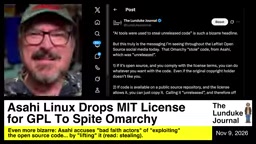
The most controversial part of Asahi's statement is the allegation that code was "stolen": "In some extreme cases, working feature code was taken directly from our personal branches and published without attribution, or lazily rewritten with LLM assistance to obscure its origin. The MIT license explicitly allows this behavior and has no exception clause for bad actors."
The YouTube creator reacted strongly: "They claim someone stole their source code that they explicitly published on the internet—that's absurd. The MIT license is exactly what lets you take the code and do anything with it, as long as you comply with the license terms."
He emphasized that Omarchy's founder DHH responded that Asahi's license change has no practical impact on Omarchy, because Omarchy already uses a lot of GPL code, and a bit more doesn't hurt.
A Fatal Procedural Error: Violating the MIT License
Asahi's license change is not only weakly justified, but its execution also has serious problems. Under the MIT license, if you want to sublicense based on someone else's MIT code, you must retain the original author's copyright notice and license notice.
But the YouTube creator found that when Asahi migrated its codebase to GPL, it directly deleted a large number of MIT license notices and declarations, replacing them with GPL notices. "This is a violation of the MIT license."
More complicated is that Asahi does not require contributors to sign a Contributor License Agreement (CLA) or copyright assignment agreement, meaning that hundreds of contributors each retain the copyright to their code. Asahi's removal of MIT notices without explicit authorization from all contributors may infringe on these contributors' rights.
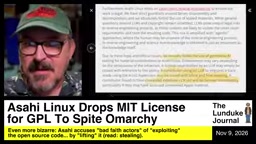
Contributor License Agreements (CLAs) and copyright assignment agreements are common legal tools when open source projects undergo license changes. A CLA allows project maintainers to obtain authorization to relicense while contributors retain copyright; copyright assignment requires contributors to transfer copyright entirely to the project or foundation. Asahi Linux did not require contributors to sign such agreements, so each contributor holds the copyright to their submitted code snippets. In this situation, changing the entire codebase uniformly to GPL V2 would theoretically require the consent of all copyright holders, or at least the retention of the original MIT notices; otherwise, it constitutes an infringement of contributors' rights. This also explains why many large open source projects (such as the Linux kernel) insist on using the Developer Certificate of Origin (DCO) rather than a CLA to reduce the legal complexity of relicensing.
The Politics and AI Stance Behind It
The YouTube creator believes that Asahi's move stems from hostility toward AI and antipathy toward non-left-wing political positions. Asahi's policy explicitly "broadly prohibits the use of generative AI" and stipulates that contributors using LLMs may receive a "first and final warning," and concealing substantial LLM use will result in an "immediate ban."
In some discussions within the open source community, Omarchy has been labeled "fascist," while Asahi is praised as a hero "resisting AI theft." But the creator points out that this narrative ignores the basic rules of open source licenses: as long as you comply with the license terms, you can do anything with the code, even if the original author doesn't like you.
The tension between "generative AI training data" and open source licenses is the deeper background of this controversy. Permissive licenses like MIT and Apache do not restrict the use of code for machine learning training, while whether GPL allows code to be used for training models—and whether the trained model constitutes a derivative work—remains legally undecided. Some open source maintainers therefore advocate changing licenses or adding "ethical clauses" to prevent AI companies from using their code for free, but such additional restrictions often conflict with the Open Source Definition (OSD)—which explicitly requires that licenses not discriminate against any person, group, or field of use. Asahi's "broad prohibition of generative AI" policy is an extreme manifestation of this trend, and it has also created a rift between it and the mainstream open source community consensus.
Damage to the Open Source Spirit
The YouTube creator concludes that Asahi's actions violate the core principle of the Open Source Definition—you cannot revoke someone's open source license just because you don't like them or their political stance. "If you do that, it fundamentally ceases to be open source."
Asahi tried to "punish" Omarchy by changing its license, but the result may backfire: Omarchy is barely affected, while Asahi has created a pile of licensing problems for itself that will take considerable effort to resolve.
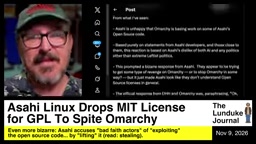
This storm ultimately reveals an awkward reality: when open source projects are driven by emotions and political stances, even with "righteous" motives, they may end up doing things that violate the basic principles of open source. For Asahi Linux, restoring community trust and fixing license compliance issues may be more urgent than retaliating against Omarchy.
Related articles
Anthropic Fable 5.2 Hands-On: 3A Games and Excel Clones from One Prompt
Anthropic Fable 5.2 hands-on: three-line prompts generate a playable Gears of War clone, a full Excel clone, and a DaVinci Resolve clone. Benchmarks, Ultra Code mode, token costs, and pricing analyzed — is it worth replacing Opus 5.5?

RL Racing Agent Stuck Against the Wall? Try These Recovery Strategies
RL racing agent stuck against walls? We analyze recovery data, observation limits, and action space, comparing DAgger, behavior cloning, and SAC with diagnostic experiments.

Giving AI Agents Long-Term Memory: A New Approach to Supply Chain Disruption Decisions
A developer uses Hindsight to build persistent memory for a supply chain AI agent, enabling retrieval of past disruptions and decision outcomes. The article analyzes its architecture, memory retention and recall design, and engineering challenges such as what to remember and how to evaluate memory effectiveness.