Giving AI Agents Long-Term Memory: A New Approach to Supply Chain Disruption Decisions

A developer builds a supply chain agent with persistent memory, exploring historical experience reuse and evaluation challenges.
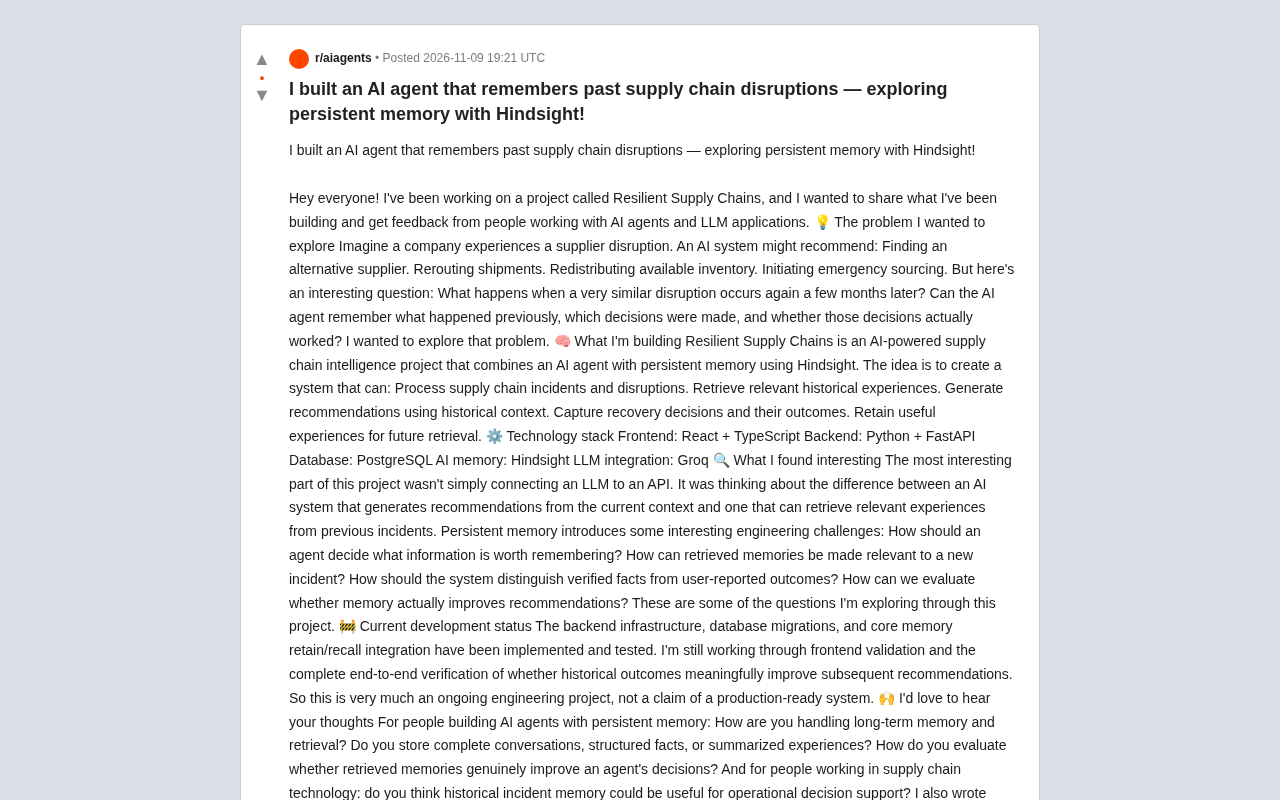
A developer shared the "Resilient Supply Chains" project on Reddit, using a persistent memory layer to address LLM applications "starting from scratch" in supply chain disruptions. The system uses React+TypeScript, Python+FastAPI, PostgreSQL, Hindsight memory, and Groq inference, covering event processing, experience recall, recommendation generation, decision recording, and retention. The author highlights four challenges: what to remember, relevant recall, distinguishing verified facts from user reports, and quantifying memory's impact. Backend and memory integration are tested, but end-to-end validation is ongoing; it is not production-ready. Long evaluation cycles and complex attribution are key constraints.
Most LLM applications can offer decent recommendations when facing supply chain disruptions—find alternative suppliers, reroute shipments, reallocate inventory, initiate emergency procurement. But if a similar supply shortage occurs again months later, does the system still remember what decisions were made last time and whether those decisions worked? A developer's "Resilient Supply Chains" project, shared on Reddit, is aimed squarely at this problem.
The Problem: Bridging the Gap from "Ad Hoc Advice" to "Experience Reuse"
According to the project author, the core question he wanted to explore is very specific: when a company experiences a supplier disruption, the AI system recommends a series of response actions; and when a highly similar disruption recurs months later, can the agent invoke the memory of the previous event, the decisions made at that time, and the actual outcomes?
This actually points to a structural weakness in most current AI Agent applications. No matter how fluent stateless reasoning may be, it is still just "one-time consultation"; true operational decision support requires continuity across events—which handling approaches worked in the past, and which seemed reasonable but led to secondary problems. If this information is not retained and retrieved, the agent starts from scratch every time.
The author frames this as an experiment in grounding "persistent memory" in a vertical scenario, rather than a simple exercise in connecting an LLM to an API.
Architecture Breakdown: Agent + Hindsight Memory Layer
From a technical stack perspective, this project is not complex, but the way it is combined is worth noting:
- Frontend: React + TypeScript
- Backend: Python + FastAPI
- Database: PostgreSQL
- AI memory: Hindsight
- LLM integration: Groq
The system workflow is broken down by the author into five stages: process supply chain events and disruptions, retrieve relevant historical experience, generate recommendations with historical context, record recovery decisions and their outcomes, and retain valuable experience for future retrieval.
The memory layer (Hindsight) here handles the "retain / recall" responsibility: writing events and decisions into memory, and retrieving relevant experience when new events arrive. The author states that the backend infrastructure, database migrations, and core memory retention and recall integration have been implemented and tested, but frontend validation and end-to-end verification of whether historical outcomes actually improve subsequent recommendations are still in progress. He explicitly emphasizes that this is a work-in-progress engineering project, not a claim of a production-ready system.
Hindsight is an open-source memory layer infrastructure for AI Agents, and its design approach differs from traditional vector database retrieval. Traditional RAG usually chunks documents, embeds them, and recalls by semantic similarity; Hindsight organizes data around "memory units," emphasizes explicit modeling of facts, events, and experience, and provides two core APIs: retain (write) and recall (retrieve). For agents that need to maintain continuity across sessions, the memory layer is not just storage—it also needs to handle time decay, conflict resolution, and relevance ranking.
Groq is an AI inference provider centered on LPU (Language Processing Unit) dedicated inference chips, focused on extremely low-latency LLM calls. In scenarios sensitive to response speed, such as supply chain incident response, choosing Groq can shorten the wait from event input to recommendation generation, but it does not itself handle memory responsibilities; memory reads and writes are still handled by Hindsight. The combination reflects an architectural tendency to decouple "inference" and "memory."
Four Engineering Challenges Brought by Persistent Memory
Compared with the tech stack itself, several questions listed by the author in the post are more worth discussing; they basically cover the common difficulties of long-term memory agents:
What to remember. How does the agent decide which information is worth writing into memory? The complete conversation stream, structured facts, or summarized experience? Different granularities directly affect the quality and cost of subsequent recall.
How to use it accurately. How can retrieved historical memories be made relevant to new events? Similar surface symptoms may correspond to completely different root causes, and mechanical matching can easily lead to misleading recommendations.
The boundary between facts and feedback. The system needs to distinguish between "verified facts" and "user-reported outcomes." The latter may be biased or incomplete, and if it is deposited into memory as fact, it will contaminate subsequent decisions.
How to evaluate. The most fundamental point: how do you prove that memory actually improves recommendation quality, rather than merely making answers seem more historically informed? This requires quantifiable evaluation design, not subjective impression.
The questions the author poses to the community at the end are also concentrated on these two points: how do people building persistent memory agents handle long-term memory and retrieval—do they store complete conversations, structured facts, or summarized experience; and how do they evaluate whether retrieved memories truly improve the agent's decisions?
In the engineering practice of persistent memory agents, the industry commonly uses a分层 (layered) distinction between short-term memory and long-term memory to correspond to needs at different time scales. Short-term memory usually refers to the context window of the current session, discarded when the conversation ends; long-term memory persists across sessions and requires additional write strategies, indexing, and eviction mechanisms. The "what to remember" mentioned in the article is essentially the write strategy problem of long-term memory.
Another commonly cited pair of concepts is episodic memory and semantic memory: the former records specific events that occurred and their temporal context, while the latter is distilled into abstract facts and rules. In supply chain scenarios, "last time a certain supplier was cut off, rerouting to a certain port caused delays" belongs to episodic memory, while "precursors of this type of supplier risk usually include lead time fluctuations" is closer to semantic memory. If the system stores only episodic memory, recall will be fragmented; if it abstracts too early into semantic memory, key context may be lost. How to trade off and convert between the two is an important dimension when evaluating memory quality.
A Judgment on the Supply Chain Scenario
Supply chain operations themselves are a field highly dependent on historical experience. The value of a senior planner largely comes from "I have seen this situation before"—the precursors of certain supplier risks, the hidden costs of certain rerouting options. Structuring this kind of experience and handing it to an agent makes sense in direction.
The difficulty lies in the uneven data quality of supply chain events: disruption causes, decision processes, and final outcomes are often scattered across different systems and people's records, and attribution of outcomes itself is controversial. The distinction between "verified facts vs user-reported outcomes" proposed by the author is exactly the key to whether such systems can be trusted.
Another practical constraint is evaluation. Supply chain decisions have long retrospective cycles; the consequences of an emergency procurement may take months to appear, which makes verification of "whether memory is effective" slow. The project currently remains in a state where end-to-end verification is incomplete, which also shows that this step is not easy.
Signals Worth Watching
The information content of this project is not large, but it represents a growing category of attempts: pushing agents from "conversation tools" toward "operational assistants with experience." The author publicly shared the motivation and architecture explanation on Reddit and Medium, and actively solicited technical feedback; the attitude is open engineering exploration rather than product launch.
For developers focused on AI Agent implementation, the four questions he listed can be used directly to compare against their own memory layer designs; for supply chain technology practitioners, the question "can historical event memory be used for operational decision support" itself deserves an internal discussion. The project has not yet proven that memory can bring measurable decision improvement, but that is precisely the part that most needs to be verified next.
One-line Summary
A developer builds a supply chain agent with persistent memory, exploring the challenges of reusing historical experience and evaluating it.
Paragraph Summary
A developer shared the "Resilient Supply Chains" project on Reddit, attempting to use a persistent memory layer to solve the problem of LLM applications "starting from scratch every time" in supply chain disruption scenarios. The system uses a React+TypeScript frontend, Python+FastAPI backend, PostgreSQL database, and integrates the Hindsight memory layer with Groq LLM inference. The workflow covers five stages: event processing, historical experience recall, recommendation generation, decision and outcome recording, and experience retention. The author points out four common challenges of persistent memory agents: what to remember, how to make recall truly relevant to new events, how to distinguish verified facts from user-reported outcomes, and how to quantitatively evaluate whether memory improves decisions. The backend and memory integration have been implemented and tested, but frontend and end-to-end effect validation are still in progress; it is not a production-ready system. The long evaluation cycles and complex outcome attribution in supply chain scenarios are the main practical constraints on implementing such systems.
Related articles

Anthropic Fable 5.2 Hands-On: 3A Games and Excel Clones from One Prompt
Anthropic Fable 5.2 hands-on: three-line prompts generate a playable Gears of War clone, a full Excel clone, and a DaVinci Resolve clone. Benchmarks, Ultra Code mode, token costs, and pricing analyzed — is it worth replacing Opus 5.5?

RL Racing Agent Stuck Against the Wall? Try These Recovery Strategies
RL racing agent stuck against walls? We analyze recovery data, observation limits, and action space, comparing DAgger, behavior cloning, and SAC with diagnostic experiments.

Cyber Book Hunt: How the BT Community 'Hijacked' Salinger's Unpublished Work
Salinger's unpublished novella, locked in a university library and barred from copying, was leaked after a private tracker posted a 6 TB bounty—solved not by hacking but by scanning a 25-copy underground eBay print run.